

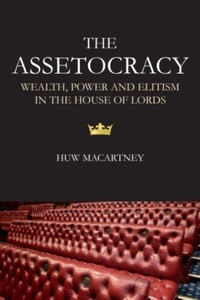
The Assetocracy
Wealth, Power and Elitism in the House of Lords
Will be published approx. on 31. October 2026
Book
Hardback
192 pages
978-1-78821-957-0 (ISBN)
Description
Parliament's second chamber may no longer be home to hereditary peers, but elitism has far from been eradicated with their departure. In this detailed analysis of the financial and political activity of the members of the House of Lords, Huw Macartney exposes the extent of the wealth elite's grip on power at the heart of British government.
The introduction of life peerages in the 1950s, the reforms by the Blair government and the removal of the remaining hereditary peers were all intended to make the House a more diverse, representative and meritocratic chamber. Macartney's investigation into the shareholdings, company directorships, landholdings, rental properties, education, attendance, speeches and voting records of the Lords demonstrates how the political apparatus at the heart of Westminster promotes economic structures that protect wealth. Far from reflecting the society they govern, the Lords continue to operate at a remove from the everyday experiences of the British public and increasingly appear to be a club for the assetocratic class.
The introduction of life peerages in the 1950s, the reforms by the Blair government and the removal of the remaining hereditary peers were all intended to make the House a more diverse, representative and meritocratic chamber. Macartney's investigation into the shareholdings, company directorships, landholdings, rental properties, education, attendance, speeches and voting records of the Lords demonstrates how the political apparatus at the heart of Westminster promotes economic structures that protect wealth. Far from reflecting the society they govern, the Lords continue to operate at a remove from the everyday experiences of the British public and increasingly appear to be a club for the assetocratic class.
Reviews / Votes
Many elements of the archaic, dysfunctional UK political system combine to make it thoroughly undemocratic, but the place of Big Money is a key factor. As Huw Macartney outlines, this is not just coming in from the outside, but also built into the House of Lords, which is thoroughly unrepresentative of the public it is supposed to serve but entirely representative of the forces of the status quo, particularly finance. Democracy demands transparency, and Huw has done an important job in exposing the entrenchment of the power of money as a replacement for feudalism in the House of Lords. This is a key work for explaining the extreme dissatisfaction and distrust with which the public - justifiably - regard British politics. -- Natalie Bennett, Green Party member of the House of LordsMore details
Language
English
Place of publication
United Kingdom
Publishing group
Edinburgh University Press
Target group
Professional and scholarly
Illustrations
48 b+w illustrations
Dimensions
Height: 234 mm
Width: 156 mm
ISBN-13
978-1-78821-957-0 (9781788219570)
Copyright in bibliographic data and cover images is held by Nielsen Book Services Limited or by the publishers or by their respective licensors: all rights reserved.
Schweitzer Classification
Person
Huw Macartney is Associate Professor in Political Economy at the University of Birmingham.
Content
Preface
Acknowledgements
Introduction
1. The Political Elite
2. The Rentier Class
3. Lords on Boards
4. Silent Knights and Industrious Barons
5. Foxes and Henhouses
6. Lords of the Land
Conclusion
Notes
Index
Acknowledgements
Introduction
1. The Political Elite
2. The Rentier Class
3. Lords on Boards
4. Silent Knights and Industrious Barons
5. Foxes and Henhouses
6. Lords of the Land
Conclusion
Notes
Index