

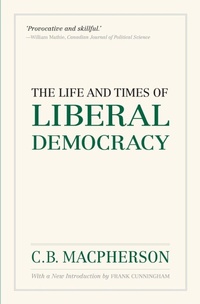
The Life and Times of Liberal Democracy
Published on 16. February 2012
Book
Paperback/Softback
144 pages
978-0-19-544780-4 (ISBN)
Description
In this brief but powerful book, acclaimed political philosopher C.B. Macpherson sets out in bold relief the essence of liberal democracy, both as it is currently conceived and as it might be reimagined. Macpherson argues that from its beginnings liberal democracy has accepted the underpinning principle of capitalist societies, that the "market maketh man." If that remains the central assumption of liberal democracy, Macpherson declares, then as an organizing framework for society, liberal democracy has reached the end of its useful life. But if a broader concept of liberal democracy is accepted-"if [Macpherson writes] liberal democracy is taken to mean a society striving to ensure that all its members are equally free to realize their capabilities"-the great days of liberal democracy may yet lie ahead. The Wynford edition includes a new Introduction by Frank Cunningham of the University of Toronto.
More details
Language
English
Place of publication
Toronto
Canada
Target group
College/higher education
Courses in political and social philosophy at the 2nd year through graduate level.
Product notice
Paperback (trade)
Unsewn / adhesive bound
Dimensions
Height: 203 mm
Width: 131 mm
Thickness: 15 mm
Weight
165 gr
ISBN-13
978-0-19-544780-4 (9780195447804)
Copyright in bibliographic data and cover images is held by Nielsen Book Services Limited or by the publishers or by their respective licensors: all rights reserved.
Schweitzer Classification
Persons
C.B. Macpherson (1911-1987) was professor of political science at the University of Toronto. Widely regarded as Canada's pre-eminent political theorist of the twentieth century, he was the author of numerous books, including Democratic Theory: Essays in Retrieval and The Real World of Democracy, and was named to the Order of Canada, the country's highest civilian honour.
Content
INTRODUCTION TO THE WYNFORD EDITION ; I. MODELS AND PRECURSORS ; I. MODELS AND PRECURSORS ; THE NATURE OF THE INQUIRY ; THE NATURE OF THE INQUIRY ; THE USE OF MODELS ; (I) WHY MODELS? ; (II) WHY HISTORICALLY SUCCESSIVE MODELS? ; (III) WHY THESE MODELS? ; PRECURSORS OF LIBERAL DEMOCRACY ; (I) DEMOCRACY AND CLASS ; (II) PRE-NINETEENTH CENTURY THEORIES AS PRECURSORS ; II. MODEL 1: PROTECTIVE DEMOCRACY ; THE BREAK IN THE DEMOCRATIC TRADITION ; THE UTILITARIAN BASE ; BENTHAM'S ENDS OF LEGISLATION ; THE POLITICAL REQUIREMENT ; JAMES MILL'S SEESAW ; PROTECTIVE DEMOCRACY FOR MARKET MAN ; III. MODEL 2: DEVELOPMENTAL DEMOCRACY ; THE EMERGENCE OF MODEL 2 ; MODEL 2A: J.S. MILL'S DEVELOPMENTAL DEMOCRACY ; THE TAMING OF THE DEMOCRATIC FRANCHISE ; MODEL 2B: TWENTIETH-CENTURY DEVELOPMENTAL DEMOCRACY ; IV. MODEL 3: EQUILIBRIUM DEMOCRACY ; THE ENTREPRENEURIAL MARKET ANALOGY ; THE ADEQUACY OF MODEL 3 ; (I) DESCRIPTIVE ADEQUACY ; (II) EXPLANATORY ADEQUACY ; (III) JUSTIFICATORY ADEQUACY ; THE FALTERING OF MODEL 3 ; V. MODEL 4: PARTICIPATORY DEMOCRACY ; THE RISE OF THE IDEA ; IS MORE PARTICIPATION NOW POSSIBLE? ; (I) THE PROBLEM OF SIZE ; (II) A VICIOUS CIRCLE AND POSSIBLE LOOPHOLES ; MODELS OF PARTICIPATORY DEMOCRACY ; (I) MODEL 4A: AN ABSTRACT FIRST APPROXIMATION ; (II) MODEL 4B: A SECOND APPROXIMATION ; PARTICIPATORY DEMOCRACY AS LIBERAL DEMOCRACY ; FURTHER READING ; INDEX