

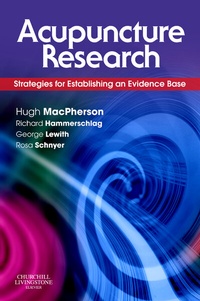
Acupuncture Research
Strategies for Establishing an Evidence Base
Published on 26. October 2007
Book
Paperback/Softback
288 pages
978-0-443-10029-1 (ISBN)
Description
This is the first book to set out a full range of research strategies for evaluating the clinical practice of acupuncture. Leading acupuncturists and researchers with international reputations share their expertise. They illustrate their descriptions with practical examples of what has worked and what has not. It outlines many of the key challenges in the field. These challenges relate to the nature of acupuncture and the gap between current research evidence and the actual experiences of acupuncturists in the field. By focusing the chapters on key research questions, rather than methods, the book has a user-friendly feel. Each chapter is easily accessible with brief explanations of research designs as well as vignettes of relevant past research. The book is based on a deep understanding of acupuncture, with its inherent complexity in practice, whether based on traditional principles or more modern concepts. By incorporating a more sophisticated understanding of the field, this book details a range of strategies aiming to develop the evidence base with the utmost rigour. It is the first book on acupuncture research to take this unique view, integrating the very best of evidence-based medicine with a genuine sensitivity to the discipline of acupuncture, from its traditional and holistic roots to its more modern interpretations.
Reviews / Votes
"This book is relevant to those who require an overview of the many aspects of acupuncture research as well as those who wishe to explore the complexitites of 'evidence' and the risks and benefits of a scientific approach in depth. In conclusion, it is a timely book and essential reading for all those involved in acupuncture research."David Mayor, Dragons Tale
"There is something for every acupuncturist in this book. For practitioners looking to improve their own clinical practice, examples of research are provided that may inspire you to contribute to patient-cantered research. For students and educational institutions this books will provide a valuable resource. It will also encourage those interested in initiating a career in research. To the educationalist it offers practical examples and guidelines on how acupuncture schools can make a significant contribution to acupuncture research by undertaking important preliminary studies. To the experienced researcher the book provides a valuable resource, providing an overview of acupuncture research."
Australian Journal of Acupuncture and Chinese Medicine. 2008, Volume 3, Issue 3
"The books will certainly be a valuable reference for researchers who are looking for a current overview of the state of acupuncture research. It will perhaps be even more valuable for teachers, students and practitioners of acupuncture, as it provides a clear roadmap to the many different techniques and perspectives necessary to take an idea born in the clinic and develop it into a coherent research theme that will be of value to the profession as a whole."
Journal of Chinese Medicine, Number 86, February 2008
"The publication of Acupuncture Research confronts the key issues that arise in the evaluation of the clinical practice of Acupuncture...This landmark text responds to the critics of Chinese Medicine who accuse us of a return to superstition and unreason." Network Review, Winter 2008
"Acupuncture Research is welcome not only because it ofers such easy reading while engaging the reader's total interest, but also because it manages to offer the struggling clinician, eager to make sense of acupuncture intervention and clinical effectiveness, a lifeline." AACP, 2008
More details
Language
English
Place of publication
London
United Kingdom
Publishing group
Elsevier Health Sciences
Target group
Professional and scholarly
Acupuncture practitioners
Progressive acupuncture schools and colleges where acupuncture research is increasingly taught and promoted
Doctors and physiotherapists
Academic researchers
Dimensions
Height: 234 mm
Width: 156 mm
Weight
530 gr
ISBN-13
978-0-443-10029-1 (9780443100291)
Copyright in bibliographic data and cover images is held by Nielsen Book Services Limited or by the publishers or by their respective licensors: all rights reserved.
Schweitzer Classification
Persons
Editor
Senior Research Fellow, Department of Health Sciences, University of York, York, UK
Guest editor
Research Director, Oregon College of Oriental Medicine, Portland, OR, USA
Research Director
Research Director
Professor of Health Research, Complementary and Integrated Medicine Research Unit, Aldermoor Health Centre, Southampton, UK
DiplAc Senior Research Associate, College of Social and Behavioral Sciences, Department of Psychology, University of Arizona, Tucson, AZ
Content
Glossary of research terminology
Chapter 1 Introduction: acupuncture and the emerging evidence mosaic, Hugh MacPherson, Kate Thomas
Chapter 2 Acupuncture research: the story so far, Stephen Birch, George Lewith
Chapter 3 Patient patterns of use and experience of acupuncture, Claire M. Cassidy, Kate Thomas
Chapter 4 The safety of acupuncture, Hugh MacPherson, Adrian White, Alan Bensoussan
Chapter 5 Measuring patient-centred outcomes, Charlotte Paterson, Rosa N. Schnyer
Chapter 6 Exploring treatment effects: studies without control groups, Adrian White, Peter Wayne, Hugh MacPherson
Chapter 7 Comparing treatment effects of acupuncture and other types of healthcare, Karen Sherman, Klaus Linde, Adrian White
Chapter 8 Investigating the components of acupuncture treatment, Peter White, Klaus Linde, Rosa N. Schnyer
Chapter 9 Acupuncture practice as the foundation for clinical evaluation, Rosa N. Schnyer, Stephen Birch, Hugh MacPherson
Chapter 10 Physiological dynamics of acupuncture:
correlations and mechanisms, Richard Hammerschlag, Helene M. Langevin, Lixing Lao,George Lewith
Chapter 11 Evidence overviews: the role of systematic reviews and meta-analyses, Klaus Linde, Richard Hammerschlag, Lixing Lao
Chapter 12 Engaging acupuncturists in research -some practical guidelines, Peter Wayne, Karen Sherman, Mark Bovey
Chapter 13 Future strategies for acupuncture research, George Lewith
Index
Chapter 1 Introduction: acupuncture and the emerging evidence mosaic, Hugh MacPherson, Kate Thomas
Chapter 2 Acupuncture research: the story so far, Stephen Birch, George Lewith
Chapter 3 Patient patterns of use and experience of acupuncture, Claire M. Cassidy, Kate Thomas
Chapter 4 The safety of acupuncture, Hugh MacPherson, Adrian White, Alan Bensoussan
Chapter 5 Measuring patient-centred outcomes, Charlotte Paterson, Rosa N. Schnyer
Chapter 6 Exploring treatment effects: studies without control groups, Adrian White, Peter Wayne, Hugh MacPherson
Chapter 7 Comparing treatment effects of acupuncture and other types of healthcare, Karen Sherman, Klaus Linde, Adrian White
Chapter 8 Investigating the components of acupuncture treatment, Peter White, Klaus Linde, Rosa N. Schnyer
Chapter 9 Acupuncture practice as the foundation for clinical evaluation, Rosa N. Schnyer, Stephen Birch, Hugh MacPherson
Chapter 10 Physiological dynamics of acupuncture:
correlations and mechanisms, Richard Hammerschlag, Helene M. Langevin, Lixing Lao,George Lewith
Chapter 11 Evidence overviews: the role of systematic reviews and meta-analyses, Klaus Linde, Richard Hammerschlag, Lixing Lao
Chapter 12 Engaging acupuncturists in research -some practical guidelines, Peter Wayne, Karen Sherman, Mark Bovey
Chapter 13 Future strategies for acupuncture research, George Lewith
Index