

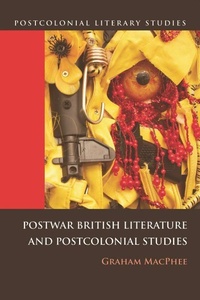
Postwar British Literature and Postcolonial Studies
Published on 8. June 2011
Book
Hardback
200 pages
978-0-7486-3900-7 (ISBN)
Description
Examines the legacy of imperialism and decolonisation, globalisation and national identityGraham MacPhee explains how postwar writers blended the experimentalism of prewar modernism with other cultural traditions to represent both the pain and the pleasures of multiculturalism. He discusses a wide range of writers, from Auden, Orwell, T.S. Eliot and Larkin to Linton Kwesi Johnson, Tony Harrison, Kazuo Ishiguro and Ian McEwan.Key Features* Explores concepts and critical terms such as 'British national literature', 'new ethnicities', 'migrancy' and 'hybridity'* Case studies of postwar texts include: Sam Selvon's The Lonely Londoners, John Arden's Serjeant Musgrave's Dance, Linton Kwesi Johnson's Dread Beat an' Blood, Tony Harrison's V, Kazuo Ishiguro's The Remains of the Day, Leila Aboulela's Minaret and Ian McEwan's Saturday
Reviews / Votes
...is an admirably lucid cultural materialist analysis of the period from the end of the Second World War to the present. -- Ashley Dawson, College of Staten Island, CUNY * College Literature 39.3 * An admirably lucid cultural materialist analysis of the period from the end of Second World War to the present, and of the literary texts through which writers sought to grapple with and represent Britain's reconfigured position in a world that - all democratizing and developmental rhetoric to the contrary - remains structured by the most brutal forms of imperial power. -- Ashley Dawson, College of Staten Island * College Literature 39.3: Summer 2012 * A very well researched, well argued, richly textured, and very rewarding read especially for students of colonial and postcolonial studies regardless of subject concentration. -- Baba G Jallow, Creighton University * Interventions 14:3 * Postwar British Literature and Postcolonial Studies suggests many fruitful ways in which one can read the intersections between empire's legacy and post-war British literature, opening up territory for future studies. -- Huw Marsh, Queen Mary, University of London * Postcolonial Text, Vol 8, No 1 * Graham MacPhee brilliantly follows the historical tracks of empire into the heartlands of post-war British literature, an area often assumed to be relatively untouched by colonial impacts and their contingent modernist entanglements. This timely and necessary study lays bare how colonial cultural legacies are everywhere palpable within this landscape. -- Elleke Boehmer, Professor of World Literature in English, University of Oxford Graham MacPhee brilliantly follows the historical tracks of empire into the heartlands of post-war British literature, an area often assumed to be relatively untouched by colonial impacts and their contingent modernist entanglements. This timely and necessary studylays bare how colonial cultural legacies are everywhere palpable within this landscape. -- Elleke Boehmer, Professor of World Literature in English, University of OxfordMore details
Series
Language
English
Place of publication
Edinburgh
United Kingdom
Target group
Professional and scholarly
Product notice
sewn/stitched
Cloth over boards
Dimensions
Height: 234 mm
Width: 157 mm
Thickness: 18 mm
Weight
454 gr
ISBN-13
978-0-7486-3900-7 (9780748639007)
Copyright in bibliographic data and cover images is held by Nielsen Book Services Limited or by the publishers or by their respective licensors: all rights reserved.
Schweitzer Classification
Other editions
Additional editions
Graham MacPhee
Postwar British Literature and Postcolonial Studies
E-Book
06/2011
Edinburgh University Press
€0.00
Available for download
Graham MacPhee
Postwar British Literature and Postcolonial Studies
E-Book
06/2011
Edinburgh University Press
€24.49
Available for download
Person
Graham MacPhee is Assistant Professor of English at West Chester University. He is the author of The Architecture of the Visible: Technology and Urban Visual Culture (Continuum, 2nd edn, 2007) and co-editor, with Prem Poddar, of Empire and After: Englishness in Postcolonial Perspective (Berghahn, 2007).