

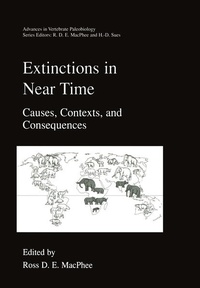
Extinctions in Near Time
Causes, Contexts, and Consequences
Published on 7. December 2010
Book
Paperback/Softback
XVII, 394 pages
978-1-4419-3315-7 (ISBN)
Description
"Near time" -an interval that spans the last 100,000 years or so of earth history-qualifies as a remarkable period for many reasons. From an anthropocentric point of view, the out standing feature of near time is the fact that the evolution, cultural diversification, and glob al spread of Homo sapiens have all occurred within it. From a wider biological perspective, however, the hallmark of near time is better conceived of as being one of enduring, repeat ed loss. The point is important. Despite the sense of uniqueness implicit in phrases like "the biodiversity crisis," meant to convey the notion that the present bout of extinctions is by far the worst endured in recent times, substantial losses have occurred throughout near time. In the majority of cases, these losses occurred when, and only when, people began to ex pand across areas that had never before experienced their presence. Although the explana tion for these correlations in time and space may seem obvious, it is one thing to rhetori cally observe that there is a connection between humans and recent extinctions, and quite another to demonstrate it scientifically. How should this be done? Traditionally, the study of past extinctions has fallen largely to researchers steeped in such disciplines as paleontology, systematics, and paleoecology. The evaluation of future losses, by contrast, has lain almost exclusively within the domain of conservation biolo gists. Now, more than ever, there is opportunity for overlap and sharing of information.
Reviews / Votes
` This book is a must-read if you have any curiosity, fascination, or professional interest in extinctions of the past or present. If you are among those concerned about our environment and the fact that we are losing more animal species each year, you should read this book. 'Discovering Archaeology, 1:5 (1999)
More details
Series
Edition
Softcover reprint of hardcover 1st ed. 1999
Language
English
Place of publication
New York
United States
Target group
Professional and scholarly
Research
Illustrations
14 s/w Abbildungen, 2 farbige Abbildungen
XVII, 394 p. 16 illus., 2 illus. in color.
Dimensions
Height: 254 mm
Width: 178 mm
Thickness: 23 mm
Weight
786 gr
ISBN-13
978-1-4419-3315-7 (9781441933157)
DOI
10.1007/978-1-4757-5202-1
Schweitzer Classification
Other editions
Additional editions
Book
06/1999
Plenum Publishing Co.,N.Y.
€213.99
Shipment within 10-15 days
Content
1 Cretaceous Meteor Showers, the Human Ecological "Niche," and the Sixth Extinction.- 2 Prehistoric Extinctions on Islands and Continents.- 3 The Interaction of Humans, Megaherbivores, and Habitats in the Late Pleistocene Extinction Event.- 4 The Power of Pleistocene Hunter-Gatherers: Forward and Backward Searching for Evidence about Mammoth Extinction.- 5 A Comparison of Methods for the Probabilistic Determination of Vertebrate Extinction Chronologies.- 6 Putting North America's End-Pleistocene Megafaunal Extinction in Context: Large-Scale Analyses of Spatial Patterns, Extinction Rates, and Size Distributions.- 7 Rates, Patterns, and Processes of Landscape Transformation and Extinction in Madagascar.- 8 Extinctions and Local Disappearances of Vertebrates in the Western Mediterranean Islands.- 9 Introduced Predators and Avifaunal Extinction in New Zealand.- 10 Late Quaternary Extinctions in Australasia: An Overview.- 11 Late Pleistocene Megafaunal Extinctions: A European Perspective.- 12 The Quiet Crisis: A Preliminary Listing of the Freshwater Fishes of the World that Are Extinct or "Missing in Action".- 13 Requiem Æternam: The Last Five Hundred Years of Mammalian Species Extinctions.- Systematic Index.- General Index.