

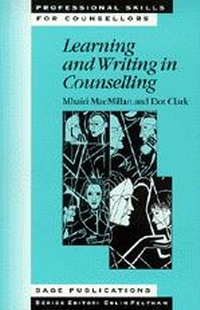
Learning and Writing in Counselling
1st Edition
Published on 5. February 1998
Book
Hardback
208 pages
978-0-7619-5062-2 (ISBN)
Description
`This is a very practical "how to" book, written for students on counselling skills courses. It is intended to help them through the various problems faced by people returning to education, perhaps after a long gap.... how useful this book could be to students who [are] confused by the increasingly academic requirements of counselling training courses... I would recommend this book as a companion for anyone who is starting a course with little or no experience of academic expectations. It is written in a friendly and reassuring style' - Counselling, The Journal of the British Association for Counselling
This book provides a comprehensive overview of the tasks and the processes of learning and writing required on counselling training courses and in the practice of counselling. The authors cover the entire period of training, from choosing a course to the early stages of professional practice.
The first part of the book discusses learning skills, methods and approaches, looking at, for example, the context for learning, motivation and experiential learning. Part Two focuses on course requirements, the form of written assignments - how to complete them and the difficulties that can be encountered - as well as the basics of writing, including language, form and style. The final part looks at the involvement of practising counsellors in continued learning and the kinds of writing that they may develop throughout their careers.
This book provides a comprehensive overview of the tasks and the processes of learning and writing required on counselling training courses and in the practice of counselling. The authors cover the entire period of training, from choosing a course to the early stages of professional practice.
The first part of the book discusses learning skills, methods and approaches, looking at, for example, the context for learning, motivation and experiential learning. Part Two focuses on course requirements, the form of written assignments - how to complete them and the difficulties that can be encountered - as well as the basics of writing, including language, form and style. The final part looks at the involvement of practising counsellors in continued learning and the kinds of writing that they may develop throughout their careers.
Reviews / Votes
`This is a very practical "how to" book, written for students on counselling skills courses. It is intended to help them through the various problems faced by people returning to education, perhaps after a long gap.... how useful this book could be to students who [are] confused by the increasingly academic requirements of counselling training courses... I would recommend this book as a companion for anyone who is starting a course with little or no experience of academic expectations. It is written in a friendly and reassuring style' - Counselling, The Journal of the British Association for CounsellingMore details
Series
Language
English
Place of publication
Thousand Oaks
United States
Target group
College/higher education
Professional and scholarly
Dimensions
Height: 198 mm
Width: 129 mm
Weight
313 gr
ISBN-13
978-0-7619-5062-2 (9780761950622)
Copyright in bibliographic data and cover images is held by Nielsen Book Services Limited or by the publishers or by their respective licensors: all rights reserved.
Schweitzer Classification
Other editions
Additional editions
Mhairi MacMillan | Dot Clark
Learning and Writing in Counselling
Book
02/1998
1st Edition
SAGE Publications Inc
€106.00
Shipment within 15-20 days
Mhairi MacMillan | Dot Clark
Learning and Writing in Counselling
E-Book
02/1998
1st Edition
SAGE Publications Ltd
from
€49.09
Available for download
Persons
Mhairi MacMillan and Dot Clark are both counsellors in private practice in Scotland.
Content
PART ONE: LEARNING
At the Beginning
The Training Course
Learning Style in a Learning Community
Skills and Techniques
Experiential Learning
PART TWO: COMMUNICATING LEARNING
How Do I Know What I Mean Unless I Say (or Write) It?
The Requirements of the Course
Assessment
Starting To Write
Writing Takes Form
Using Other People's Work
Problems, Problems, Problems
Motivation, Concentration and Writing Block
Writing about Practice
PART THREE: CONTINUING TO LEARN AND TO WRITE
Beyond the Training Course
Continuing To Write
Our Experience of Writing This Book
At the Beginning
The Training Course
Learning Style in a Learning Community
Skills and Techniques
Experiential Learning
PART TWO: COMMUNICATING LEARNING
How Do I Know What I Mean Unless I Say (or Write) It?
The Requirements of the Course
Assessment
Starting To Write
Writing Takes Form
Using Other People's Work
Problems, Problems, Problems
Motivation, Concentration and Writing Block
Writing about Practice
PART THREE: CONTINUING TO LEARN AND TO WRITE
Beyond the Training Course
Continuing To Write
Our Experience of Writing This Book