

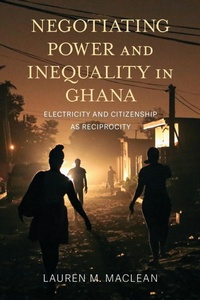
Negotiating Power and Inequality in Ghana
Electricity and Citizenship As Reciprocity
Published on 3. February 2026
Book
Paperback/Softback
312 pages
978-0-253-07476-8 (ISBN)
Description
In Ghana, much as in other parts of the Global South, postcolonial leaders aimed for industrial growth through the establishment of affordable hydroelectric power. However, in the current rapidly changing climate, many nations face recurring droughts, which hinder electricity production just when demand is on the rise. This situation has led to challenges like load shedding and unplanned power outages, which have strained the bond between citizens and the government.
Negotiating Power and Inequality in Ghana aims to unravel the puzzling reality that, despite enduring increasing difficulties from these electricity shortages, the Ghanaian citizens who suffer most harshly are also the least likely to demand political accountability from the state. Drawing on archival evidence, focus groups, qualitative interviews, survey data, and contemporary art and music, author Lauren M. MacLean explains how this disparity in experience - fueled by differences in income and geographical location - has led lower- and higher-income Ghanaians to form contrasting perspectives on their social rights regarding public services and to adopt varying approaches to political involvement. Rather than relying on a predetermined social contract, citizens in Ghana develop a more fluid relationship with the state, shaped by their histories, identities, and personal experiences. This reciprocity highlights their awareness of how climate change and the global shift toward green energy can significantly impact their lives while also underscoring the necessity for the government to take the lead and engage with Ghanaians to promote climate justice.
Targeted at a diverse audience that includes academics, policymakers, activists, and the general public, Negotiating Power and Inequality in Ghana encourages readers to gain insight into the dynamics that lead to political crises and to explore potential solutions to energy poverty in a time marked by increasing inequality and global climate challenges.
Negotiating Power and Inequality in Ghana aims to unravel the puzzling reality that, despite enduring increasing difficulties from these electricity shortages, the Ghanaian citizens who suffer most harshly are also the least likely to demand political accountability from the state. Drawing on archival evidence, focus groups, qualitative interviews, survey data, and contemporary art and music, author Lauren M. MacLean explains how this disparity in experience - fueled by differences in income and geographical location - has led lower- and higher-income Ghanaians to form contrasting perspectives on their social rights regarding public services and to adopt varying approaches to political involvement. Rather than relying on a predetermined social contract, citizens in Ghana develop a more fluid relationship with the state, shaped by their histories, identities, and personal experiences. This reciprocity highlights their awareness of how climate change and the global shift toward green energy can significantly impact their lives while also underscoring the necessity for the government to take the lead and engage with Ghanaians to promote climate justice.
Targeted at a diverse audience that includes academics, policymakers, activists, and the general public, Negotiating Power and Inequality in Ghana encourages readers to gain insight into the dynamics that lead to political crises and to explore potential solutions to energy poverty in a time marked by increasing inequality and global climate challenges.
Reviews / Votes
"Lauren MacLean shows that reliable electricity is not only fundamental to a prosperous economy but intimately tied to successful democracy too."-Todd Moss, Executive Director, Energy for Growth Hub"In this creative and insightful book on Ghana's persistent electricity crisis, Lauren Maclean carefully demonstrates how power literally begets power, in both senses of the word, with inequality in access to reliable electricity a function of much deeper forms of inequality in citizens' ability to make effective bottom-up claims on the state. This is important reading for scholars and students of service delivery, citizenship, and grassroots politics in Ghana and beyond."-Noah Nathan, author of The Scarce State: Inequality and Political Power in the Hinterland
"This is a great book, based on very solid and extensive research, on a topic that is both pointed in terms of its occurrence and also evergreen in its relevance as controversy and debates over access to electricity have and continue to plague Ghana. . . . MacLean draws on a wide range of sources . . . [and] in doing so, she seeks to create a book that is interdisciplinary in its methods and broad in its audience, seeking to engage academics, policymakers, activists, and practitioners alike by providing straightforward explanation for this ongoing crisis."-Jennifer Hart, author of Making an African City
"This is an excellent book that makes three important contributions. First, it introduces a theory of citizenship based on reciprocity, thereby revising social contract theory. Second, it traces the history of electricity provision in Ghana and analyzes it in the context of energy poverty and the era of climate change. Third, it integrates unique methodologies (some of which are used in disciplines outside of the social sciences) to center the perspectives of ordinary people in the study of politics and development. For these reasons, Negotiating Power and Inequality in Ghana will be of great interest to students of comparative politics, African politics, development studies, and environmental studies."-Jeffrey W. Paller, author of Democracy in Ghana: Everyday Politics in Urban Africa
More details
Language
English
Place of publication
Bloomington, IN
United States
Target group
Professional and scholarly
Product notice
Paperback (trade)
Illustrations
7 color illus., 17 b&w illus., 1 map
Dimensions
Height: 229 mm
Width: 152 mm
Weight
499 gr
ISBN-13
978-0-253-07476-8 (9780253074768)
Copyright in bibliographic data and cover images is held by Nielsen Book Services Limited or by the publishers or by their respective licensors: all rights reserved.
Schweitzer Classification
Other editions
Additional editions
Lauren M. MacLean
Negotiating Power and Inequality in Ghana
Electricity and Citizenship As Reciprocity
E-Book
02/2026
Indiana University Press
€43.99
Available for download
Person
Lauren M. MacLean is Dr. Thomas P. O'Neill Jr. Chair of Public Life and Department Chair of Political Science at Northeastern University. She is author of Informal Institutions and Citizenship in Rural Africa, (with Melani Cammett) The Politics of Non-State Social Welfare, (with Diana Kapiszewski and Benjamin L. Read) Field Research in Political Science, and (with Gustavo Garcia-Lopez and Prakash Kashwan) Climate Justice in the City (forthcoming).
Content
Acknowledgments
List of Acronyms
Introduction
Part I: The Historical Construction of the State Role in Providing Unequal Electricity to Citizens and Subjects
1. The History of Electricity as a Right of Citizenship: From Colonial Subjects to Neoliberal Consumers in the Fourth Republic
2. New Pressures on Ghana's Emerging Democracy: Climate Change and Increasing Frustrations by Citizens as Consumers
3. Desperate Efforts to End the Electricity Crisis: The Cost of Foreign Non-State Providers and Promise of Green Energy
Part II: The Unequal Experience of the Electricity Crisis and Negotiation of Citizenship as Reciprocity
4. The Unequal Citizen Experience of the Electricity Crisis
5. The Emotional Stress of Disconnection for the Youth: Images and Lyrics from Contemporary Ghanaian Artists and Musicians
6. Inequalities of Citizen Protest: From #Dumsormuststop to Harassment
7. Inequalities of Citizen Exit: From Solar Generators to Illegal Connections
8. The Right to Electricity and the Strain on Citizenship as Reciprocity
Conclusion: Inequality and the Decline of the National Grid
Appendix: Interview Guides
Bibliography
Index
List of Acronyms
Introduction
Part I: The Historical Construction of the State Role in Providing Unequal Electricity to Citizens and Subjects
1. The History of Electricity as a Right of Citizenship: From Colonial Subjects to Neoliberal Consumers in the Fourth Republic
2. New Pressures on Ghana's Emerging Democracy: Climate Change and Increasing Frustrations by Citizens as Consumers
3. Desperate Efforts to End the Electricity Crisis: The Cost of Foreign Non-State Providers and Promise of Green Energy
Part II: The Unequal Experience of the Electricity Crisis and Negotiation of Citizenship as Reciprocity
4. The Unequal Citizen Experience of the Electricity Crisis
5. The Emotional Stress of Disconnection for the Youth: Images and Lyrics from Contemporary Ghanaian Artists and Musicians
6. Inequalities of Citizen Protest: From #Dumsormuststop to Harassment
7. Inequalities of Citizen Exit: From Solar Generators to Illegal Connections
8. The Right to Electricity and the Strain on Citizenship as Reciprocity
Conclusion: Inequality and the Decline of the National Grid
Appendix: Interview Guides
Bibliography
Index