

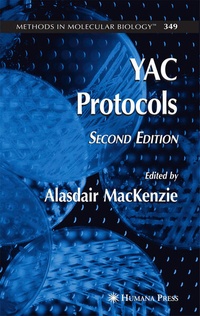
YAC Protocols
2nd Edition
Published on 18. August 2006
Book
Hardback
XVI, 204 pages
978-1-58829-612-2 (ISBN)
Description
It is now 10 years since the first edition of YAC Protocols was published in 1996. YAC Protocols was first produced to address the huge demand within the research community for a lab-based text that described in detail the wide range of uses for large insert yeast artificial chromosome (YAC) DNA clones. In doing this, the original editor, David Markie, and the many different contri- tors who provided descriptions of the protocols they used and developed, did a magnificent job. Indeed many of the techniques described within the first e- tion require little change and have stood up admirably to the test of time. Since the first edition, the use of YACs has proved invaluable for addressing a wide range of new biological problems ranging from those of basic biochemistry to assisting in the mapping and sequencing of the human genome. The requirement for a second edition of YAC Protocols was prompted by a number of major advances in biology since the publication of the first edition. These advances have included the sequencing of the human genome, and the genomes of a wide variety of other organisms, and the increased use of transgenic animals for understanding the molecular basis of human and animal disease.
More details
Series
Edition
2nd ed. 2006
Language
English
Place of publication
Totowa
United States
Target group
Professional and scholarly
Research
Edition type
Revised edition
Product notice
Unsewn / adhesive bound
Paper over boards
Illustrations
49 s/w Abbildungen
XVI, 204 p. 49 illus.
Dimensions
Height: 238 mm
Width: 159 mm
Thickness: 20 mm
Weight
499 gr
ISBN-13
978-1-58829-612-2 (9781588296122)
DOI
10.1385/1597451584
Schweitzer Classification
Other editions
Additional editions
Alasdair MacKenzie
YAC Protocols
Book
12/2010
2nd Edition
Humana Press Inc.
€106.99
Shipment within 15-20 days
Previous edition

Content
Markers, Selection, and Media in Yeast Artificial Chromosome Cloning.- Construction of Yeast Artificial Chromosome Libraries From Pathogens and Nonmodel Organisms.- Analysis and Screening of Yeast Artificial Chromosome Libraries by Filter Hybridization.- Analysis of Yeast Artificial Chromosome DNA by Restriction Digestion, Southern Blotting Nucleic Acid Hybridization, and Polymerase Chain Reaction.- Postgenomic Bioinformatic Analysis of Yeast Artificial Chromosome Sequence.- Transformation of Yeast Using Bioactive Beads With Surface-Immobilized Yeast Artificial Chromosomes.- Modification and Amplification of Yeast Artificial Chromosomes.- Modifying Yeast Artificial Chromosomes to Generate Cre/LoxP and FLP/FRT Site-Specific Deletions and Inversions.- Selective Isolation of Large Chromosomal Regions by Transformation-Associated Recombination Cloning for Structural and Functional Analysis of Mammalian Genomes.- A Polymerase Chain Reaction-Mediated Yeast Artificial Chromosome-Splitting Technology for Generating Targeted Yeast Artificial Chromosomes Subclones.- Genomic Reconstruction by Serial Mitotic Recombination of Yeast Artificial Chromosomes.- Targeting Vector Construction by Yeast Artificial Chromosome Modification.- Production of Yeast Artificial Chromosome Transgenic Mice by Pronuclear Injection of One-Cell Embryos.- Generation of Yeast Artificial Chromosome Transgenic Mice by Intracytoplasmic Sperm Injection.- Establishment of Cell Lines That Exhibit Correct Ontogenic Stage-Specific Gene Expression Profiles From Tissues of Yeast Artificial Chromosome Transgenic Mice Using Chemically Induced Growth Signals.- Application of Yeast Artificial Chromosomes in Fluorescence In Situ Hybridization.- Contribution of Yeast Artificial Chromosome-Based Physical Maps to the FinalAssembly of the Trypanosoma cruzi Genome.