

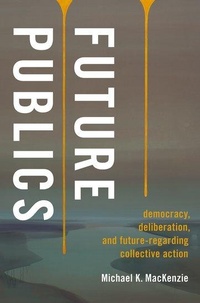
Future Publics
Democracy, Deliberation, and Future-Regarding Collective Action
Published on 8. October 2021
Book
Hardback
240 pages
978-0-19-755715-0 (ISBN)
Description
Scholars have often claimed that democracies, whatever their virtues, are functionally short-sighted. The evidence is clear: we have been unable to manage many long-term issues including climate change, nuclear waste disposal, natural disaster preparedness, infrastructure maintenance, and budget deficits. If voters and influential actors, such as interest groups and corporations, have dominant short-term interests, it may be difficult for elected politicians to act in the long-term interests of society, even if they think that it would be the right thing to do. To solve long-term problems, do we need political systems that are less democratic, or even authoritarian?
This idea, which Michael K. MacKenzie calls the "democratic myopia thesis," is a sort of conventional wisdom; it is an idea that scholars and pundits take for granted as a truth about democracy without subjecting it to adequate critical scrutiny. In Future Publics, MacKenzie challenges this conventional wisdom and articulates a deliberative, democratic theory of future-regarding collective action. Specifically, MacKenzie argues that each part of the democratic myopia problem can be addressed through democratic--rather than authoritarian--means. At a more fundamental level, once we recognize that democratic practices are world-making activities that empower us to make our shared worlds together, they should also be understood as future-making activities. Despite the short-term dynamics associated with electoral democracy, MacKenzie asserts that we need more inclusive and deliberative democracies if we are going to make shared futures that will work for us all.
This idea, which Michael K. MacKenzie calls the "democratic myopia thesis," is a sort of conventional wisdom; it is an idea that scholars and pundits take for granted as a truth about democracy without subjecting it to adequate critical scrutiny. In Future Publics, MacKenzie challenges this conventional wisdom and articulates a deliberative, democratic theory of future-regarding collective action. Specifically, MacKenzie argues that each part of the democratic myopia problem can be addressed through democratic--rather than authoritarian--means. At a more fundamental level, once we recognize that democratic practices are world-making activities that empower us to make our shared worlds together, they should also be understood as future-making activities. Despite the short-term dynamics associated with electoral democracy, MacKenzie asserts that we need more inclusive and deliberative democracies if we are going to make shared futures that will work for us all.
Reviews / Votes
Can democracies meet the looming problems of the 21st century? There is a growing suspicion that the answer is no or not well. Michael MacKenzie challenges this view and offers a powerful counterpunch to the doomsaying that has dominated democratic crisis literature. Drawing on and contributing to the latest deliberative democracy research, MacKenzie offers a compelling picture of the democratic institutions through which citizens can take hold of their fate and plan for the future. Inclusive deliberative institutions can break away from the short sightedness imposed by election cycles and develop sensible future oriented policies. Realistic, empirically grounded, and most importantly, constructive, Future Publics is a wonderful and original contribution to contemporary democratic theory. * Simone Chambers, Professor of Political Science, University of California, Irvine * A ground-breaking book. MacKenzie combines a rigorous analysis of the different elements of democratic myopia with a systematic account of the reasons why we can expect deliberation to be future regarding and questions of institutional design. The literature on democracy and future generations is in its infancy and Future Publics will be a highly influential reference point as work in this area matures. * Graham Smith, Professor of Politics, University of Westminster * Michael MacKenzie shows effectively how inclusive deliberation can render political systems more capable of giving due weight to the long term and proceeds in compelling fashion to supply institutional correctives lenses for the myopia that currently plagues democratic systems. Future Publics should be recognized as the definitive treatment of this crucial topic in democratic theory and practice. * John Dryzek, John Dryzek, Centenary Professor, Centre for Deliberative Democracy and Global Governance, University of Canberra *More details
Language
English
Place of publication
New York
United States
Target group
Professional and scholarly
Product notice
sewn/stitched
Cloth over boards
Dimensions
Height: 241 mm
Width: 160 mm
Thickness: 22 mm
Weight
498 gr
ISBN-13
978-0-19-755715-0 (9780197557150)
Copyright in bibliographic data and cover images is held by Nielsen Book Services Limited or by the publishers or by their respective licensors: all rights reserved.
Schweitzer Classification
Other editions
Additional editions

E-Book
06/2021
OUP eBook
€43.49
Available for download

E-Book
06/2021
OUP eBook
€43.49
Available for download
Person
Michael K. MacKenzie is an Assistant Professor in the Department of Political Science at the University of Pittsburgh.
Content
Acknowledgements
Preface
PART I: CONCEPTUAL BACKGROUND
Chapter 1 - Introduction: The Democratic Myopia Thesis
Chapter 2 - Future-Making: Politics, Democracy, and Deliberation
Chapter 3 - Moving Beyond Theories of Intergenerational Justice
PART II: A DELIBERATIVE THEORY OF FUTURE-REGARDING COLLECTIVE ACTION
Chapter 4 - Deliberative Responses to the Democratic Myopic Problem
Chapter 5 - Getting to the Future: Inclusion, Deliberation, and Future-Regarding Collective Action
Chapter 6 - Acting Through Time: Coordinating the Actions of Current and Future Publics
PART III: INSTITUTIONAL DESIGN
Chapter 7 - Future-Regarding Democratic Institutions
Chapter 8 - Conclusion: Unresolved Themes
References
Preface
PART I: CONCEPTUAL BACKGROUND
Chapter 1 - Introduction: The Democratic Myopia Thesis
Chapter 2 - Future-Making: Politics, Democracy, and Deliberation
Chapter 3 - Moving Beyond Theories of Intergenerational Justice
PART II: A DELIBERATIVE THEORY OF FUTURE-REGARDING COLLECTIVE ACTION
Chapter 4 - Deliberative Responses to the Democratic Myopic Problem
Chapter 5 - Getting to the Future: Inclusion, Deliberation, and Future-Regarding Collective Action
Chapter 6 - Acting Through Time: Coordinating the Actions of Current and Future Publics
PART III: INSTITUTIONAL DESIGN
Chapter 7 - Future-Regarding Democratic Institutions
Chapter 8 - Conclusion: Unresolved Themes
References