

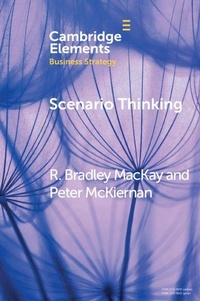
Scenario Thinking
A Historical Evolution of Strategic Foresight
Published on 4. October 2018
Book
Paperback/Softback
92 pages
978-1-108-46900-5 (ISBN)
Description
This Element infuses established scenario planning routines with an exploration of cognitive reasoning, by contextualising scenario thinking within the wider human endeavour of grappling with future uncertainties. A study of ancient civilisations shows that scenario thinking is not new, but has evolved significantly since ancient times. By de-coupling scenario thinking from scenario planning, it is elevated as the essential ingredient in managerial foresight projects. The historical theme continues, focussing on the evolution of modern scenario planning, by way of the French and Anglo-American schools of thought, using the intuitive logics methodology. Archival research has discovered early contributions in the UK around the development and use of scenario thinking in public policy, which has been overlooked in many received histories. Finally, the usefulness of scenario thinking for strategic management is challenged here and the argument that it is a heuristic device for overcoming cognitive biases and making better strategic decisions is refined.
More details
Series
Language
English
Place of publication
Cambridge
United Kingdom
Target group
Professional and scholarly
Product notice
Paperback (trade)
Illustrations
Worked examples or Exercises; 2 Tables, black and white; 1 Line drawings, black and white
Dimensions
Height: 229 mm
Width: 152 mm
Thickness: 6 mm
Weight
148 gr
ISBN-13
978-1-108-46900-5 (9781108469005)
Copyright in bibliographic data and cover images is held by Nielsen Book Services Limited or by the publishers or by their respective licensors: all rights reserved.
Schweitzer Classification
Other editions
Additional editions
E-Book
10/2018
Cambridge University Press
€14.49
Available for download
E-Book
09/2018
Cambridge University Press
€17.49
Available for download