

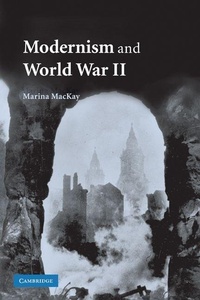
Modernism and World War II
Published on 11. February 2010
Book
Paperback/Softback
204 pages
978-0-521-13014-1 (ISBN)
Description
World War II marked the beginning of the end of literary modernism in Britain. However, this late period of modernism and its response to the war have not yet received the scholarly attention they deserve. In this full-length study of modernism and World War II, Marina MacKay offers historical readings of Virginia Woolf, Rebecca West, T. S. Eliot, Henry Green and Evelyn Waugh set against the dramatic background of national struggle and transformation. In recovering how these major authors engaged with other texts of their time - political discourses, mass and middlebrow culture - this study reveals how World War II brought to the surface the underlying politics of modernism's aesthetic practices. Through close analyses of the revisions made to modernist thinking after 1939, MacKay establishes the significance of this persistently neglected phase of modern literature as a watershed moment in twentieth-century literary history.
More details
Language
English
Place of publication
Cambridge
United Kingdom
Target group
Professional and scholarly
Product notice
Paperback (trade)
Illustrations
Worked examples or Exercises
Dimensions
Height: 229 mm
Width: 152 mm
Thickness: 12 mm
Weight
339 gr
ISBN-13
978-0-521-13014-1 (9780521130141)
Copyright in bibliographic data and cover images is held by Nielsen Book Services Limited or by the publishers or by their respective licensors: all rights reserved.
Schweitzer Classification
Other editions
Additional editions
Marina MacKay
Modernism and World War II
E-Book
03/2007
1st Edition
Cambridge University Press
€38.49
Available for download
Person
Marina MacKay is Assistant Professor of English at Washington University in St. Louis.
Content
Introduction: modernism beyond the Blitz; 1. Virginia Woolf and the pastoral Patria; 2. Rebecca West's anti-Bloomsbury Group; 3. The situational politics of Four Quartets; 4. The neutrality of Henry Green; 5. Evelyn Waugh and the ends of minority culture; Coda: national historiography after the post-War settlement; Bibliography.