

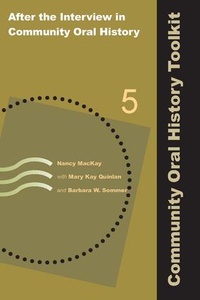
After the Interview in Community Oral History
1st Edition
Published on 15. March 2013
Book
Paperback/Softback
172 pages
978-1-61132-253-8 (ISBN)
Description
Community projects often falter after the interviews are completed. This final book of the five-volume Community Oral History Toolkit explains the importance of processing and archiving oral histories and takes the reader through all the steps required for good archiving and for concluding the oral history project so that it is preserved and accessible for future generations. The authors give special attention to record-keeping systems and repositories, and provide several examples from actual projects to ground the information in practical terms. Charts, checklists, and sample forms also help the reader apply concepts to practice. Volume 5 finishes with examples of creative ways community projects have used oral histories, such as performances, exhibitions, celebrations, websites, and more, in order to promote history and engage the community.
More details
Series
Language
English
Place of publication
Walnut Creek
United States
Illustrations
black & white illustrations, black & white line drawings, black & white tables, figures
Dimensions
Height: 229 mm
Width: 152 mm
Weight
294 gr
ISBN-13
978-1-61132-253-8 (9781611322538)
Copyright in bibliographic data and cover images is held by Nielsen Book Services Limited or by the publishers or by their respective licensors: all rights reserved.
Schweitzer Classification
Other editions
Additional editions
Nancy MacKay | Mary Kay Quinlan | Barbara W. Sommer
After the Interview in Community Oral History
E-Book
06/2016
Routledge
€53.99
Available for download
Nancy MacKay | Mary Kay Quinlan | Barbara W. Sommer
After the Interview in Community Oral History
E-Book
06/2016
Routledge
€53.99
Available for download
Persons
MacKay, Nancy; Quinlan, Mary Kay; Sommer, Barbara W
Content
Chapter 1 Series Introduction; Chapter 1a Getting Started; Chapter 2 Processing; Chapter 3 Transcribing; Chapter 4 Cataloging; Chapter 5 Preservation and Access; Chapter 6 Winding Up; Chapter 7 Using Oral Histories; Chapter 9 Final Words;