


Community
A Sociological Study, Being an Attempt to Set Out Native & Fundamental Laws
1st Edition
Published on 18. November 2016
Book
Paperback/Softback
472 pages
978-1-138-97120-2 (ISBN)
Description
First Published in 1970. Written before the term sociology was in use, this book has two main principles. One concerns the conception of what a state is and what its relation is to the other organizations that enter into the structure or framework of all society. The second major principle is that individualization and socialization are intimately interdependent. that a developed society stimulates the development of the personality of its members. and vice-versa. This principle still seems to the writer to have high significance and to be capable of application for the interpretation of many phases of social change. A difficulty that may impede its acceptance is a failure to appreciate the significance of the word socialization.
More details
Language
English
Place of publication
London
United Kingdom
Publishing group
Taylor & Francis Ltd
Target group
College/higher education
Dimensions
Height: 216 mm
Width: 140 mm
Thickness: 25 mm
Weight
587 gr
ISBN-13
978-1-138-97120-2 (9781138971202)
Copyright in bibliographic data and cover images is held by Nielsen Book Services Limited or by the publishers or by their respective licensors: all rights reserved.
Schweitzer Classification
Other editions
Additional editions

Robert M. MacIver
Community
A Sociological Study, Being an Attempt to Set Out Native & Fundamental Laws
E-Book
11/2012
1st Edition
Routledge
€65.99
Available for download

Robert M. MacIver
Community
A Sociological Study, Being an Attempt to Set Out Native & Fundamental Laws
E-Book
11/2012
1st Edition
Routledge
€65.99
Available for download
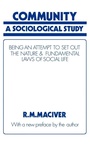
Robert M. MacIver
Community
A Sociological Study, Being an Attempt to Set Out Native & Fundamental Laws
Book
12/1970
4th Edition
Routledge
€207.30
Shipment within 10-20 days
Person
Robert M. MacIver
Content
1. 27 Years. 2. Theoretical Approaches to Eyewitness Identification. 3. Estimator Variables. 4. System Variables. 5. Indicia of Reliability. 6. Field Studies of Eyewitness Identification. 7. Expert Testimony. 8. Conclusions and Thoughts. 9. Philosophical Afterword: Memory and Reasonable Belief.