

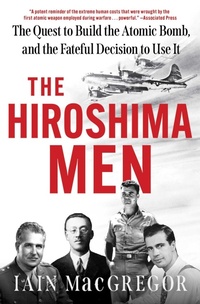
The Hiroshima Men
The Quest to Build the Atomic Bomb, and the Fateful Decision to Use It
Will be published approx. on 14. July 2026
Book
Paperback/Softback
448 pages
978-1-6680-3805-5 (ISBN)
Description
An epic, “painstakingly researched” (Los Angeles Times) work of historical nonfiction, based on new interviews and research, that elucidates the approval, construction, and fateful decision to drop the atomic bomb on Hiroshima—one of the most consequential moments in World War II history.
At 8:15 a.m. on August 6, 1945, the Japanese port city of Hiroshima was struck by the world’s first atomic bomb. Built in the US by the top-secret Manhattan Project and delivered by a B-29 Superfortress, the weapon destroyed large swaths of the city, instantly killing tens of thousands. The world would never be the same.
The Hiroshima Men’s vivid narrative recounts the decade-long path to this first atomic attack. It charts the race for the bomb during World War II, as the Allies fought the Axis powers, and is told through several pivotal figures: General Leslie Groves, leader of the Manhattan Project alongside Robert Oppenheimer; pioneering Army Air Force pilot Colonel Paul Tibbets Jr.; the mayor of Hiroshima, Senkichi Awaya, who died alongside eighty thousand fellow citizens; and Pulitzer Prize–winning journalist John Hersey, whose landmark New Yorker article exposed the devastation the bomb inflicted on the city and described in unflinching detail the dangers of radiation poisoning.
This “potent…powerful” (Associated Press), and compelling military history spans from the corridors of power in the White House and the Pentagon to the test sites of New Mexico; from the air war above Germany to the Potsdam Conference of Truman, Churchill, and Stalin; from the savage reconquest of the Pacific Theater to the deadly firebombing air raids across Japan. The Hiroshima Men also includes Japanese perspectives—a vital element often missing from Western accounts—to complete Iain MacGregor’s deeply human exploration of the ethical implications, political context, and long shadow cast by the atomic bomb.
At 8:15 a.m. on August 6, 1945, the Japanese port city of Hiroshima was struck by the world’s first atomic bomb. Built in the US by the top-secret Manhattan Project and delivered by a B-29 Superfortress, the weapon destroyed large swaths of the city, instantly killing tens of thousands. The world would never be the same.
The Hiroshima Men’s vivid narrative recounts the decade-long path to this first atomic attack. It charts the race for the bomb during World War II, as the Allies fought the Axis powers, and is told through several pivotal figures: General Leslie Groves, leader of the Manhattan Project alongside Robert Oppenheimer; pioneering Army Air Force pilot Colonel Paul Tibbets Jr.; the mayor of Hiroshima, Senkichi Awaya, who died alongside eighty thousand fellow citizens; and Pulitzer Prize–winning journalist John Hersey, whose landmark New Yorker article exposed the devastation the bomb inflicted on the city and described in unflinching detail the dangers of radiation poisoning.
This “potent…powerful” (Associated Press), and compelling military history spans from the corridors of power in the White House and the Pentagon to the test sites of New Mexico; from the air war above Germany to the Potsdam Conference of Truman, Churchill, and Stalin; from the savage reconquest of the Pacific Theater to the deadly firebombing air raids across Japan. The Hiroshima Men also includes Japanese perspectives—a vital element often missing from Western accounts—to complete Iain MacGregor’s deeply human exploration of the ethical implications, political context, and long shadow cast by the atomic bomb.
More details
Language
English
Place of publication
New York
United States
Publishing group
Simon & Schuster
Product notice
Paperback (trade)
Unsewn / adhesive bound
Dimensions
Height: 213 mm
Width: 140 mm
Thickness: 28 mm
Weight
458 gr
ISBN-13
978-1-6680-3805-5 (9781668038055)
Copyright in bibliographic data and cover images is held by Nielsen Book Services Limited or by the publishers or by their respective licensors: all rights reserved.
Schweitzer Classification
Person
Iain MacGregor is the author of the acclaimed history of Cold War Berlin: Checkpoint Charlie and the award-winning The Lighthouse of Stalingrad: The Hidden Truth Behind WWII’s Greatest Battle. He is a Fellow of the Royal Historical Society, has spoken at many literary festivals and conferences in the UK and abroad, appeared on podcasts such as The Rest Is History and on television documentaries. His writing has appeared in The Washington Post, The Spectator, BBC History Magazine, and The Guardian. He lives in London.