

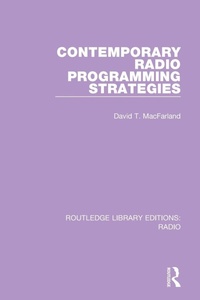
Contemporary Radio Programming Strategies
1st Edition
Published on 10. April 2018
Book
Paperback/Softback
228 pages
978-1-138-21567-2 (ISBN)
Description
This book, first published in 1990, offers an in-depth analysis of the 'fundamental beliefs' of radio. This refers to the common understanding of what the radio enterprise is - and should be - about: entertainment and information. A major thrust of this book is to arrive at a set of fundamental beliefs about the values and the realities of the radio business in regard to entertainment programming - a set of beliefs that may or may not be right, or forever, but that might at least provide a basis for developing programming strategies. Most other books on radio programming describe the formats and programming that already exist. This one starts with a clean sheet of paper and the question 'What do listeners really want from radio?'
More details
Series
Language
English
Place of publication
London
United Kingdom
Publishing group
Taylor & Francis Ltd
Target group
College/higher education
Dimensions
Height: 234 mm
Width: 156 mm
Thickness: 12 mm
Weight
354 gr
ISBN-13
978-1-138-21567-2 (9781138215672)
Copyright in bibliographic data and cover images is held by Nielsen Book Services Limited or by the publishers or by their respective licensors: all rights reserved.
Schweitzer Classification
Other editions
Additional editions
David T. MacFarland
Contemporary Radio Programming Strategies
E-Book
10/2016
Routledge
€45.99
Available for download
David T. MacFarland
Contemporary Radio Programming Strategies
E-Book
10/2016
Routledge
€45.99
Available for download
David T. MacFarland
Contemporary Radio Programming Strategies
Book
09/2016
1st Edition
Routledge
€215.77
Shipment within 10-20 days
Person
David T. MacFarland
Content
1. An Overview of the Book Part 1. Radio's Arena, Attributes and Audiences 2. Radio's Arena 3. Radio's Attributes 4. What Radio Audiences Want Part 2. Formats, Soundscapes and Voices 5. Format Structure and Management 6. The Structure and Appeal of Acoustic Space 7. Air Personality: the Structure of Spoken Gesture Part 3. Music Programming 8. The Appeals of Radio Music 9. Music Moods Research 10. The Components of a Mood-Evoking Music Progression 11. Factors in MOST - Mood-Oriented Selection Testing 12. Factors in MEMO - Mood-Evoking Music Order 13. Toward MERIT