

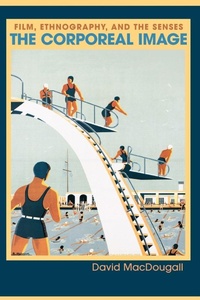
The Corporeal Image
Film, Ethnography, and the Senses
Published on 30. October 2005
Book
Paperback/Softback
328 pages
978-0-691-12156-7 (ISBN)
Description
In this book, David MacDougall, one of the leading ethnographic filmmakers and film scholars of his generation, builds upon the ideas from his widely praised Transcultural Cinema and argues for a new conception of how visual images create human knowledge in a world in which the value of seeing has often been eclipsed by words. In ten chapters, MacDougall explores the relations between photographic images and the human body-the body of the viewer and the body behind the camera as well as the body as seen in ethnography, cinema, and photography. In a landmark piece, he discusses the need for a new field of social aesthetics, further elaborated in his reflections on filming at an elite boys' school in northern India. The theme of the school is taken up as well in his discussion of fiction and nonfiction films of childhood. The book's final section presents a radical view of the history of visual anthropology as a maverick anthropological practice that was always at odds with the anthropology of words. In place of the conventional wisdom, he proposes a new set of principles for visual anthropology.
These are essays in the classical sense--speculative, judicious, lucidly written, and mercifully jargon-free. The Corporeal Image presents the latest ideas from one of our foremost thinkers on the role of vision and visual representation in contemporary social thought.
These are essays in the classical sense--speculative, judicious, lucidly written, and mercifully jargon-free. The Corporeal Image presents the latest ideas from one of our foremost thinkers on the role of vision and visual representation in contemporary social thought.
Reviews / Votes
Winner of the 2007 Dorothy Lee Award, Media Ecology Association One of Choice's Outstanding Academic Titles for 2006 "The prose is jargon-free, lucid, and, at its best, poignant, especially when the author writes about the now-grown child subjects of his treasured postcard collection... [MacDougall] urges scholars to see the visual as a complement rather than as a substitute for the verbal, as a language with its own vocabulary and potential. Given the author's obvious accomplishments in both forms, his long and successful career stands as the best evidence for the validity of his argument."--Richard John Ascarate, MEDIENMore details
Language
English
Place of publication
New Jersey
United States
Target group
Professional and scholarly
College/higher education
Product notice
Paperback (trade)
Illustrations
45 halftones.
Dimensions
Height: 229 mm
Width: 152 mm
Thickness: 20 mm
Weight
540 gr
ISBN-13
978-0-691-12156-7 (9780691121567)
Copyright in bibliographic data and cover images is held by Nielsen Book Services Limited or by the publishers or by their respective licensors: all rights reserved.
Schweitzer Classification
Other editions
Additional editions
Book
10/2005
Princeton University Press
€76.75
Article exhausted; check different version
E-Book
10/2005
1st Edition
Princeton University Press
€161.95
Available for download
Person
David MacDougall's films have won numerous international awards, including the Film Prize of Cinema du Reel and the Earthwatch Film Award. He is the author of "Transcultural Cinema" (Princeton) and is currently ARC Professorial Fellow at the Centre for Cross-Cultural Research, Australian National University, Canberra.
Content
Illustrations ix Acknowledgments xiii INTRODUCTION: Meaning and Being 1 PART I: MATTER AND IMAGE 11 CHAPTER 1: The Body in Cinema 13 CHAPTER 2: Voice and Vision 32 PART II:IMAGES OF CHILDHOOD 65 CHAPTER 3: Films of Childhood 67 CHAPTER 4: Social Aesthetics and the Doon School 94 CHAPTER 5: Doon School Reconsidered 120 PART III:THE PHOTOGRAPHIC IMAGINATION 145 CHAPTER 6: Photo Hierarchicus: Signs and Mirrors in Indian Photography 147 CHAPTER 7: Staging the Body: The Photography of Jean Audema 176 PART IV:THE ETHNOGRAPHIC IMAGINATION 211 CHAPTER 8: The Visual in Anthropology 213 CHAPTER 9: Anthropology 's Lost Vision 227 CHAPTER 10: New Principles of Visual Anthropology 264 Filmography 275 Bibliography 283 Index 299