

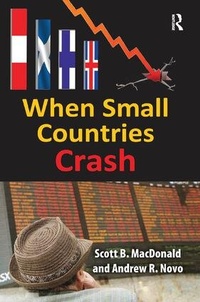
When Small Countries Crash
1st Edition
Published on 28. September 2017
Book
Paperback/Softback
223 pages
978-1-138-51792-9 (ISBN)
Description
The public is fascinated with financial crashes. Historians portray the roar of an angry mob toppling presidents or prime ministers and destroying the property of those who are regarded as malefactors. And certainly, financial crisis is often a factor in political change. It is often overlooked, but nonetheless significant that one of the major causes for the French Revolution was the poor state of finances, with the nation coming to bankruptcy.
Large systemic financial crises create history. Various actors, big and small, become caught in the drama, contributing to it in their own special way. When Small Countries Crash seeks to capture some of the drama of financial collapses and their impact on small countries, which the authors define as populations under 10 million, generally 5-6 million. MacDonald and Novo have selected countries that have had a financial crisis in the national economy; that included key actors; and where access to reliable data is available.
As the authors demonstrate, the story of small countries suffering the costs of financial missteps is long and painful. They argue that smaller economies tend to be more vulnerable to economic shocks, many of which are externally generated. Small economies confront particular challenges in terms of economies of scale, diversification, and depth of expertise and workforce. The chapters in this absorbing book focus on Iceland, Latvia, Ireland, the Caribbean, Scotland, Finland, and Albania. This in-depth study is unique in its close look at financial disasters in countries that have, until now, been overlooked.
Large systemic financial crises create history. Various actors, big and small, become caught in the drama, contributing to it in their own special way. When Small Countries Crash seeks to capture some of the drama of financial collapses and their impact on small countries, which the authors define as populations under 10 million, generally 5-6 million. MacDonald and Novo have selected countries that have had a financial crisis in the national economy; that included key actors; and where access to reliable data is available.
As the authors demonstrate, the story of small countries suffering the costs of financial missteps is long and painful. They argue that smaller economies tend to be more vulnerable to economic shocks, many of which are externally generated. Small economies confront particular challenges in terms of economies of scale, diversification, and depth of expertise and workforce. The chapters in this absorbing book focus on Iceland, Latvia, Ireland, the Caribbean, Scotland, Finland, and Albania. This in-depth study is unique in its close look at financial disasters in countries that have, until now, been overlooked.
More details
Language
English
Place of publication
London
United Kingdom
Publishing group
Taylor & Francis Ltd
Target group
College/higher education
Dimensions
Height: 229 mm
Width: 152 mm
Weight
453 gr
ISBN-13
978-1-138-51792-9 (9781138517929)
Copyright in bibliographic data and cover images is held by Nielsen Book Services Limited or by the publishers or by their respective licensors: all rights reserved.
Schweitzer Classification
Other editions
Additional editions
Scott B. MacDonald | Andrew Novo
When Small Countries Crash
E-Book
07/2017
Routledge
€64.49
Available for download
Scott B. MacDonald | Andrew Novo
When Small Countries Crash
E-Book
07/2017
Routledge
€64.49
Available for download
Scott B. MacDonald | Andrew Novo
When Small Countries Crash
Book
03/2011
1st Edition
Routledge
€215.77
Shipment within 10-15 days
Persons
Andrew Novo, Scott B. MacDonald
Content
1: When Small Countries Crash; 2: Sinking Scotland; 3: Caribbean Follies; 4: Austria, Credit-Anstalt, and the Great Depression; 5: When Finland Almost Failed; 6: Albanian Pyramid Schemes; 7: Volcanoes, Icelandic Banks, and McDonald's; 8: Ireland's Time of Troubles; 9: Acropolis Now; 10: Conclusion