


Varieties of Things
Foundations of Contemporary Metaphysics
1st Edition
Published on 19. August 2005
Book
Hardback
292 pages
978-0-631-18694-6 (ISBN)
Description
Varieties of Things: Foundations of Contemporary Metaphysics is about some of the most fundamental kinds of things that there are; the things that we encounter in everyday experience.
A book about the things that we encounter in everyday experience.
Contains a thorough and accessible discussion of the nature and aims of metaphysics.
Examines a wide range of ontological categories, including both particulars and universals.
Mounts a forceful and persuasive case for anti-reductionism.
A book about the things that we encounter in everyday experience.
Contains a thorough and accessible discussion of the nature and aims of metaphysics.
Examines a wide range of ontological categories, including both particulars and universals.
Mounts a forceful and persuasive case for anti-reductionism.
Reviews / Votes
"[This] book is well written in a no-nonsense style. First Rate." (The Philosophical Quarterly)"An exceptionally good introduction and tour through central topics in contemporary metaphysics. The book could easily be used alone for an upper level course in metaphysics or as a commentary alongside original articles. It is written clearly, with illuminating examples and engaging discussion." (Review of Metaphysics)
"Macdonald's Varieties of Things: Foundations of Contemporary Metaphysics is an excellent study in ontology. It provides a descriptive metaphysical account of the ontology of material substances, persons, events, and universals. While the book provides a sophisticated account of the issues, it is written in a way that makes it accessible to an advanced undergraduate student audience. And given its novel defenses of some positions, it will also be of considerable interest to professional philosophers working on the issues"
-Brian McLaughlin, Rutgers University
"Amongst the book's most notable virtues are its clarity and the author's careful attention to detail in setting out arguments and counter-arguments for various positions. The opening chapters on the nature of metaphysics are excellent. The later chapters on material substances, persons, events, and universals are thorough, closely argued and well informed."
-Jonathan Lowe, University of Durham
More details
Language
English
Place of publication
Hoboken
United Kingdom
Publishing group
John Wiley and Sons Ltd
Target group
Professional and scholarly
Product notice
Pop-up book
sewn/stitched
Cloth over boards
Dimensions
Height: 240 mm
Width: 161 mm
Thickness: 20 mm
Weight
607 gr
ISBN-13
978-0-631-18694-6 (9780631186946)
Copyright in bibliographic data and cover images is held by Nielsen Book Services Limited or by the publishers or by their respective licensors: all rights reserved.
Schweitzer Classification
Other editions
Additional editions
E-Book
05/2008
Wiley-Blackwell
€34.99
Available for download
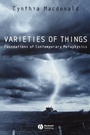
Book
08/2005
1st Edition
Wiley
€44.00
Shipment within 15-20 days
Person
Cynthia Macdonald is Professor of Philosophy at the University of Canterbury, New Zealand. She is Associate Editor of the Australasian Journal of Philosophy and the author or editor of numerous publications, including The Philosophy of Psychology: Debates on Psychological Explanation (co-edited with Graham Macdonald, Blackwell, 1994), Connectionism: Debates on Psychological Explanation (co-edited with Graham Macdonald, Blackwell, 1995) and Contemporary Readings in the Foundations of Metaphysics (co-edited with Stephen Laurence, Blackwell, 1998).
Content
Preface vii
Part I: Metaphysics and Its Tools
1 The Nature and Function of Metaphysics 3
The Methodology and Subject Matter of Metaphysics 4
Aristotle's Conception of Metaphysics 8
Kant's Conception of Metaphysics 11
A Working Conception of Metaphysics 14
2 Some Tools of Metaphysics 36
Criteria of Ontological Commitment: Two Examples 36
'No Entity without Identity': Identity Conditions for Objects 56
Individuation Conditions, Identity Conditions, and Metaphysical Kinds 59
Principles and Criteria of Identity 63
Part II: Particulars
3 Material Substances 79
Our Ontological Commitment to Material Substances 79
The Bundle Theory and the Principle of the Identity of Indiscernibles 81
Problems with the Bundle Theory 84
The Bare Substratum Theory and the Principle of Acquaintance 110
Objections to the Bare Substratum Theory 113
An Alternative 114
4 Persons and Personal Identity 135
Our Ontological Commitment to Persons 135
Candidates for Persistence Conditions for Persons 138
The Closest Continuer Theory and Its Problems 150
Does the Concept of Identity Apply to Persons? 155
The Multiple Occupancy Thesis 162
Back to Basics: Continuity and Fission 164
A Suggestion 169
5 Events 181
Our Ontological Commitment to Events 183
Three Criteria: Spatio-temporal Coincidence, Necessary Spatio-temporal Coincidence, and Sameness of Cause and Effect 186
The Property Exemplification Account of Events (PEE) 193
Part III: Universals
6 Universals and the Realism/Nominalism Dispute 219
The Issue 223
Varieties of Nominalism 225
Two Conceptions of Universals 236
The Regress Charge and Two Unsuccessful Attempts to Meet It 239
An Alternative 245
Bibliography 260
Index 272
Part I: Metaphysics and Its Tools
1 The Nature and Function of Metaphysics 3
The Methodology and Subject Matter of Metaphysics 4
Aristotle's Conception of Metaphysics 8
Kant's Conception of Metaphysics 11
A Working Conception of Metaphysics 14
2 Some Tools of Metaphysics 36
Criteria of Ontological Commitment: Two Examples 36
'No Entity without Identity': Identity Conditions for Objects 56
Individuation Conditions, Identity Conditions, and Metaphysical Kinds 59
Principles and Criteria of Identity 63
Part II: Particulars
3 Material Substances 79
Our Ontological Commitment to Material Substances 79
The Bundle Theory and the Principle of the Identity of Indiscernibles 81
Problems with the Bundle Theory 84
The Bare Substratum Theory and the Principle of Acquaintance 110
Objections to the Bare Substratum Theory 113
An Alternative 114
4 Persons and Personal Identity 135
Our Ontological Commitment to Persons 135
Candidates for Persistence Conditions for Persons 138
The Closest Continuer Theory and Its Problems 150
Does the Concept of Identity Apply to Persons? 155
The Multiple Occupancy Thesis 162
Back to Basics: Continuity and Fission 164
A Suggestion 169
5 Events 181
Our Ontological Commitment to Events 183
Three Criteria: Spatio-temporal Coincidence, Necessary Spatio-temporal Coincidence, and Sameness of Cause and Effect 186
The Property Exemplification Account of Events (PEE) 193
Part III: Universals
6 Universals and the Realism/Nominalism Dispute 219
The Issue 223
Varieties of Nominalism 225
Two Conceptions of Universals 236
The Regress Charge and Two Unsuccessful Attempts to Meet It 239
An Alternative 245
Bibliography 260
Index 272