

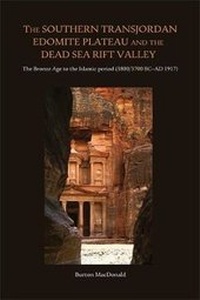
The Southern Transjordan Edomite Plateau and the Dead Sea Rift Valley
The Bronze Age to the Islamic Period (3800/3700 BC-AD 1917)
Published on 12. March 2015
Book
Hardback
208 pages
978-1-78297-832-9 (ISBN)
Description
Burton MacDonald presents an in-depth study of the archaeology and history of human presence over the past five-six thousand years in the southern segment of the Transjordan/Edomite Plateau and the Dead Sea Rift Valley to the west. The evidence from archaeology for the area spans the entire period though the time for which literary evidence is available is only the past 4000 years, from the Middle Bronze Age (2000-1550 BC). Once literary evidence is available, however, it complements the archaeological record and, as can be amply demonstrated, the written records can be clarified only through the archaeological data. These two sources are, thus, used to describe environments, resources, industries, settlement patterns, and the lifestyles of the inhabitants of this pivotal region. The result is a "story" of the people who lived in the area from the Bronze Age through the Islamic period.
What is evident is that there were differences in certain archaeological periods in settlement patterns, as well as lifestyles, between those who lived on the southern segment of the Plateau and those who lived in the Dead Sea Rift Valley or in the lowlands immediately to the west. Moreover, it is obvious that when there were periods of trade and industry, for example, the spice trade and copper mining and processing, the population of the area was higher. Stable governance brought about growth in population and prosperity. But other factors also played their part in these ebbs and flows of population: climatic fluctuations affecting the availability of water and arable land; the development and adoption of new technologies in farming practices, raw material extraction and industrial methods, processes and transportation; and political change resulting in periods of relative stability and instability in government.
What is evident is that there were differences in certain archaeological periods in settlement patterns, as well as lifestyles, between those who lived on the southern segment of the Plateau and those who lived in the Dead Sea Rift Valley or in the lowlands immediately to the west. Moreover, it is obvious that when there were periods of trade and industry, for example, the spice trade and copper mining and processing, the population of the area was higher. Stable governance brought about growth in population and prosperity. But other factors also played their part in these ebbs and flows of population: climatic fluctuations affecting the availability of water and arable land; the development and adoption of new technologies in farming practices, raw material extraction and industrial methods, processes and transportation; and political change resulting in periods of relative stability and instability in government.
Reviews / Votes
This book is the corollary of the enormous archaeological work done by MacDonald in southern Transjordan for almost 40 years, inserting the large amount of data gathered during his five archaeological surveys into the longue duree and the wider Levantine world. The book displays many detailed maps, figures, and plates that effectively follow the reading... MacDonald should be congratulated for this work, which will be an invaluable source of information for archaeologists and historians working on Jordan and the arid peripheries of the Near East. * BASOR * In all, Burton MacDonald has accomplished the enormous task he set himself and provided us with an inspiring and very informative book on the history of the people inhabiting the southern Transjordan Edomite plateau and the Dead Sea rift valley ... MacDonald has managed to bring together a wealth of information on this region and I am certain that this book will prove to be the starting point for everyone interested in the southern Levant for many years to come. * Bibliotheca Orientalis *More details
Language
English
Place of publication
Oxford
United Kingdom
Target group
College/higher education
Illustrations
b/w and colour illustrations
Dimensions
Height: 240 mm
Width: 170 mm
ISBN-13
978-1-78297-832-9 (9781782978329)
Copyright in bibliographic data and cover images is held by Nielsen Book Services Limited or by the publishers or by their respective licensors: all rights reserved.
Schweitzer Classification
Other editions
Additional editions
MacDonald Burton MacDonald
Southern Transjordan Edomite Plateau and the Dead Sea Rift Valley
The Bronze Age to the Islamic Period (3800/3700 BC-AD 1917)
E-Book
03/2015
Oxbow Books
€44.49
Available for download
MacDonald Burton MacDonald
Southern Transjordan Edomite Plateau and the Dead Sea Rift Valley
The Bronze Age to the Islamic Period (3800/3700 BC-AD 1917)
E-Book
03/2015
OXBOW BOOKS
€44.49
Available for download
Content
Contents
List of Figures
List of Photos
Acknowledgements
Abbreviations and Symbols
Archaeological Periods and Dates
Dedication
Chapter 1: Introduction
Chapter 2: Early, Middle and Late Bronze Periods (3800/3700-1200 BC)
Chapter 3: Iron I and II Periods (1200-539 BC)
Chapter 4: Persian (539-332 BC) and Hellenistic (and Nabataean) Periods (332-63 BC)
Chapter 5: Roman (and Nabataean) Period (63 BC-AD 324)
Chapter 6: Byzantine Period (AD 324-640)
Chapter 7: Early, Middle and Late Islamic Periods (AD 640-1917)
Chapter 8: Summary and Conclusions
References
Indices: Sites; Subjects; Biblical Passages
List of Figures
List of Photos
Acknowledgements
Abbreviations and Symbols
Archaeological Periods and Dates
Dedication
Chapter 1: Introduction
Chapter 2: Early, Middle and Late Bronze Periods (3800/3700-1200 BC)
Chapter 3: Iron I and II Periods (1200-539 BC)
Chapter 4: Persian (539-332 BC) and Hellenistic (and Nabataean) Periods (332-63 BC)
Chapter 5: Roman (and Nabataean) Period (63 BC-AD 324)
Chapter 6: Byzantine Period (AD 324-640)
Chapter 7: Early, Middle and Late Islamic Periods (AD 640-1917)
Chapter 8: Summary and Conclusions
References
Indices: Sites; Subjects; Biblical Passages