

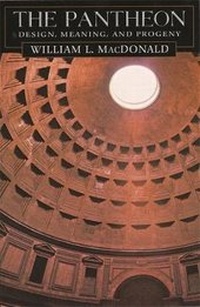
The Pantheon
Design, Meaning, and Progeny, With a New Foreword by John Pinto, Second Edition
2nd Edition
Published on 30. October 2002
Book
Paperback/Softback
160 pages
978-0-674-01019-2 (ISBN)
Description
The Pantheon in Rome is one of the grand architectural statements of all ages. This richly illustrated book isolates the reasons for its extraordinary impact on Western architecture, discussing the Pantheon as a building in its time but also as a building for all time.
Mr. MacDonald traces the history of the structure since its completion and examines its progeny--domed rotundas with temple-fronted porches built from the second century to the twentieth--relating them to the original. He analyzes the Pantheon's design and the details of its technology and construction, and explores the meaning of the building on the basis of ancient texts, formal symbolism, and architectural analogy. He sees the immense unobstructed interior, with its disk of light that marks the sun's passage through the day, as an architectural metaphor for the ecumenical pretensions of the Roman Empire.
Past discussions of the Pantheon have tended to center on design and structure. These are but the starting point for Mr. MacDonald, who goes on to show why it ranks--along with Cheops's pyramid, the Parthenon, Wren's churches, Mansard's palaces-as an architectural archetype.
Mr. MacDonald traces the history of the structure since its completion and examines its progeny--domed rotundas with temple-fronted porches built from the second century to the twentieth--relating them to the original. He analyzes the Pantheon's design and the details of its technology and construction, and explores the meaning of the building on the basis of ancient texts, formal symbolism, and architectural analogy. He sees the immense unobstructed interior, with its disk of light that marks the sun's passage through the day, as an architectural metaphor for the ecumenical pretensions of the Roman Empire.
Past discussions of the Pantheon have tended to center on design and structure. These are but the starting point for Mr. MacDonald, who goes on to show why it ranks--along with Cheops's pyramid, the Parthenon, Wren's churches, Mansard's palaces-as an architectural archetype.
Reviews / Votes
The Pantheon is an informative and extremely well organized [book on] one of the most important and influential buildings in world history. Throughout, the language is appealing...Not only a coherent summary of the history, description, and analysis of the building, but also a discussion of the relevant architectural issues within a larger framework. * Journal of the Society of Architectural Historians * MacDonald describes the Pantheon's structure in some detail, against the background of contemporary architecture and building methods...and he gives a brilliant resume of its influence on other architects from just after its building to the 1950s...an exceptionally well constructed and readable book. * The Economist *More details
Edition
2nd New edition
Language
English
Place of publication
Cambridge, Mass
United States
Target group
Professional and scholarly
Edition type
New edition
Illustrations
129 halftones, 27 line illustrations
Dimensions
Height: 235 mm
Width: 156 mm
Weight
254 gr
ISBN-13
978-0-674-01019-2 (9780674010192)
Copyright in bibliographic data and cover images is held by Nielsen Book Services Limited or by the publishers or by their respective licensors: all rights reserved.
Schweitzer Classification
Persons
William L. MacDonald was Alice Pratt Brown Professor of Art History at Smith College.
Content
Acknowledgements 1. In The Temple of The Whole World 2. The Building Proper 3. Background and Principles of Design 4. The Problem of Meaning 5. 'The Most Celebrated Edifice' Bibliography Notes List of Illustrations Index