

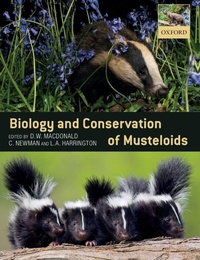
Biology and Conservation of Musteloids
Published on 19. October 2017
Book
Paperback/Softback
720 pages
978-0-19-875981-2 (ISBN)
Description
The musteloids are the most diverse super-family among carnivores, ranging from little known, exotic, and highly-endangered species to the popular and familiar, and include a large number of introduced invasives. They feature terrestrial, fossorial, arboreal, and aquatic members, ranging from tenacious predators to frugivorous omnivores, span weights from a 100g weasel to 30kg giant otters, and express a range of social behaviours from the highly gregarious to the fiercely solitary. Musteloids are the subjects of extensive cutting-edge research from phylogenetics to the evolution of sociality and through to the practical implications of disease epidemiology, introduced species management, and climate change. Their diversity and extensive biogeography inform a wide spectrum of ecological theory and conservation practice.
The editors of this book have used their combined 90 years of experience working on the behaviour and ecology of wild musteloids to draw together a unique network of the world's most successful and knowledgeable experts. The book begins with nine review chapters covering hot topics in musteloid biology including evolution, disease, social communication, and management. These are followed by twenty extensive case studies providing a range of comprehensive geographic and taxonomic coverage. The final chapter synthesises what has been discussed in the book, and reflects on the different and diverse conservation needs of musteloids and the wealth of conservation lessons they offer.
Biology and Conservation of Musteloids provides a conceptual framework for future research and applied conservation management that is suitable for graduate level students as well as professional researchers in musteloid and carnivore ecology and conservation biology. It will also be of relevance and use to conservationists and wildlife managers.
The editors of this book have used their combined 90 years of experience working on the behaviour and ecology of wild musteloids to draw together a unique network of the world's most successful and knowledgeable experts. The book begins with nine review chapters covering hot topics in musteloid biology including evolution, disease, social communication, and management. These are followed by twenty extensive case studies providing a range of comprehensive geographic and taxonomic coverage. The final chapter synthesises what has been discussed in the book, and reflects on the different and diverse conservation needs of musteloids and the wealth of conservation lessons they offer.
Biology and Conservation of Musteloids provides a conceptual framework for future research and applied conservation management that is suitable for graduate level students as well as professional researchers in musteloid and carnivore ecology and conservation biology. It will also be of relevance and use to conservationists and wildlife managers.
Reviews / Votes
[This] volume is a must have for all musteloid researchers, conservationists, and enthusiasts. As a fellow musteloid researcher, I have used this book quite often in my research. The knowledge and expertise in musteloid biology gathered in this volume is unparalleled. * Chris J. Law, Mammalogy, American Museum of Natural History, New York, New York * The Biology and Conservation of Musteloids' is a comprehensive synthesis of and much-needed addition to its field. As well as offering a valuable reference for everything we know about musteloid ecology, the book also identifies avenues for further work and research, in both ecology and conservation. * Lydia Murphy, Orynx - The International Journal of Conservation * This is a mighty and well-referenced work that belongs in every library... Highly recommended. * CHOICE * the overall effect is one of coherence, clarity and a wealth of evidence-based knowledge. This text will be of fundamental and lasting value to all musteloid researchers and graduate students. It is also likely to be of use to those interested in the ecology and conservation of carnivores and the management of wildlife. * Sue Howarth CBiol, Royal Society of Biology *More details
Language
English
Place of publication
Oxford
United Kingdom
Target group
College/higher education
Dimensions
Height: 246 mm
Width: 189 mm
Thickness: 38 mm
Weight
1367 gr
ISBN-13
978-0-19-875981-2 (9780198759812)
Copyright in bibliographic data and cover images is held by Nielsen Book Services Limited or by the publishers or by their respective licensors: all rights reserved.
Schweitzer Classification
Other editions
Additional editions
David W. Macdonald | Chris Newman | Lauren A. Harrington
Biology and Conservation of Musteloids
E-Book
11/2017
1st Edition
OUP eBook
€68.49
Available for download
Persons
David Macdonald is the founder and Director of the Wildlife Conservation Research Unit at Oxford University, Senior Research Fellow in Wildlife Conservation at Lady Margaret Hall, Oxford, and Professor of Wildlife Conservation at the University of Oxford. A recent survey by BBC Wildlife magazine listed him amongst the ten most influential living conservationists. He won the 2005 Dawkins Prize for Conservation and has published over 600 refereed papers on aspects of mammalian behaviour, ecology, and conservation. In 2006 he was awarded the American Society of Mammalogists Merriam Award for scientific contributions to mammalogy and, in 2007, the equivalent gold medal from the British Mammal Society. In 2007 he was elected a Fellow of the Royal Society of Edinburgh. David is also known for his books and television documentaries, and has twice been awarded the Natural History Author of the Year.
Chris Newman joined the WildCRU in 1991. He is the co-ordinator for the WildCRUs Badger Project, specialising in life-history evolution and the effects of climate change and disease on population dynamics. His work is highly inter-disciplinary, drawing together insights from demography, animal behaviour, physiology, genetics and parasitology to synthesise new ideas and comprehensive approaches to understand wildlife biology. He collaborates extensively with other researchers internationally, particularly in Asia, and is an author of over 100 peer reviewed papers and book chapters. As a former Earthwatch Principal Investigator, he is also an advocate of public and corporate participation in conservation initiatives. Chris is the Mammals Officer for the Zoology Departments Animal Welfare and Ethical Review Board. Outside of academia, he manages 350 acres of Forest Stewardship Council certified woodland in Nova Scotia, Canada, including 16 acres growing Haskap berries.
Lauren Harrington has worked with a number of mustelid species that include the most endangered mustelid, once extinct in the wild the black-footed ferret, and the most widespread invasive mustelid the American mink. She developed a passion for mustelids during long nights spent on the prairies of Wyoming and Montana radio-tracking some of the first captive-bred black-footed ferrets to be released into the wild. Lauren has been a member of the WildCRU since 1996, and has published a number of refereed papers on diverse topics, including diving behaviour of mink, interactions and coexistence between small carnivores, wildlife management, and reintroduction, focusing predominantly on UK species. Lauren formerly served as an Independent Monitoring Partner for the trial release of beavers in Scotland, and is currently a member of the IUCN Otter Specialist Group.
Chris Newman joined the WildCRU in 1991. He is the co-ordinator for the WildCRUs Badger Project, specialising in life-history evolution and the effects of climate change and disease on population dynamics. His work is highly inter-disciplinary, drawing together insights from demography, animal behaviour, physiology, genetics and parasitology to synthesise new ideas and comprehensive approaches to understand wildlife biology. He collaborates extensively with other researchers internationally, particularly in Asia, and is an author of over 100 peer reviewed papers and book chapters. As a former Earthwatch Principal Investigator, he is also an advocate of public and corporate participation in conservation initiatives. Chris is the Mammals Officer for the Zoology Departments Animal Welfare and Ethical Review Board. Outside of academia, he manages 350 acres of Forest Stewardship Council certified woodland in Nova Scotia, Canada, including 16 acres growing Haskap berries.
Lauren Harrington has worked with a number of mustelid species that include the most endangered mustelid, once extinct in the wild the black-footed ferret, and the most widespread invasive mustelid the American mink. She developed a passion for mustelids during long nights spent on the prairies of Wyoming and Montana radio-tracking some of the first captive-bred black-footed ferrets to be released into the wild. Lauren has been a member of the WildCRU since 1996, and has published a number of refereed papers on diverse topics, including diving behaviour of mink, interactions and coexistence between small carnivores, wildlife management, and reintroduction, focusing predominantly on UK species. Lauren formerly served as an Independent Monitoring Partner for the trial release of beavers in Scotland, and is currently a member of the IUCN Otter Specialist Group.
Content
PART I: REVIEWS; PART II: CASE STUDIES; PART III: SYNTHESIS