

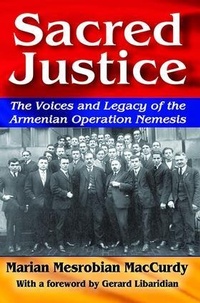
Sacred Justice
The Voices and Legacy of the Armenian Operation Nemesis
1st Edition
Published on 30. May 2016
Book
Paperback/Softback
408 pages
978-1-4128-6315-5 (ISBN)
Description
Sacred Justice is a cross-genre book that uses narrative, memoir, unpublished letters, and other primary and secondary sources to tell the story of a group of Armenian men who organized Operation Nemesis, a covert operation created to assassinate the Turkish architects of the Armenian Genocide. The leaders of Operation Nemesis took it upon themselves to seek justice for their murdered families, friends, and compatriots.
Sacred Justice includes a large collection of previously unpublished letters, found in the upstairs study of the author's grandfather, Aaron Sachaklian, one of the leaders of Nemesis, that show the strategies, personalities, plans, and dedication of Soghomon Tehlirian, who killed Talaat Pasha, a genocide leader; Shahan Natalie, the agent on the ground in Europe; Armen Garo, the centre of Operation Nemesis; Aaron Sachaklian, the logistics and finance officer; and others involved with Nemesis.
Marian Mesrobian MacCurdy tells a story that has been either hidden by the necessity of silence or ignored in spite of victims' narratives-the story of those who attempted to seek justice for the victims of genocide and the effect this effort had on them and on their families. Ultimately, this volume reveals how the narratives of resistance and trauma can play out in the next generation and how this resistance can promote resilience.
Sacred Justice includes a large collection of previously unpublished letters, found in the upstairs study of the author's grandfather, Aaron Sachaklian, one of the leaders of Nemesis, that show the strategies, personalities, plans, and dedication of Soghomon Tehlirian, who killed Talaat Pasha, a genocide leader; Shahan Natalie, the agent on the ground in Europe; Armen Garo, the centre of Operation Nemesis; Aaron Sachaklian, the logistics and finance officer; and others involved with Nemesis.
Marian Mesrobian MacCurdy tells a story that has been either hidden by the necessity of silence or ignored in spite of victims' narratives-the story of those who attempted to seek justice for the victims of genocide and the effect this effort had on them and on their families. Ultimately, this volume reveals how the narratives of resistance and trauma can play out in the next generation and how this resistance can promote resilience.
Reviews / Votes
"Mesrobian MacCurdy has done an admirable job in bringing together different genres to tell an important story -one she is personally connected to. This, coupled with her engaging writing and beautiful use of language, is vital to the success of the book. Sacred Justice is the result of meticulous, years-long research and study. Not only has Mesrobian MacCurdy been able to offer a comprehensive historical account of an important aspect of modern Armenian history, but through the personal narratives of her grandparents and those directly involved with Operation Nemesis, she has given readers a look into the details, which were previously unavailable... Nearly 100 years later, Mesrobian MacCurdy's book proves to be another significant work in the quest for justice for the 1.5 million victims that were killed a century ago." -Rupen Janbazian, The Armenian Weekly "How could a secret plot to murder the perpetrators of the Armenian genocide be viewed as 'sacred justice?' Marian Mesrobian MacCurdy explores this troubling question in her brilliantly researched and deeply moving book about Operation Nemesis, the secret organization created to assassinate the unpunished Turkish leaders responsible for the massacres of Ottoman Armenians during World War I. Through previously unpublished letters, which will be a treasure trove for historians and political scientists, and her keen memories of her maternal grandfather, one of the key figures of the clandestine group, she brings to life one of the most tragic struggles of the early twentieth century. She shows how calamities such as genocide are passed on intergenerationally, influencing second- and third-generation survivors. The Armenian tragedy passed virtually unnoticed, as Hitler cynically observed when he asked, 'Who, after all, speaks today of the annihilation of the Armenians?' Professor MacCurdy does, we might respond. Combining archival research, trauma theory, writing studies, and personal memoir, Sacred Justice took a lifetime to write-and will be read for generations to come." -Jeffrey Berman, author of Dying in Character: Memoirs on the End of Life "A riveting, important book. With deep and cogent analysis, Marian Mesrobian MacCurdy reveals her grandfather's secret involvement in 'Operation Nemesis,' a small cadre of individuals who avenged the Armenian genocide through assassination in 1921 and 1922. In this book are secret documents that have not been seen before. MacCurdy then explores the complex relationships and interactions between generations that have inherited the legacy of an unspeakable crime. This book is significant in more than one way: it reveals the inner-workings of an incredible secret organization while exhaustively investigating how genocide and its denial infects its victims and the children and grandchildren of those victims. There are revelations in this book that cannot be found anywhere else." -Eric Bogosian, actor, playwright, and novelist "Sacred Justice is a magnificent synthesis of familial memory, history, outrage, witness, and mourning. It is also a celebration of the resilience of people who refused to be erased, whose lives were dedicated to the restoration of moral balance, and whose legacy is a kind of recipe for survival. What a rich, flavorful, exciting, and deeply satisfying book this is!" -Richard Hoffman, author of Half the House and Love & Fury "Sacred Justice reads like a taut spy thriller and invokes vivid images of the people and what they endured... I highly recommend 'Sacred Justice' for anyone interested in the subject...because of the wealth of new source material valuable to students studying the history of genocide." -Sharon Mills, SJ2B House Of BooksMore details
Language
English
Place of publication
New York
United States
Publishing group
Taylor & Francis Inc
Product notice
Paperback (trade)
Unsewn / adhesive bound
Dimensions
Height: 226 mm
Width: 152 mm
Thickness: 25 mm
Weight
590 gr
ISBN-13
978-1-4128-6315-5 (9781412863155)
Copyright in bibliographic data and cover images is held by Nielsen Book Services Limited or by the publishers or by their respective licensors: all rights reserved.
Schweitzer Classification
Other editions
Additional editions
E-Book
10/2017
Routledge
€68.49
Available for download
E-Book
10/2017
Routledge
€68.49
Available for download
Book
04/2015
1st Edition
AldineTransaction
€178.27
Article exhausted; check different version
Person
Marian Mesrobian MacCurdy, retired professor and chair of the Department of Writing at Ithaca College, USA, is currently special assistant to the president at Hampshire College, USA, where she teaches courses in the personal essay, teaching writing, and the theory and practice of therapeutic writing. Gerard Libaridian is is retired professor of history and Alex Manouqian Chair in Modern Armenian History at the University of Michigan, Ann Arbor, USA. He served as advisor to Levon Ter-Petrosyan, first president of Armenia, in the 1990s.
Content
Foreword,
by Gerard Libaridian
Acknowledgments
Introduction
1 Eliza Der Melkonian Sachaklian
2 Aaron Sachaklian
3 Hadug Kordz
Part I: Genocidal Context
Part II: Th e Rise of Operation Nemesis
Part III: The Voices of Hadug Kordz
4 The First Generation and Its Legacy
5 Witnesses into the Future
Part I: Th e Power of the Word
Part II: From Resistance to Resilience
Bibliography
Photographs
Maps
Index
by Gerard Libaridian
Acknowledgments
Introduction
1 Eliza Der Melkonian Sachaklian
2 Aaron Sachaklian
3 Hadug Kordz
Part I: Genocidal Context
Part II: Th e Rise of Operation Nemesis
Part III: The Voices of Hadug Kordz
4 The First Generation and Its Legacy
5 Witnesses into the Future
Part I: Th e Power of the Word
Part II: From Resistance to Resilience
Bibliography
Photographs
Maps
Index