

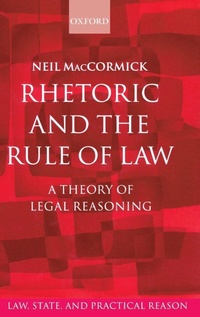
Rhetoric and The Rule of Law
A Theory of Legal Reasoning
Published on 28. July 2005
Book
Hardback
304 pages
978-0-19-826878-9 (ISBN)
Description
Is legal reasoning rationally persuasive, working within a discernible structure and using recognisable kinds of arguments? Does it belong to rhetoric in this sense, or to the domain of the merely 'rhetorical' in an adversative sense? Is there any reasonable certainty about legal outcomes in dispute-situations? If not, what becomes of the Rule of Law? Neil MacCormick's book tackles these questions in establishing an overall theory of legal reasoning which shows the essential part 'legal syllogism' plays in reasoning aimed at the application of law, while acknowledging that simple deductive reasoning, though always necessary, is very rarely sufficient to justify a decision.
There are always problems of relevancy, classification or interpretation in relation to both facts and law. In justifying conclusions about such problems, reasoning has to be universalistic and yet fully sensitive to the particulars of specific cases. How is this possible? Is legal justification at this level consequentialist in character or principled and right-based?
Both normative coherence and narrative coherence have a part to play in justification, and in accounting for the validity of arguments by analogy. Looking at such long-discussed subjects as precedent and analogy and the interpretative character of the reasoning involved, Neil MacCormick expands upon his celebrated Legal Reasoning and Legal Theory (OUP 1978 and 1994) and restates his 'institutional theory of law'.
There are always problems of relevancy, classification or interpretation in relation to both facts and law. In justifying conclusions about such problems, reasoning has to be universalistic and yet fully sensitive to the particulars of specific cases. How is this possible? Is legal justification at this level consequentialist in character or principled and right-based?
Both normative coherence and narrative coherence have a part to play in justification, and in accounting for the validity of arguments by analogy. Looking at such long-discussed subjects as precedent and analogy and the interpretative character of the reasoning involved, Neil MacCormick expands upon his celebrated Legal Reasoning and Legal Theory (OUP 1978 and 1994) and restates his 'institutional theory of law'.
Reviews / Votes
Rhetoric and the Rule of Law is a fine work. It is stimulating: it makes the reader want to argue and test its tenets. It is too good to be read only by legal theorists. * Joe Thomson, Edinburgh Law Review, Vol 13, 2009 * Its erudite elegance means that it will serve as an excellent introduction to jurisprudence for undergraduates, as well as providing a major contribution to legal philosophy. MacCormick reaffirms the dialectic between the universal and the particular. * James Lee, University of Birmingham, Jurisprudence *More details
Series
Language
English
Place of publication
Oxford
United Kingdom
Target group
College/higher education
Dimensions
Height: 240 mm
Width: 161 mm
Thickness: 21 mm
Weight
622 gr
ISBN-13
978-0-19-826878-9 (9780198268789)
Copyright in bibliographic data and cover images is held by Nielsen Book Services Limited or by the publishers or by their respective licensors: all rights reserved.
Schweitzer Classification
Other editions
Additional editions
Book
09/2009
Oxford University Press
€66.96
Shipment within 15-20 days
E-Book
07/2005
1st Edition
OUP eBook
€33.99
Available for download
Person
Leverhulme Personal Research Professor and Regius Professor of Public Law and the Law of Nature and Nations, the University of Edinburgh
QC honoris causa, England and Wales 1999
Knighthood for services to scholarship in law 2001
Royal Medal for Humanities and Social Sciences, Royal Society of Edinburgh 2004
1999-2004 he served as Member of the European Parliament
QC honoris causa, England and Wales 1999
Knighthood for services to scholarship in law 2001
Royal Medal for Humanities and Social Sciences, Royal Society of Edinburgh 2004
1999-2004 he served as Member of the European Parliament
Content
1. Prologue ; 2. Rhetoric and the Rule of Law ; 3. The Legal Syllogism ; 4. Defending Deduction ; 5. Universalising Deduction ; 6. Judging by Consequences ; 7. Being Reasonable ; 8. Arguing About Interpretation ; 9. Using Precedents ; 10. Legal Narratives ; 11. Principles, Consistency and Coherence ; 12. Arguing Defeasibly ; 13. Judging Mistakenly