

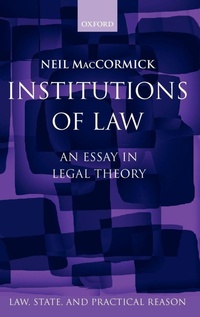
Institutions of Law
An EsSay in Legal Theory
Published on 11. January 2007
Book
Hardback
336 pages
978-0-19-826791-1 (ISBN)
Description
Institutions of Law offers an original account of the nature of law and legal systems in the contemporary world. It provides the definitive statement of Sir Neil MacCormick's well-known 'institutional theory of law', defining law as 'institutional normative order' and explaining each of these three terms in depth. It attempts to fulfil the need for a twenty-first century introduction to legal theory marking a fresh start such as was achieved in the last century by H. L. A. Hart's The Concept of Law.
It is written with a view to elucidating law, legal concepts and legal institutions in a manner that takes account of current scholarly controversies but does not get bogged down in them. It shows how law relates to the state and civil society, establishing the conditions of social peace and a functioning economy. In so doing, it takes account of recent developments in the sociology of law, particularly 'system theory'. It also seeks to clarify the nature of claims to 'knowledge of law' and thus indicate the possibility of legal studies having a genuinely 'scientific' character. It shows that there is an essential value-orientation of all work of this kind, so that valid analytical jurisprudence not merely need not, but cannot, be 'positivist' as that term has come to be understood. Nevertheless it is explained why law and morality are genuinely distinct by virtue of the positive character of law contrasted with the autonomy that is foundational for morality.
It is written with a view to elucidating law, legal concepts and legal institutions in a manner that takes account of current scholarly controversies but does not get bogged down in them. It shows how law relates to the state and civil society, establishing the conditions of social peace and a functioning economy. In so doing, it takes account of recent developments in the sociology of law, particularly 'system theory'. It also seeks to clarify the nature of claims to 'knowledge of law' and thus indicate the possibility of legal studies having a genuinely 'scientific' character. It shows that there is an essential value-orientation of all work of this kind, so that valid analytical jurisprudence not merely need not, but cannot, be 'positivist' as that term has come to be understood. Nevertheless it is explained why law and morality are genuinely distinct by virtue of the positive character of law contrasted with the autonomy that is foundational for morality.
Reviews / Votes
MacCormick's general theory of law finds his most detailed expression in Institutions of Law. This book...is an elucidation of the concept of law as a kind of institutional normative order realised prominently...in the modern state. * Cristobal Orrego, University of the Andes, Chile, Jurisprudence *More details
Series
Language
English
Place of publication
Oxford
United Kingdom
Target group
College/higher education
Professional and scholarly
Dimensions
Height: 240 mm
Width: 161 mm
Thickness: 23 mm
Weight
666 gr
ISBN-13
978-0-19-826791-1 (9780198267911)
Copyright in bibliographic data and cover images is held by Nielsen Book Services Limited or by the publishers or by their respective licensors: all rights reserved.
Schweitzer Classification
Other editions
Additional editions
Book
02/2008
Oxford University Press
€71.80
Shipment within 15-20 days
Person
The late Professor Sir Neil MacCormick was the Leverhulme Personal Research Professor and Regius Professor of Public Law and the Law of Nature and Nations, the University of Edinburgh
Content
Preface ; Acknowledgements ; PART I: NORM, INSTITUTION AND ORDER ; 1. On Normative Order ; 2. On Institutional Order ; 3. Law and the Constitutional State ; 4. A Problem: Rules or Habits? ; PART II: LEGAL POSITIONS AND RELATIONS ; 5. On Persons ; 6. Wrongs and Duties ; 7. Rights and Obligations ; 8. Legal Relations and Things: Property ; 9. Legal Powers and Validity ; PART III: LAW STATE AND CIVIL SOCIETY ; 10. Powers and Public Law: Law and Politics ; 11. Constraints on Power: Fundamental Rights ; 12. Criminal Law and Civil Society: Law and Morality ; 13. Private Law and Civil Society: Law and Economy ; PART IV: LAW, VALUE AND METHOD ; 14. Positive Law and Moral Autonomy ; 15. On Law and Justice ; 16. Laws and Values: Reflections on Method