

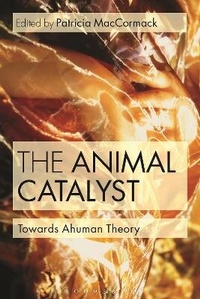
The Animal Catalyst
Towards Ahuman Theory
Published on 19. June 2014
Book
Paperback/Softback
224 pages
978-1-4725-3444-6 (ISBN)
Description
The Animal Catalyst deals with the 'question' of 'what is an animal' and also in some instances, 'what is a human'? It pushes critical animal studies in important new directions; it re-examines basic assumptions, suggests new paradigms for how we can live and function ecologically, in a world that is not simply "ours." It argues that it is not enough to recognise the ethical demands placed upon us by our encounters with animals, or to critique our often murderous treatment of them: this simply reinforces human exceptionalism. Featuring contributions from leading academics, lawyers, artists and activists, the book examines key issues such as:
- How "compassion" for animals reinforces ideas of what distinguishes human beings from other animals.
- How speciesism and human centricity are built into the legal system.
- How individualist subjectivity works in relation to animals who may not think of themselves in the same way.
- How any consideration of animal others must involve a radical deconstruction of our very notion of the "human."
- How art, philosophy and literature can both avoid speciesism and deliver the human from subjectivity.
This volume is a unique project which stands at the cutting edge of both animal rights philosophies and posthuman/artistic/abstract philosophies of identity. It will be of great interest to undergraduates and researchers in philosophy, ethics, particularly continental philosophy, critical theory and cultural studies.
- How "compassion" for animals reinforces ideas of what distinguishes human beings from other animals.
- How speciesism and human centricity are built into the legal system.
- How individualist subjectivity works in relation to animals who may not think of themselves in the same way.
- How any consideration of animal others must involve a radical deconstruction of our very notion of the "human."
- How art, philosophy and literature can both avoid speciesism and deliver the human from subjectivity.
This volume is a unique project which stands at the cutting edge of both animal rights philosophies and posthuman/artistic/abstract philosophies of identity. It will be of great interest to undergraduates and researchers in philosophy, ethics, particularly continental philosophy, critical theory and cultural studies.
Reviews / Votes
How do "we" relate to animals? Treating "them" with respect and granting "them" legal rights just isn't enough. The chapters in this book propose more radical approaches- starting with the rejection of the whole "we vs. them" framework. The Animal Catalyst is an urgent and necessary book, because it tells us that we cannot love and care for others without questioning and undoing ourselves. * Steven Shaviro, DeRoy Professor of English, Wayne State University, USA * The so called "Animal Turn" in the arts and humanities is neither the 'next big thing' nor a flash in the pan: it is here to stay with us and its confluences with posthuman, transhuman, and nonhuman theory will reshape these fields permanently. MacCormack has collected a brilliant selection of essays at the exact point of this conjunction, with original contributions in animal studies, philosophy, film and media theory, cultural studies and queer theory. As MacCormack says, though, The Animal Catalyst belongs to no one discourse, creating a new standard and class of "ahuman" theory that is all its own. * John Mullarkey, Professor of Film and TV, Kingston University, London *More details
Language
English
Place of publication
London
United Kingdom
Publishing group
Bloomsbury Publishing PLC
Target group
College/higher education
Dimensions
Height: 232 mm
Width: 156 mm
Thickness: 16 mm
Weight
400 gr
ISBN-13
978-1-4725-3444-6 (9781472534446)
DOI
CBID182065
Copyright in bibliographic data and cover images is held by Nielsen Book Services Limited or by the publishers or by their respective licensors: all rights reserved.
Schweitzer Classification
Other editions
Additional editions
E-Book
06/2014
1st Edition
Bloomsbury Academic
€36.49
Available for download
E-Book
06/2014
1st Edition
Bloomsbury Academic
€36.49
Available for download
Person
Patricia MacCormack is Reader in English, Communication, Film and Media at Anglia Ruskin University, Cambridge, UK. She is the author of Cinesexuality (2008) and Posthuman Ethics (2012).
Content
Notes on Contributors
Acknowledgements
Introduction, Patricia MacCormack
Part I: New Abolitionist Approaches
1. The War on Compassion, Carol J. Adams
2. Legal Technology Confronts Speciesism or We Have Met the Enemy and He is Us, John T. Maher
3. 'Beyond' the Singular? Ecology, Subjectivity, Politics, Danielle Sands
Part II: Animal Mediators: Philosophy, Film, Literature
4. 'Etre aux aguets': Deleuze, Creation and Territorialization, Charles J. Stivale
5. 'Out of the Labyrinth, into the Metro: Becoming-animal, the Waking Dream and Movements of World in Raymond Queneau and Louis Malle's Zazie dans le metro.', Colin Gardner
6. The Animal That Therefore I Am Not: Inhuman Mediations on the Ultimate Degeneration of Bios and Zoe via the Inevitable Process of Phenomenophagism, Charlie Blake
7. The Taste of Living, Chrysanthi Nigianni
Part III: Ahumanity: A Liberation of Life
8. Suicide for Animals, Claire Colebrook
9. Dark Pedagogy, Jason Wallin
10. Self-Harm, Human Harm?, Ruth McPhee
11. After Life, Patricia MacCormack
Bibliography
Index
Acknowledgements
Introduction, Patricia MacCormack
Part I: New Abolitionist Approaches
1. The War on Compassion, Carol J. Adams
2. Legal Technology Confronts Speciesism or We Have Met the Enemy and He is Us, John T. Maher
3. 'Beyond' the Singular? Ecology, Subjectivity, Politics, Danielle Sands
Part II: Animal Mediators: Philosophy, Film, Literature
4. 'Etre aux aguets': Deleuze, Creation and Territorialization, Charles J. Stivale
5. 'Out of the Labyrinth, into the Metro: Becoming-animal, the Waking Dream and Movements of World in Raymond Queneau and Louis Malle's Zazie dans le metro.', Colin Gardner
6. The Animal That Therefore I Am Not: Inhuman Mediations on the Ultimate Degeneration of Bios and Zoe via the Inevitable Process of Phenomenophagism, Charlie Blake
7. The Taste of Living, Chrysanthi Nigianni
Part III: Ahumanity: A Liberation of Life
8. Suicide for Animals, Claire Colebrook
9. Dark Pedagogy, Jason Wallin
10. Self-Harm, Human Harm?, Ruth McPhee
11. After Life, Patricia MacCormack
Bibliography
Index