

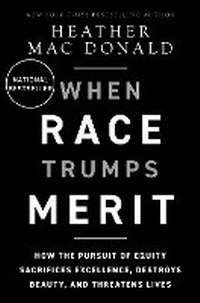
The When Race Trumps Merit
How the Pursuit of Equity Sacrifices Excellence, Destroys Beauty, and Threatens Lives
Published on 1. June 2023
Book
Hardback
320 pages
978-1-956007-16-9 (ISBN)
Description
Does your workplace have too few black people in top jobs? It's racist. Does the advanced math and science high school in your city have too many Asians? It's racist. Does your local museum employ too many white women? It's racist, too.
After the Black Lives Matter protests of 2020, prestigious American institutions, from the medical profession to the fine arts, pleaded guilty to "systemic racism." How else explain why blacks are overrepresented in prisons and underrepresented in C-suites and faculty lounges, their leaders asked?
The official answer for those disparities is "disparate impact," a once obscure legal theory that is now transforming our world. Any traditional standard of behavior or achievement that impedes exact racial proportionality in any enterprise is now presumed racist. Medical school admissions tests, expectations of scientific accomplishment in the award of research grants, the enforcement of the criminal law-all are under assault, because they have a "disparate impact" on underrepresented minorities.
When Race Trumps Merit provides an alternative explanation for those racial disparities. It is large academic skills gaps that cause the lack of proportional representation in our most meritocratic organizations and large differences in criminal offending that account for the racially disproportionate prison population.
The need for such a corrective argument could not be more urgent. Federal science agencies now treat researchers' skin color as a scientific qualification. Museums and orchestras choose which art and music to promote based on race. Police officers avoid making arrests and prosecutors decline to bring charges to avoid disparate impact on minority criminals.
When Race Trumps Merit breaks powerful taboos. But it is driven by a sense of alarm, supported by detailed case studies of how disparate-impact thinking is jeopardizing scientific progress, destroying public order, and poisoning the appreciation of art and culture. As long as alleged racism remains the only allowable explanation for racial differences, we will continue tearing down excellence and putting lives, as well as civilizational achievement, at risk.
After the Black Lives Matter protests of 2020, prestigious American institutions, from the medical profession to the fine arts, pleaded guilty to "systemic racism." How else explain why blacks are overrepresented in prisons and underrepresented in C-suites and faculty lounges, their leaders asked?
The official answer for those disparities is "disparate impact," a once obscure legal theory that is now transforming our world. Any traditional standard of behavior or achievement that impedes exact racial proportionality in any enterprise is now presumed racist. Medical school admissions tests, expectations of scientific accomplishment in the award of research grants, the enforcement of the criminal law-all are under assault, because they have a "disparate impact" on underrepresented minorities.
When Race Trumps Merit provides an alternative explanation for those racial disparities. It is large academic skills gaps that cause the lack of proportional representation in our most meritocratic organizations and large differences in criminal offending that account for the racially disproportionate prison population.
The need for such a corrective argument could not be more urgent. Federal science agencies now treat researchers' skin color as a scientific qualification. Museums and orchestras choose which art and music to promote based on race. Police officers avoid making arrests and prosecutors decline to bring charges to avoid disparate impact on minority criminals.
When Race Trumps Merit breaks powerful taboos. But it is driven by a sense of alarm, supported by detailed case studies of how disparate-impact thinking is jeopardizing scientific progress, destroying public order, and poisoning the appreciation of art and culture. As long as alleged racism remains the only allowable explanation for racial differences, we will continue tearing down excellence and putting lives, as well as civilizational achievement, at risk.
Reviews / Votes
Western institutions that once stood tall have begun to erode under the utter destruction brought on by one word: equity. Heather Mac Donald brilliantly breaks down this regressive equity epidemic in which race overtakes merit. Built on a foundation of pseudo-intellectual drivel, it has infected our justice system, science, medicine, and more.- Ben Shapiro, Host of The Ben Shapiro Show Heather Mac Donald's When Race Trumps Merit is a tour de force that brings to bear the author's prodigious cultural formation, clear prose, and, most important of all, unflinching courage. Mac Donald observes the growing threats to the West, from criminal acts to cultural degradation-burglaries to rewriting Beethoven-and she proposes to excise the pernicious ideology behind these evils at a time when more cowardly commentators dare not even criticize it by name. A book to strengthen both mind and spine.
- Michael Knowles, Host of The Michael Knowles Show Heather Mac Donald has done it again! Her new book, When Race Trumps Merit, is a fact-filled, eloquent, and passionate critique of the drift toward relativism and mediocrity that is being visited upon us by progressive elites in the name of diversity, equity, and inclusion. This is an important, persuasive, and morally righteous jeremiad that deserves to be widely read.
- Glenn C. Loury, Merton P. Stoltz Professor of the Social Sciences at Brown University
More details
Language
English
Place of publication
United States
Product notice
With dust jacket
Dimensions
Height: 228 mm
Width: 152 mm
ISBN-13
978-1-956007-16-9 (9781956007169)
Copyright in bibliographic data and cover images is held by Nielsen Book Services Limited or by the publishers or by their respective licensors: all rights reserved.
Schweitzer Classification
Person
Heather Mac Donald is the Thomas W. Smith Fellow at the Manhattan Institute, a contributing editor at City Journal, and the 2005 recipient of the Bradley Prize. Mac Donald received a BA from Yale University, an MA from Cambridge University, and a JD from Stanford University. Her work has covered a range of topics, from higher education and immigration to policing and race relations. Mac Donald's writing has appeared in publications such as the Wall Street Journal, Washington Post, and New York Times. She is the author of several critically acclaimed books, including The Diversity Delusion and the New York Times bestseller The War on Cops.
Content
INTRODUCTION: A Cultural Revolution
OVERVIEW: The Bias Fallacy
PART I: SCIENCE AND MEDICINE
CHAPTER ONE: Medicine's Racial Reckoning
CHAPTER TWO: How 'Diversity' Subverts Science
PART II: CULTURE AND ARTS
CHAPTER THREE: The Crusade Against Classical Music
CHAPTER FOUR: Scapegoats and the Rise of Mediocrity
CHAPTER FIVE: Making Beethoven Woke
CHAPTER SIX: Can Opera Survive the Culture Wars?
CHAPTER SEVEN: The Revolution Comes to Juilliard
CHAPTER EIGHT: The Swamping of Swan Lake
CHAPTER NINE: The Demise of the Docent
CHAPTER TEN: Museums Apologize for Art
CHAPTER ELEVEN: An Art Museum Cancels Art
CHAPTER TWELVE: Abstainers
PART III: LAW AND ORDER
CHAPTER THIRTEEN: A New Crime Wave
CHAPTER FOURTEEN: The Road to Anarchy
CHAPTER FIFTEEN: On Double Standards
CHAPTER SIXTEEN: A Grim-and Ignored-Body Count
CHAPTER SEVENTEEN: Mass Shootings, Hate Crimes, and Race
CHAPTER EIGHTEEN: The Chauvin Trial and Its Aftermath
CONCLUSION: Saving Meritocracy, Saving a Civilization
OVERVIEW: The Bias Fallacy
PART I: SCIENCE AND MEDICINE
CHAPTER ONE: Medicine's Racial Reckoning
CHAPTER TWO: How 'Diversity' Subverts Science
PART II: CULTURE AND ARTS
CHAPTER THREE: The Crusade Against Classical Music
CHAPTER FOUR: Scapegoats and the Rise of Mediocrity
CHAPTER FIVE: Making Beethoven Woke
CHAPTER SIX: Can Opera Survive the Culture Wars?
CHAPTER SEVEN: The Revolution Comes to Juilliard
CHAPTER EIGHT: The Swamping of Swan Lake
CHAPTER NINE: The Demise of the Docent
CHAPTER TEN: Museums Apologize for Art
CHAPTER ELEVEN: An Art Museum Cancels Art
CHAPTER TWELVE: Abstainers
PART III: LAW AND ORDER
CHAPTER THIRTEEN: A New Crime Wave
CHAPTER FOURTEEN: The Road to Anarchy
CHAPTER FIFTEEN: On Double Standards
CHAPTER SIXTEEN: A Grim-and Ignored-Body Count
CHAPTER SEVENTEEN: Mass Shootings, Hate Crimes, and Race
CHAPTER EIGHTEEN: The Chauvin Trial and Its Aftermath
CONCLUSION: Saving Meritocracy, Saving a Civilization