

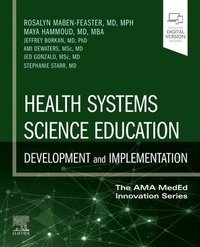
Health Systems Science Education: Development and Implementation: Volume 4
Volume 4
Published on 22. February 2023
Book
Paperback/Softback
180 pages
978-0-443-11096-2 (ISBN)
Description
Now taught in a majority of medical schools nationwide, health systems science (HSS) prepares learners for the health systems of the future-an essential topic in modern health care. Health Systems Science Education, part of the American Medical Association's MedEd Innovation Series, is a first-of-its-kind, instructor-focused field book that that equips educators to not just teach health systems science, but to know how to integrate and implement HSS comprehensively and effectively across the curriculum. This change management-oriented volume.
Provides practical approaches and addresses common challenges to successfully implementing health systems science
Considers both clinical and classroom settings and discusses best practices, successful cases, and common frameworks implemented by early adopters of the third pillar of medical education
Contains clear lists of competencies
Covers both medical school (UME) and residency program (GME) implementation strategies
Offers a framework for creating an environment of continuous improvement-from pre-implementation to sustainability
One of the American Medical Association's Change MedEd initiatives and innovations, written and edited by members of the Accelerating Change in Medical Education Consortium - a unique, innovative collaborative that allows for the sharing and dissemination of groundbreaking ideas and projects
Enhanced eBook version included with purchase. Your enhanced eBook allows you to access all of the text, figures, and references from the book on a variety of devices.
Provides practical approaches and addresses common challenges to successfully implementing health systems science
Considers both clinical and classroom settings and discusses best practices, successful cases, and common frameworks implemented by early adopters of the third pillar of medical education
Contains clear lists of competencies
Covers both medical school (UME) and residency program (GME) implementation strategies
Offers a framework for creating an environment of continuous improvement-from pre-implementation to sustainability
One of the American Medical Association's Change MedEd initiatives and innovations, written and edited by members of the Accelerating Change in Medical Education Consortium - a unique, innovative collaborative that allows for the sharing and dissemination of groundbreaking ideas and projects
Enhanced eBook version included with purchase. Your enhanced eBook allows you to access all of the text, figures, and references from the book on a variety of devices.
More details
Series
Language
English
Place of publication
London
United Kingdom
Publishing group
Elsevier Health Sciences
Target group
Professional and scholarly
Product notice
Paperback (trade)
Unsewn / adhesive bound
Dimensions
Height: 241 mm
Width: 192 mm
Thickness: 11 mm
Weight
290 gr
ISBN-13
978-0-443-11096-2 (9780443110962)
Copyright in bibliographic data and cover images is held by Nielsen Book Services Limited or by the publishers or by their respective licensors: all rights reserved.
Schweitzer Classification
Persons
Maya Hammoud, MD, MBA, is Professor of Obstetrics and Gynecology, Professor of Medical Education at the University of Michigan Medical School, and the AMA's special adviser on medical education innovation. She is a fellow ACOG and past president of the Association of Professors of Gynecology and Obstetrics (APGO). Dr. Jed Gonzalo is Assistant Professor of Medicine and Public Health Sciences and Associate Dean for Health Systems Education. He oversees the design of curricula related to the emerging field of health systems science, which prepares physicians for evolving health systems. Gonzalo is funded by the AMA "Accelerating Change in Medical Education? initiative, has 39 peer-reviewed publications related to medical education and clinical research, and is one of the authors our AMA Health Systems Science text. In his first five years as a member of the Penn State faculty, Gonzalo has been awarded seven education awards. He also won the National Society of General Internal Medicine Scholarship in Medical Education Award in 2016.
Editor
Clinical Assistant Professor, Dept of Obstetrics and Gynecology, University of Michigan
Professor, Obstetrics and Gynecology, University of Michigan, Ann Arbor, Michigan, USA
Assistant Dean for Primary Care-Population Health Faculty, Bio Med Family Medicine, Brown University, Providence, Rhode Island
Hospitalist, Internal Medicine, Penn State Medical Center, Hershey, Pennsylvania
Medical Student and Resident Education, Mayo Clinic, Rochester, Minnesota
Content
1. Getting Started: General Considerations for Health Systems Science Implementation
2. Health Systems Science Competencies in Medical Education
3. Health Systems Science Implementation in Pre-clerkship Curricula
4. Health Systems Science Implementation in the Clinical Learning Environment: Undergraduate Medical Education
5. Health Systems Science Implementation in Graduate Medical Education
6. The Role of Interprofessional Education and Collaborative Practice in Health Systems Science Curricula
7. Sustainability in a Health Systems Science Program: Assessment, Evaluation, and Continuous Improvement
2. Health Systems Science Competencies in Medical Education
3. Health Systems Science Implementation in Pre-clerkship Curricula
4. Health Systems Science Implementation in the Clinical Learning Environment: Undergraduate Medical Education
5. Health Systems Science Implementation in Graduate Medical Education
6. The Role of Interprofessional Education and Collaborative Practice in Health Systems Science Curricula
7. Sustainability in a Health Systems Science Program: Assessment, Evaluation, and Continuous Improvement