

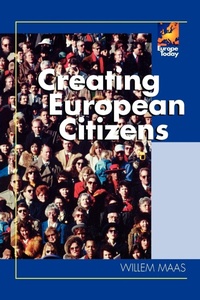
Creating European Citizens
Published on 1. February 2007
Book
Paperback/Softback
190 pages
978-0-7425-5486-3 (ISBN)
Description
Exploring a key aspect of European integration, this clear and thoughtful book considers the remarkable experiment with common rights and citizenship in the EU. Governments around the world traditionally distinguish insiders (citizens) from outsiders (foreigners). Yet over the past half-century, an extensive set of supranational rights has been created in Europe that removes member governments' authority to privilege their own citizens, a hallmark of sovereignty. The culmination of supranational rights, European citizenship not only provides individuals with choices about where to live and work but also forces governments to respect those choices. Explaining this innovation-why states cede their sovereignty and eradicate or redefine the boundaries of the political community by including "foreigners"-Willem Maas analyzes the development of European citizenship within the larger context of the evolution of rights. Imagining more than simply a free trade market, the goal of building a "broader and deeper community among peoples" with a "destiny henceforward shared"-creating European citizens-has informed European integration since its origins. The author argues that its success or failure will not only determine the future of Europe but will also provide lessons for political integration elsewhere.
Reviews / Votes
Skillfully guiding the reader through a complex history, the author illustrates how the EU has multiplied the sources of rights and political identity available to individuals, thereby challenging orthodox notions of citizenship based on a mutually exclusive set of relations between state and citizen. . . . An important contribution towards understanding the contemporary condition of, and future challenges to, the European polity. * Perspectives on Politics * Maas has written an excellent analysis and review of the evolution of European citizenship thus far. It is a welcome addition to EU literature and recommended for political scientists, historians, and scholars of the EU. The book is clearly written with extensive footnotes and references that are especially useful and valuable. There are meticulous details of negotiations and contentious debates among member states and EU institutions that bring a deeper understanding of EU workings behind closed doors. . . . Highly recommended. * Choice Reviews * In this short but very detailed work, Willem Maas seeks to outline the history of citizenship as it applies to the European Union and its antecedent organizations. The focus is both on 'the "high politics" of intergovernmental conferences'-and their behind-the-scenes compromises-and 'the "low politics" of interpretation by the Court and implementation by the Commission.' Developments in both of these areas are clearly outlined and analyzed. . . . What comes through in Maas's work is the sense that European Union citizenship is a clear illustration of both the achievements and limitations of European integration. * Canadian Journal of Political Science * Rather than focusing narrowly on the economic ramifications of integration, the author explores the drive to create a wider community of people. . . . Well written, with the argument set out in a chronological and straightforward fashion. . . . This book will appeal to theorists and practitioners alike, as well as undergraduates and those with a more specialist interest in issues of integration, citizenship, and nationalism. * Political Studies Review * Maas's book provides a clear description and thoughtful analysis of the history of European citizenship from the Treaties of Paris and Rome in the 1950s until the present phase of European integration marked by the debate on the EU constitution. An examination of the rise of European citizenship enables a better understanding of the political nature of the European project. Contrary to the majority of works on European integration. . . . Maas argues that European political development is a manifestation of the drive to create not only a free trade zone but also a community of people. * Journal of Common Market Studies * [The book] has many strengths. . . . The organization of the book is masterly. All these issues are woven together in a mere 120 pages of text in such a way that none of their complexity is lost, while, at the same time, the book could easily be read by an interested member of the public as well as the student or scholar. -- Elizabeth Meehan * Race Relations Abstracts * Willem Maas's study is a definitive political history of European citizenship rights and the free movement of persons, from the Treaties of Paris and Rome in the 1950s to the struggles over the EU constitution. It combines careful empirical documentation with incisive political theory, on a subject insufficiently studied by mainstream political science. While offering an upbeat account of the steady expansion and deepening of the remarkable legal construction of European citizenship, he wisely reminds us of its limitations and reversibility. -- Adrian Favell, Centre d'etudes europeennes de Sciences PoMore details
Series
Language
English
Place of publication
United States
Publishing group
Bloomsbury Publishing Plc
Target group
US School Grade: From College Freshman to College Graduate Student
Dimensions
Height: 229 mm
Width: 152 mm
Thickness: 10 mm
Weight
284 gr
ISBN-13
978-0-7425-5486-3 (9780742554863)
Copyright in bibliographic data and cover images is held by Nielsen Book Services Limited or by the publishers or by their respective licensors: all rights reserved.
Schweitzer Classification
Other editions
Additional editions
Willem Maas
Creating European Citizens
E-Book
02/2007
1st Edition
Rowman & Littlefield Publishers
€38.49
Available for download
Person
Willem Maas is Jean Monnet Chair in European Integration and associate professor of political science at Glendon College, York University, Toronto.
Content
Introduction
Chapter 1: Introducing European Rights
Chapter 2: From Rights to Citizenship
Chapter 3: Maastricht's Constitutional Moment
Chapter 4: Europe's Homogeneous Space
Chapter 5: Toward a Constitution
Chapter 6: The Limits of European Citizenship
Conclusion
Selected Bibliography
Chapter 1: Introducing European Rights
Chapter 2: From Rights to Citizenship
Chapter 3: Maastricht's Constitutional Moment
Chapter 4: Europe's Homogeneous Space
Chapter 5: Toward a Constitution
Chapter 6: The Limits of European Citizenship
Conclusion
Selected Bibliography