

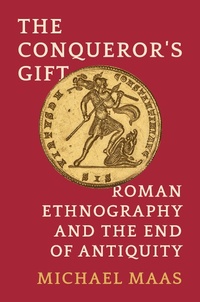
The Conqueror's Gift
Roman Ethnography and the End of Antiquity
Published on 25. February 2025
Book
Hardback
456 pages
978-0-691-25902-4 (ISBN)
Description
The essential role of ethnographic thought in the Roman empire and how it evolved in Late Antiquity
Ethnography is indispensable for every empire, as important as armies, tax collectors, or ambassadors. It helps rulers articulate cultural differences, and it lets the inhabitants of the empire, especially those who guide its course, understand themselves in the midst of enemies, allies, and friends. In The Conqueror's Gift, Michael Maas examines the ethnographic infrastructure of the Roman Empire and the transformation of Rome's ethnographic vision during Late Antiquity. Drawing on a wide range of texts, Maas shows how the Romans' ethnographic thought evolved as they attended to the business of ruling an empire on three continents.
Ethnography, the "conqueror's gift," gave Romans structured ways of finding a place for foreigners in the imperial worldview and helped justify imperial action affecting them. In Late Antiquity, Christianity revolutionized the imperial ethnographic infrastructure by altering old concepts and introducing credal models of community. The Bible became a source for organizing the Roman world. At the same time, many previously unseen collective identities emerged across Western Eurasia in reaction to the diminution of Roman power. These changes deeply affected the Empire's ethnographic infrastructure and vision of the world. Maas argues that a major consequence of these developments was the beginning of a sectarian age, as individuals and political communities came to identify themselves primarily in terms of religion as well as ethnicity. As they adjusted to changing ethnographic realities, Romans understood their place among the peoples of the world in new ways. Willingly or not, we continue to be recipients of the conqueror's gift today.
Ethnography is indispensable for every empire, as important as armies, tax collectors, or ambassadors. It helps rulers articulate cultural differences, and it lets the inhabitants of the empire, especially those who guide its course, understand themselves in the midst of enemies, allies, and friends. In The Conqueror's Gift, Michael Maas examines the ethnographic infrastructure of the Roman Empire and the transformation of Rome's ethnographic vision during Late Antiquity. Drawing on a wide range of texts, Maas shows how the Romans' ethnographic thought evolved as they attended to the business of ruling an empire on three continents.
Ethnography, the "conqueror's gift," gave Romans structured ways of finding a place for foreigners in the imperial worldview and helped justify imperial action affecting them. In Late Antiquity, Christianity revolutionized the imperial ethnographic infrastructure by altering old concepts and introducing credal models of community. The Bible became a source for organizing the Roman world. At the same time, many previously unseen collective identities emerged across Western Eurasia in reaction to the diminution of Roman power. These changes deeply affected the Empire's ethnographic infrastructure and vision of the world. Maas argues that a major consequence of these developments was the beginning of a sectarian age, as individuals and political communities came to identify themselves primarily in terms of religion as well as ethnicity. As they adjusted to changing ethnographic realities, Romans understood their place among the peoples of the world in new ways. Willingly or not, we continue to be recipients of the conqueror's gift today.
Reviews / Votes
"A landmark study that synthesizes a vast array of data, this study reveals clearly for the first time details of how the Roman Empire (both East and West) engaged with foreign peoples. The processes of assimilation, exclusion, war and peace, astral and environmental determinism all have resonance with how our world of the 21 century is being shaped. This is a book for their time, for our time, for all time."---Cliff Cunningham, Sun News Austin "Michael Maas's thought-provoking study The Conqueror's Gift surveys the different structures by which the human population of the world was conceptualized and ordered in late antiquity. . . . [It] does an excellent job of highlighting the very different sections of 'the ethnographic dossier', and in showing how contrasting models of conceptualizing the world became operative throughout late antiquity."---Andy Merrills, Bryn Mawr Classical Review "An important contribution to scholarship on late antiquity." * Choice * "Ambitious and elegantly written. . . . Maas works masterfully across scholarly siloes that have so often distorted understandings of the history of ethnicity: Greek and Latin, East and West, 'pagan' and Christian, 'ancient' and 'medieval'. In this respect, his book deserves to be placed alongside some of the best works that have emerged from the late antique historiographic project."---John Merrington, The Journal of Ecclesiastical HistoryMore details
Language
English
Place of publication
New Jersey
United States
Target group
College/higher education
Product notice
Trade binding
Illustrations
6 b/w illus. 3 maps.
Dimensions
Height: 237 mm
Width: 166 mm
Thickness: 39 mm
Weight
822 gr
ISBN-13
978-0-691-25902-4 (9780691259024)
Copyright in bibliographic data and cover images is held by Nielsen Book Services Limited or by the publishers or by their respective licensors: all rights reserved.
Schweitzer Classification
Other editions
Additional editions
E-Book
02/2025
1st Edition
Princeton University Press
€48.99
Available for download
Person
Michael Maas is the William Gaines Twyman Professor of History at Rice University. His most recent book, Empires and Exchanges in Eurasian Late Antiquity: Rome, China, Iran, and the Steppe, ca. 250-750, edited with Nicola Di Cosmo, won a CHOICE Academic Book of the Year Award.