

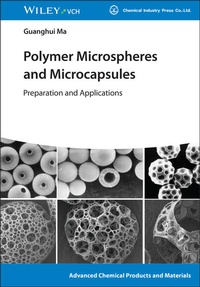
Polymer Microspheres and Microcapsules
Preparation and Applications
1st Edition
Will be published approx. on 14. October 2026
Book
Hardback
384 pages
978-3-527-35349-1 (ISBN)
Description
Enables readers to develop more efficient polymer microspheres and capsules
Polymer Microspheres and Microcapsules provides comprehensive insights on microspheres, their production, and a broad range of applications in areas like biopharmaceutical and biomedical engineering, consumer home and personal care products, heat storage, sensors, drug delivery, and electron information. The book not only includes the advancement in biotechnology applications, but also includes preparation methods, principles, and technologies from monomer and preformed polymer systems. Examples of key concepts are included throughout along with the latest state-of-the-art research in the field.
Polymer Microspheres and Microcapsules includes information on:
* Important characteristics of microspheres, such as size (diameter) and size distribution and how to measure these two characteristics through laser particles and static/dynamic light scattering
* Existing challenges in the field, including preparation and manufacturing with smaller particle sizes (tens of nanometers) and lack of biodegradable materials approved for injection
* Hollow microcapsules as a micro-reservoir for energy storage, where the energy storage material is encapsulated in a microcapsule
* Preparation of polymer microspheres and microcapsules from preformed polymers, covering morphology control, the emulsification-solidification method, and the single and complex coacervation methods
Polymer Microspheres and Microcapsules serves as an excellent resource for undergraduate and graduate students in chemistry, chemical engineering, biology, pharmaceutics and medicines, polymer materials, electronic information, and other related majors. The book is also valuable as a reference for researchers and technicians in related fields.
Polymer Microspheres and Microcapsules provides comprehensive insights on microspheres, their production, and a broad range of applications in areas like biopharmaceutical and biomedical engineering, consumer home and personal care products, heat storage, sensors, drug delivery, and electron information. The book not only includes the advancement in biotechnology applications, but also includes preparation methods, principles, and technologies from monomer and preformed polymer systems. Examples of key concepts are included throughout along with the latest state-of-the-art research in the field.
Polymer Microspheres and Microcapsules includes information on:
* Important characteristics of microspheres, such as size (diameter) and size distribution and how to measure these two characteristics through laser particles and static/dynamic light scattering
* Existing challenges in the field, including preparation and manufacturing with smaller particle sizes (tens of nanometers) and lack of biodegradable materials approved for injection
* Hollow microcapsules as a micro-reservoir for energy storage, where the energy storage material is encapsulated in a microcapsule
* Preparation of polymer microspheres and microcapsules from preformed polymers, covering morphology control, the emulsification-solidification method, and the single and complex coacervation methods
Polymer Microspheres and Microcapsules serves as an excellent resource for undergraduate and graduate students in chemistry, chemical engineering, biology, pharmaceutics and medicines, polymer materials, electronic information, and other related majors. The book is also valuable as a reference for researchers and technicians in related fields.
More details
Series
Edition
1. Auflage
Language
English
Place of publication
Berlin
Germany
Target group
Professional and scholarly
College/higher education
Illustrations
150
100 s/w Abbildungen, 50 farbige Abbildungen
100 schwarz-weiße und 50 farbige Abbildungen
Dimensions
Height: 244 mm
Width: 170 mm
ISBN-13
978-3-527-35349-1 (9783527353491)
Schweitzer Classification
Person
Prof. Ma Guanghui is Director of State Key Laboratory of Biochemical Engineering, Institute of Process Engineering, Chinese Academy of Sciences (CAS). Having obtained her Ph.D degree from Tokyo Institute of Technology (Japan), she started her academic career at Tokyo University of Agriculture and Technology as an assistant professor (1994). She moved to Institute of Process Engineering, CAS as a full professor in 2001. She is one of the earliest women scientists who have won the China National Science Fund for Distinguished Young Scholars in Chemical Engineering. She has received Outstanding Contribution Award from Federation of Biotechnology (AFOB), the First Prize of Beijing Science and Technology Award, and the Second Prize of National Technological Invention Award, TWAS-TWOWS-SCOUPS Regional Young Women Researcher Award. She is elected as a member of Chinese Academy of Sciences, and a fellow of AIMBE (American Institute for Medical and Biological Engineering).
Content
CHAPTER 1 INTRODUCTION
1.1 Introduction of Polymer Microspheres and Microcapsules
1.2 Preparation Technology of Polymer Microspheres and Microcapsules
1.3 Application of Polymer Microspheres and Microcapsules
1.4 Summary and Prospects
References
CHAPTER 2 PREPARATION OF POLYMER MICROSPHERES FROM MONOMERS
2.1 Emulsion Polymerization vs Suspension Polymerization
2.2 Soap-free Emulsion Polymerization vs Emulsion Polymerization
2.3 Dispersion/Precipitation Polymerization vs Soap-free Emulsion Polymerization
2.4 Mini-emulsion Polymerization vs Suspension Polymerization
2.5 Microemulsion Polymerization vs Emulsion Polymerization
2.6 Seeded Polymerization
2.7 New Technique ? Porous Membrane Emulsion Technique for Preparation of Uniform Microspheres
2.8 New Technology - Microfluidic Technology for Preparation of Uniform Microspheres
2.9 Morphology Control and Preparation of Composite Microspheres
2.10 Summary and Prospect
References
CHAPTER 3 PREPARATION OF POLYMER MICROSPHERES AND MICROCAPSULES FROM PREFORMED POLYMERS
3.1 Emulsification-solidification Method
3.2 Membrane Emulsification Technique to Prepare Uniform Microspheres
3.3 Single Coacervation Method
3.4 Complex Coacervation Method
3.5 Self-emulsification-solidification Method
3.6 Morphology Control of Polymer Microspheres
3.7 Summary and Prospects
References
CHAPTER 4 APPLICATION OF MICROSPHERES AND MICROCAPSULES IN BIOREACTION ENGINEERING
4.1 Application of Microspheres and Microcapsules in Cell Culture
4.2 Applications of Microspheres and Microcapsules in Tissue Engineering and Stem Cell Culture
4.3 Application of Microspheres and Microcapsules in Enzyme Immobilization
4.4 Summary and Prospect
Reference
CHAPTER 5 APPLICATIONS OF POLYMER MICROSPHERES AND MICROCAPSULES IN BIOSEPARATION ENGINEERING
5.1 Introduction
5.2 Overview of Polymer Microspheres for Chromatography Media
5.3 Main Types and Characteristics of Chromatography Media
5.4 High-throughput Chromatography Based on High-performance Chromatography Media
5.5 Applications of Polymer Microspheres in Purification of Biomacromolecules
5.6 Applications of Polymer Microspheres in Purification of Peptides and Natural Products
5.7 Protein Refolding by On-column Chromatography
5.8 New Separation Technologies Based on Polymer Microspheres
5.9 Summary and Outlook
References
CHAPTER 6 APPLICATIONS OF POLYMER MICROSPHERES AND MICROCAPSULES IN PHARMACEUTICAL FORMULATION ENGINEERING
6.1 Application of Polymer Microspheres and Microcapsules in Sustained-release Systems
6.2 Preparation Strategies of Polymer Microspheres and Microcapsules for Sustained-release Formulations
6.3 Exploration of Polymer Micro/nano Particles (MPs/NPs) in Vaccine Formulations
6.4 Exploration of Polymer MPs/NPs in Antitumor Drug Delivery
6.5 Summary and Prospects
References
CHAPTER 7 APPLICATION OF POLYMER MICROSPHERES AND MICROCAPSULES IN DETECTION REAGENTS
7.1 Advancements in Biological Imaging through Polymer Microspheres and Microcapsules
7.2 The Application of Polymer Microspheres and Microcapsules in Biomedical Detection
7.3 Other Applications of Polymer Microspheres and Microcapsules in Detection
7.4 Summary and Outlook
Reference
CHAPTER 8 APPLICATION OF POLYMER MICROSPHERES AND MICROCAPSULES IN ELECTRONIC INFORMATION
8.1 Introduction
8.2 Development of polymer microcapsules in display devices
8.3 Applications of microspheres and microcapsules in sensors
8.4 Research progress of microspheres and microcapsules in electrical conductivity
8.5 Self-repair materials and technology of polymer microcapsules
8.6 Application of microspheres and microcapsules in graphic communication fields
8.7 Summary and prospects
References
CHAPTER 9 APPLICATION OF POLYMER MICROCAPSULES IN THERMAL STORAGE
9.1 Introduction
9.2 Preparation Technology of Polymer Thermal Storage Microcapsules
9.3 Application of Polymer Thermal Storage Microcapsules in the Green Building Field
9.4 Application of Polymer Heat Storage Microcapsules in Textile
9.5 Application of Polymer Heat Storage Microcapsules in Functional Fluids
9.6 Summary and Outlook
References
CHAPTER 10 APPLICATION OF POLYMER MICROSPHERES AND MICROCAPSULES IN DAILY CHEMICAL PRODUCTS
10.1 Preparation Technology for Microspheres and Microcapsules used in Daily Chemicals
10. 2 Characterization of Mechanical Properties of Microspheres and Microcapsules
10.3 Application of Microcapsules in Daily Chemical Products
10.4 Summary and Prospects
References
1.1 Introduction of Polymer Microspheres and Microcapsules
1.2 Preparation Technology of Polymer Microspheres and Microcapsules
1.3 Application of Polymer Microspheres and Microcapsules
1.4 Summary and Prospects
References
CHAPTER 2 PREPARATION OF POLYMER MICROSPHERES FROM MONOMERS
2.1 Emulsion Polymerization vs Suspension Polymerization
2.2 Soap-free Emulsion Polymerization vs Emulsion Polymerization
2.3 Dispersion/Precipitation Polymerization vs Soap-free Emulsion Polymerization
2.4 Mini-emulsion Polymerization vs Suspension Polymerization
2.5 Microemulsion Polymerization vs Emulsion Polymerization
2.6 Seeded Polymerization
2.7 New Technique ? Porous Membrane Emulsion Technique for Preparation of Uniform Microspheres
2.8 New Technology - Microfluidic Technology for Preparation of Uniform Microspheres
2.9 Morphology Control and Preparation of Composite Microspheres
2.10 Summary and Prospect
References
CHAPTER 3 PREPARATION OF POLYMER MICROSPHERES AND MICROCAPSULES FROM PREFORMED POLYMERS
3.1 Emulsification-solidification Method
3.2 Membrane Emulsification Technique to Prepare Uniform Microspheres
3.3 Single Coacervation Method
3.4 Complex Coacervation Method
3.5 Self-emulsification-solidification Method
3.6 Morphology Control of Polymer Microspheres
3.7 Summary and Prospects
References
CHAPTER 4 APPLICATION OF MICROSPHERES AND MICROCAPSULES IN BIOREACTION ENGINEERING
4.1 Application of Microspheres and Microcapsules in Cell Culture
4.2 Applications of Microspheres and Microcapsules in Tissue Engineering and Stem Cell Culture
4.3 Application of Microspheres and Microcapsules in Enzyme Immobilization
4.4 Summary and Prospect
Reference
CHAPTER 5 APPLICATIONS OF POLYMER MICROSPHERES AND MICROCAPSULES IN BIOSEPARATION ENGINEERING
5.1 Introduction
5.2 Overview of Polymer Microspheres for Chromatography Media
5.3 Main Types and Characteristics of Chromatography Media
5.4 High-throughput Chromatography Based on High-performance Chromatography Media
5.5 Applications of Polymer Microspheres in Purification of Biomacromolecules
5.6 Applications of Polymer Microspheres in Purification of Peptides and Natural Products
5.7 Protein Refolding by On-column Chromatography
5.8 New Separation Technologies Based on Polymer Microspheres
5.9 Summary and Outlook
References
CHAPTER 6 APPLICATIONS OF POLYMER MICROSPHERES AND MICROCAPSULES IN PHARMACEUTICAL FORMULATION ENGINEERING
6.1 Application of Polymer Microspheres and Microcapsules in Sustained-release Systems
6.2 Preparation Strategies of Polymer Microspheres and Microcapsules for Sustained-release Formulations
6.3 Exploration of Polymer Micro/nano Particles (MPs/NPs) in Vaccine Formulations
6.4 Exploration of Polymer MPs/NPs in Antitumor Drug Delivery
6.5 Summary and Prospects
References
CHAPTER 7 APPLICATION OF POLYMER MICROSPHERES AND MICROCAPSULES IN DETECTION REAGENTS
7.1 Advancements in Biological Imaging through Polymer Microspheres and Microcapsules
7.2 The Application of Polymer Microspheres and Microcapsules in Biomedical Detection
7.3 Other Applications of Polymer Microspheres and Microcapsules in Detection
7.4 Summary and Outlook
Reference
CHAPTER 8 APPLICATION OF POLYMER MICROSPHERES AND MICROCAPSULES IN ELECTRONIC INFORMATION
8.1 Introduction
8.2 Development of polymer microcapsules in display devices
8.3 Applications of microspheres and microcapsules in sensors
8.4 Research progress of microspheres and microcapsules in electrical conductivity
8.5 Self-repair materials and technology of polymer microcapsules
8.6 Application of microspheres and microcapsules in graphic communication fields
8.7 Summary and prospects
References
CHAPTER 9 APPLICATION OF POLYMER MICROCAPSULES IN THERMAL STORAGE
9.1 Introduction
9.2 Preparation Technology of Polymer Thermal Storage Microcapsules
9.3 Application of Polymer Thermal Storage Microcapsules in the Green Building Field
9.4 Application of Polymer Heat Storage Microcapsules in Textile
9.5 Application of Polymer Heat Storage Microcapsules in Functional Fluids
9.6 Summary and Outlook
References
CHAPTER 10 APPLICATION OF POLYMER MICROSPHERES AND MICROCAPSULES IN DAILY CHEMICAL PRODUCTS
10.1 Preparation Technology for Microspheres and Microcapsules used in Daily Chemicals
10. 2 Characterization of Mechanical Properties of Microspheres and Microcapsules
10.3 Application of Microcapsules in Daily Chemical Products
10.4 Summary and Prospects
References