

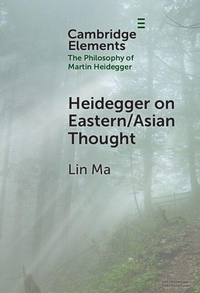
Heidegger on Eastern/Asian Thought
Published on 24. October 2024
Book
Hardback
92 pages
978-1-009-53673-8 (ISBN)
Description
This Element elucidates the metamorphoses of Heidegger's comportment toward Eastern/Asian thought from the 1910s to the 1960s. With a view to the many meanings of the East at play in Heidegger's thinking, it considers how his diversified 'dialogues' with the East are embedded in different phases of his Denkweg. Various themes unexplored previously are examined: Heidegger's early treatment of near Eastern traditions and Islamic philosophy, his views on alien cultures, the 'primitive Dasein' and the 'mythical Dasein,' and his meditation on Russianism's deeply rooted spirituality and its recuperative possibilities for the West. Finally, this Element reveals how Heidegger opened the promise of a dialogue with the East and yet stepped back from the threshold, and how his move from the Occidental line of philosophizing toward the Oriental line is integral to his shift from the guiding question of "Being" to the abyssal question of 'Beyng.'
More details
Series
Language
English
Place of publication
Cambridge
United Kingdom
Illustrations
Worked examples or Exercises
Dimensions
Height: 235 mm
Width: 157 mm
Thickness: 10 mm
Weight
297 gr
ISBN-13
978-1-009-53673-8 (9781009536738)
Copyright in bibliographic data and cover images is held by Nielsen Book Services Limited or by the publishers or by their respective licensors: all rights reserved.
Schweitzer Classification
Other editions
Additional editions
Book
10/2024
Cambridge University Press
€26.80
Shipment within 15-20 days
E-Book
06/2024
Cambridge University Press
€20.99
Available for download
E-Book
05/2024
Cambridge University Press
€20.99
Available for download
Person
Content
Introduction; 1. Near Eastern Traditions and Islamic Philosophy; 2. The Alien Cultures, Primitive Dasein, and Mythical Dasein; 3. The Early Greeks and the Duplicity of the Asiatic; 4. The Russian 'East' from out of the History of Beyng; 5. Appropriation of the Zhuangzi in the 1940s; 6. A Different Configuration of the Confrontation/Engagement with the Asiatic/Asia; Conclusion; Note on Referencing; References.