

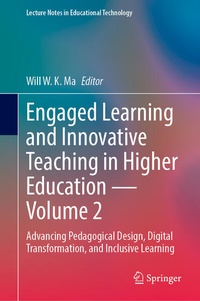
Engaged Learning and Innovative Teaching in Higher Education - Volume 2
Description
This book is the second of two volumes, and draws together urgent themes in pedagogical innovation, digital transformation, and diversity, contributing to the ongoing evolution of higher education. Grounded in the realities of contemporary education systems, this book offers a sweeping yet focused examination of how higher education institutions worldwide are responding to the challenges of a dynamic knowledge economy, rapid technological advances, and the imperatives of inclusion and multicultural understanding. At its core, this book integrates curriculum design, technology-enhanced learning, and the cultivation of diverse, inclusive academic environments.
The principal benefit for readers is the book's synthesis of empirical evidence, innovative pedagogy, and pragmatic solutions. Educators will find tested models and strategies for enhancing curriculum and supporting diverse learners. Researchers are offered robust frameworks and comparative studies for further inquiry, while policymakers will gain evidence-based recommendations for supporting technology integration, multicultural engagement, and sustainable development. Above all, this book provides students, practitioners, and institutional leaders with a roadmap for cultivating excellence, resilience, and ethical readiness in the face of rapid changes.
Readers who wish to learn more about this topic can refer to 'Engaged Learning and Innovative Teaching in Higher Education, Volume 1: Connecting Professional Development, AI-Driven Innovation, and Academic Experience'.
More details
Person
Professor Will Ma is currently Professor of Teaching and Learning at the School of Arts and Humanities, and the Director of the Centre for Innovative Teaching and Learning (CITL) at Tung Wah College, Hong Kong. He has more than 20 years of expertise in higher education, including teaching, administration, and research. Professor Ma's research focuses on communication, information systems adoption, education technology, knowledge sharing, and knowledge creation. He has publications in international refereed journals, such as Computers and Human Behavior , Computers & Education , Journal of Computer Assisted Learning , Asia Pacific Journal of Teacher Education , Journal of Technology and Teacher Education , International Journal of Communication , Law and Policy , Knowledge Management & E-Learning , and Information & Management . Professor Ma participated in and organised international conferences in technology and learning, such as the International Conference on Applied Education, Technology and Innovation (AETI); Hong Kong Association for Educational Communications and Technology (HKAECT) International Conference; and International Conference on Blended Learning (ICBL). He is the series editor of the Educational, Communication and Technology Yearbook series, published by Springer, and is also an active independent reviewer for international refereed journals. As one of the top 1% of Social Science peer reviewers, he was recognised with the Publons Peer Review Awards 2017.
Content
Chapter 01. Emerging Trends and Perspectives on Pedagogical Design, Digital Transformation, and Inclusive Learning.- Part I. Pedagogies and Curriculum Design.- Chapter 02 - Education 5.0 as a Response to Knowledge Economy Challenges: Case Study of Zimbabwe.- Chapter 03. Ecological Literacy in Educational Curricula: Bridging Pathways Between Creative Industries and Future Generations.- Chapter 04. Critical Pedagogy in Moroccan EFL Higher Education: A Mandated Decision or an Informed Choice.- Chapter 05. Development and ISO/IEC 25010 Evaluation of an Online Reviewer for Licensure Examination for Teachers Specialized in Technology and Livelihood Education in the Philippines Context.- Chapter 06. Assessing Pedagogical Strategies used in Technical-Vocational Education Contribute to Sustainable Development 4: Quality Education.- Chapter 07. Impact of Cognitive Load and Instructional Design Strategies on Students' Attitudes and Learning Outcomes in Mathematics: A PLS-SEM Approach.- Part II. Technology-Enhanced Learning and Digital Transformation.- Chapter 08. Memory Information Modeling: Exploring the Application of Building Information Modeling on Community-Centric Project-Based Learning.- Chapter 09. Designing an Integrated Academic Management Information System: A Bridging Operation and Insight in One Platform.- Chapter 10. Exploring Virtual and Augmented Reality in Higher Education: A Review of Current Trends and Applications.- Chapter 11. Evaluation of Student Nurses' Use of Web Technologies for Research Purpose.- Chapter 12. Digital Simulation Adoption in Higher Education: Linking Behavioral Intentions to Teaching Competence in Pre-Service Science Teachers.- Part III. Diversity, Inclusion, and Multicultural Perspectives.- Chapter 13. Navigating Crises: A Qualitative Study on Sustainable Tourism Education in Hong Kong.- Chapter 14. Rethinking Career Pathways in Tourism: Student Attitudes Towards the Tour Guide Profession in Contemporary Higher Education.- Chapter 15. How do We Support Neurodiverse Radiography Students in Radiography Education?.- Chapter 16. Integrating Civic Engagement and Service Learning to Strengthen Tolerance and Multiculturalism in Indonesia's National Identity in Higher Education.- Chapter 17. Exploring the Multiple Intelligences of Learners in Higher Technical Vocational Institutions in the Caraga Region, Philippines.