

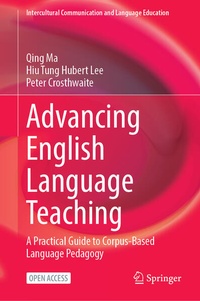
Advancing English Language Teaching
Description
This open access book conducts a thorough exploration of corpus linguistics and its applications in language teaching. It first presents the research-informed theoretical foundation of the two main components: corpus literacy (CL) and corpus-based language pedagogy (CBLP), before showcasing its didactic elements in the form of step-by-step guidance on using and navigating corpus websites and tools, tasks and exercises to perform hands-on corpus searches, and tips for adopting different corpus tools or websites in classroom teaching. Given the advance of AI, this book also discusses how AI can be systematically integrated into CBLP by proposing a new framework of AI-empowered CBLP. Additionally, this book shares lesson plans designed teachers featuring the integration of corpus technology for English language classes, targeting various language skills and levels of students.
This book is a practical, research-informed guide for pre- and in-service English teachers, teacher educators, materials developers, and educational researchers. It shows frontline teachers how to use corpus linguistics to diagnose learner needs, design corpus-based activities, and strengthen lesson planning, assessment, and feedback, thus expanding their teaching repertoire with free online tools. For teacher educators and materials developers, it distills current methodologies and corpus technologies into clear frameworks for creating corpus-based and corpus-informed resources, ensuring programs and materials remain current, evidence-based, and classroom-ready.
More details
Persons
Dr. MA Qing (Angel) is a Professor in the Department of Linguistics and Modern Language Studies, and currently holds the position of Associate Dean (Research & Postgraduate Studies) in the Faculty of Humanities at The Education University of Hong Kong (EdUHK). Her research primarily focuses on second language vocabulary acquisition, corpus linguistics, corpus-based literature studies, and the application of technology in language learning, including corpus-based language pedagogy (CBLP), computer-assisted language learning (CALL), and mobile-assisted language learning (MALL). She has developed the Parallel EAP Corpora for research purposes, as well as the Corpus-Aided Platform for Language Teachers (CAP) for teaching applications. She is an experimenter of corpus technology in teaching and a passionate English teacher trainer.
Mr. LEE Hiu Tung Hubert is currently a research associate at The Education University of Hong Kong (EdUHK). Prior to his employment since 2021, he obtained his Master of Arts (MA) degree at The Hong Kong Polytechnic University (PolyU) in 2020, majoring in English Language for the Professions, and a Bachelor of Arts (BA) degree at EdUHK in Language Studies. His research interests include corpus linguistics, corpus-based language learning and teaching, data-driven learning, language teacher education, and qualitative research methods. He has assisted Prof MA Qing's research projects related to enhancing English language teachers' Technological, Pedagogical, and Content Knowledge (TPACK) in using corpus technology mainly in the Greater Bay Area in China, and engaging an international community of English language teachers to promote corpus-based language pedagogy (CBLP). He has co-authored a journal article in the British Journal of Educational Technology with Prof MA Qing.
Dr. Peter Crosthwaite is an Associate Professor in the School of Languages and Cultures at UQ (since 2017), having formerly been an assistant professor at the Centre for Applied English Studies (CAES), University of Hong Kong (since 2014). His areas of research and supervisory expertise include corpus linguistics and the use of corpora for language learning (known as 'data-driven learning'), as well as English for General and Specific Academic Purposes. He is widely published in leading journals including Language Learning, Corpus Linguistics and Linguistic Theory, Studies in Second Language Acquisition, Journal of English for Academic Purposes, English for Specific Purposes, and Computer-Assisted Language Learning, ReCALL, System, Journal of Second Language Writing, IRAL and the International Journal of Learner Corpus Research. He has featured in Stanford's Top 2% Scientists lists for 2023 and 2024. He is currently Editor in Chief of the Australian Review of Applied Linguistics, has served as Associate Editor for the Q1 Journal of English for Academic Purposes, and sits on the editorial boards of JSLW, CALL, IRAL, System, Applied Corpus Linguistics, Research Syntheses in Applied Linguistics, Research Methods in Applied Linguistics, and the book series Studies in Corpus Linguistics.
Content
Chapter 1 Corpus Linguistics and Its Applications.- Chapter 2 Corpus Literacy for Novice users: Web Concordancers. Chapter 3 Corpus Literacy for Advanced Web Concordancers.- Chapter 4 Corpus Literacy for User Corpus Analysis Software.