

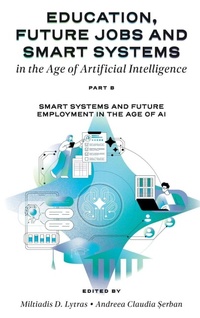
Education, Future Jobs and Smart Systems in the Age of Artificial Intelligence, Part B
Smart Systems and Future Employment in the Age of AI
Published on 29. September 2025
Book
Hardback
192 pages
978-1-83708-433-3 (ISBN)
Description
In an era defined by unprecedented technological advancements, the intersection of artificial intelligence (AI) and the Smart Systems presents both challenges and opportunities. Rapid advancements in automation, machine learning, and AI-driven technologies are reshaping job roles and creating new avenues for employment. The urgency lies in equipping educators, policymakers, and industry professionals with insights to navigate this transformative period effectively.
The second of two volumes, Education, Future Jobs and Smart Systems in the Age of Artificial Intelligence, Part B is a timely collected edition, emerging precisely when the ramifications of AI on the job market are becoming palpable. Each section of the work explores a unique aspect, covering the foundational role of AI as a catalyst for developing new skills and competencies. It provides insights for higher education institutions, discusses AI as a powerful tool for sharing knowledge, considers policy implications, and examines the emergence of innovative job markets.
The chapters serve as a comprehensive guide for higher education stakeholders, offering actionable insights and strategies to navigate the evolving landscape of AI-influenced job markets. Authors work to bridge the gap between academic theory and real-world application, providing a roadmap for institutions to adapt curricula, teaching methodologies, and policies to meet the demands of the AI-driven future.
The second of two volumes, Education, Future Jobs and Smart Systems in the Age of Artificial Intelligence, Part B is a timely collected edition, emerging precisely when the ramifications of AI on the job market are becoming palpable. Each section of the work explores a unique aspect, covering the foundational role of AI as a catalyst for developing new skills and competencies. It provides insights for higher education institutions, discusses AI as a powerful tool for sharing knowledge, considers policy implications, and examines the emergence of innovative job markets.
The chapters serve as a comprehensive guide for higher education stakeholders, offering actionable insights and strategies to navigate the evolving landscape of AI-influenced job markets. Authors work to bridge the gap between academic theory and real-world application, providing a roadmap for institutions to adapt curricula, teaching methodologies, and policies to meet the demands of the AI-driven future.
More details
Language
English
Place of publication
Bingley
United Kingdom
Target group
Professional and scholarly
Dimensions
Height: 237 mm
Width: 159 mm
Thickness: 17 mm
Weight
398 gr
ISBN-13
978-1-83708-433-3 (9781837084333)
Copyright in bibliographic data and cover images is held by Nielsen Book Services Limited or by the publishers or by their respective licensors: all rights reserved.
Schweitzer Classification
Persons
Miltiadis D. Lytras is a Full Professor of Management Information Systems at Deree - The American College of Greece, and a Visiting Professor in the Department of Computer Science, College of Engineering at Effat University. He is a recognized expert in Digital Transformation and AI-enabled Innovation. His research has been acknowledged among the Stanford's Top 2% Scientists worldwide for both career-long and single-year impact. He has co-edited more than 100 academic volumes.
Andreea Claudia ?erban is a Professor at the Department of Economics and Economic Policies within the Faculty of Theoretical and Applied Economics at the Bucharest University of Economic Studies, Romania.
Andreea Claudia ?erban is a Professor at the Department of Economics and Economic Policies within the Faculty of Theoretical and Applied Economics at the Bucharest University of Economic Studies, Romania.
Content
Chapter 1. Regulating Artificial Intelligence for Social Impact; Miltiadis Demetrios Lytras and Andreea Claudia ?erban
Chapter 2. Artificial Intelligence and Performance Measurement Systems in Higher Education: Enhancing Faculty Evaluations and Organizational Outcomes; Alice AlAkoum and Elvira Nica
Chapter 3. Dark Side of AI: Addressing Ethical and Legislative Concerns in Personal Data Privacy; Bedour Alboloushi and Mohammad Alkandari
Chapter 4. Optimizing Teaching Pedagogy: AI-Driven Innovations in Smart Education Systems; Mei Kei Leong, Yen Mee Leow, and Jen Ling Gan
Chapter 5. Democratisation of Generative Artificial Intelligence; Jacek Paluszak and Oleksandra Oliynychuk
Chapter 6. Enhancing Sustainability in Finance Using AI: A Review of Current Practices and Future Possibilities; Suzan Dsouza and Mohammad Abiad
Chapter 7. Artificial Intelligence and Education in Qatar: Making Peace with the Future of Learning; Ahmed Badran and Sara Badran
Chapter 8. From Chalkboards to Chatbots: AI in Modern Education; Soha Rawas and Agariadne Dwinggo Samala
Chapter 9. AI and ChatGPT: Will It Build Business Education's Future?; Karima Sayari, Revenio C. Jalagat, Jr., and Mayssa Ahmed Ben Belgacem
Chapter 10. Integration of Green and Digital Competences in the Study Programmes of University of Maribor, Slovenia; Ana Vovk
Chapter 2. Artificial Intelligence and Performance Measurement Systems in Higher Education: Enhancing Faculty Evaluations and Organizational Outcomes; Alice AlAkoum and Elvira Nica
Chapter 3. Dark Side of AI: Addressing Ethical and Legislative Concerns in Personal Data Privacy; Bedour Alboloushi and Mohammad Alkandari
Chapter 4. Optimizing Teaching Pedagogy: AI-Driven Innovations in Smart Education Systems; Mei Kei Leong, Yen Mee Leow, and Jen Ling Gan
Chapter 5. Democratisation of Generative Artificial Intelligence; Jacek Paluszak and Oleksandra Oliynychuk
Chapter 6. Enhancing Sustainability in Finance Using AI: A Review of Current Practices and Future Possibilities; Suzan Dsouza and Mohammad Abiad
Chapter 7. Artificial Intelligence and Education in Qatar: Making Peace with the Future of Learning; Ahmed Badran and Sara Badran
Chapter 8. From Chalkboards to Chatbots: AI in Modern Education; Soha Rawas and Agariadne Dwinggo Samala
Chapter 9. AI and ChatGPT: Will It Build Business Education's Future?; Karima Sayari, Revenio C. Jalagat, Jr., and Mayssa Ahmed Ben Belgacem
Chapter 10. Integration of Green and Digital Competences in the Study Programmes of University of Maribor, Slovenia; Ana Vovk