

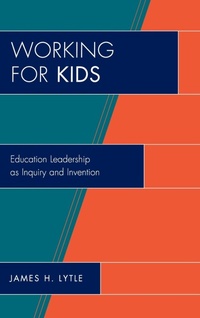
Working for Kids
Educational Leadership as Inquiry and Invention
Published on 15. February 2010
Book
Hardback
184 pages
978-1-60709-055-7 (ISBN)
Description
Much of the current discourse on improving school leadership, and particularly the performance of principals, is misguided. There is much too much emphasis on evaluation and standards as determined by policy makers and professors and not nearly enough attention to how one provides performance-driven leadership in the context of day-to-day practice.
As an administrator, academic, consultant and researcher, Lytle has traveled widely in the school leadership province. This book draws on his career as a school administrator and his experience teaching leadership at the graduate level. The author uses personal stories to address such questions as: How does one learn to lead? How does one become a leader? How does one teach others to lead? What does it mean to lead for learning?
As an administrator, academic, consultant and researcher, Lytle has traveled widely in the school leadership province. This book draws on his career as a school administrator and his experience teaching leadership at the graduate level. The author uses personal stories to address such questions as: How does one learn to lead? How does one become a leader? How does one teach others to lead? What does it mean to lead for learning?
Reviews / Votes
Working for Kids is a must-read for current and prospective educational leaders interested in leading in the twenty-first century and beyond. It is a masterfully written account of the evolution of a school leader's entrepreneurial approach to both public and private school reform. The triumphs and challenges of this unconventional and transformative leader speaks from and to the heart of the matter, learning to lead and leading for learning. Lytle takes you on a journey as he boldly and intentionally crosses traditional boundaries and conventions by challenging the status quo of schooling and creating a space to improve outcomes for student students, teachers, and administrators. Although intended for educational leaders it transcends the educational sector and offers pearls of wisdom for anyone interested in the art of leadership. -- Gloria Hancock, executive director, Office of Education, New Jersey Juvenile Justice Commission An engaging inside look at the rollercoaster career of a can-do urban educator who cares deeply about kids. Street-wise and book-wise, Lytle is an innovator who spells out what real leadership requires-not mechanistic shortcuts but purpose, respect, trust, inquiry, improvisation, and sometimes eating crow. -- Jerry Murphy, former dean, Harvard Graduate School of Education We have diced and sliced the urban school reform pie until there is very little coherence in understanding what works in schools. We know that reinventing urban education is paramount, however we do not all agree on what the ingredients are for reinvention. This book provides a roadmap for how educators can have a positive impact on school culture and foster sustainable reform in schools. It is not a quick fix or microwave approach to transforming education; it is an intelligent course of action that educational leaders should be prompted to take if they want to have the greatest impact on learning and transforming the lives of the students that we serve in our classroomsss -- Thomas G. Maridada, II, superintendent, Pontiac, MI Public Schools and Michigan Superintendent of the Year, 2007-2008 We have diced and sliced the urban school reform pie until there is very little coherence in understanding what works in schools. We know that reinventing urban education is paramount, however we do not all agree on what the ingredients are for reinvention. This book provides a roadmap for how educators can have a positive impact on school culture and foster sustainable reform in schools. It is not a quick fix or microwave approach to transforming education; it is an intelligent course of action that educational leaders should be prompted to take if they want to have the greatest impact on learning and transforming the lives of the students that we serve in our classrooms -- Thomas G. Maridada, II, superintendent, Pontiac, MI Public Schools and Michigan Superintendent of the Year, 2007-2008More details
Series
Language
English
Place of publication
United States
Publishing group
Bloomsbury Publishing Plc
Target group
Professional and scholarly
Dimensions
Height: 235 mm
Width: 157 mm
Thickness: 15 mm
Weight
426 gr
ISBN-13
978-1-60709-055-7 (9781607090557)
Copyright in bibliographic data and cover images is held by Nielsen Book Services Limited or by the publishers or by their respective licensors: all rights reserved.
Schweitzer Classification
Other editions
Additional editions
E-Book
02/2010
1st Edition
Rowman & Littlefield Education
€43.49
Available for download
Person
James H. "Torch" Lytle is practice professor of educational leadership at the Graduate School of Education, University of Pennsylvania. From 1998-2006 Lytle was superintendent of the Trenton, NJ Public Schools; prior to his appointment in Trenton, he served in a variety of capacities in the School District of Philadelphia as an elementary, middle, and high school principal; executive director for planning, research, and evaluation; regional superintendent; and assistant superintendent.
Content
Part 1 Emergence of a School Leader
Chapter 2 Principal
Chapter 3 Central Office and "Sabbatical"
Chapter 4 Regional and Assistant Superintendent
Chapter 5 Principal, Again
Part 6 Changing States: Superintendent, Trenton, New Jersey
Chapter 7 Learning the Context
Chapter 8 Determining the Work
Chapter 9 Designing and Getting Under Way
Chapter 10 Building Capacity
Chapter 11 High School Reform
Chapter 12 To What End?
Part 13 Leadership for Learning
Chapter 14 Considering the Teaching of Leadership
Chapter 2 Principal
Chapter 3 Central Office and "Sabbatical"
Chapter 4 Regional and Assistant Superintendent
Chapter 5 Principal, Again
Part 6 Changing States: Superintendent, Trenton, New Jersey
Chapter 7 Learning the Context
Chapter 8 Determining the Work
Chapter 9 Designing and Getting Under Way
Chapter 10 Building Capacity
Chapter 11 High School Reform
Chapter 12 To What End?
Part 13 Leadership for Learning
Chapter 14 Considering the Teaching of Leadership