

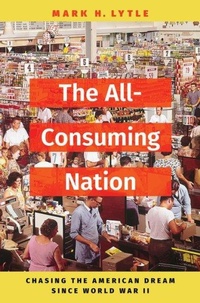
The All-Consuming Nation
Chasing the American Dream Since World War II
Published on 2. February 2022
Book
Hardback
536 pages
978-0-19-756825-5 (ISBN)
Description
In his 1958 "kitchen debate" with Nikita Khrushchev, Richard Nixon argued that the freedom to consume defined the American way of life. High wages, full employment, new technologies, and a rapid growth in population known as the "Baby Boom" ushered in a golden age of economic growth. By the end of the twentieth century, consumerism triumphed over communism, socialism, and all other isms seeking to win hearts and minds around the world. Advertising, popular culture, and mass media persuaded Americans that shopping was both spiritually fulfilling and a patriotic virtue.
Mark Lytle argues that Nixon's view of consumer democracy contained fatal flaws -- if unregulated, it would wholly ignore the creativedestruction that, in destroying jobs, erodes the capacity to consume. The All-Consuming Nation also examines how planners failed to take into account the environmental costs, as early warning signs--whether smog over Los Angeles, the overuse of toxic chemicals such as DDT, or the Cuyahoga River in flames--provided evidence that all was not well. Environmentalists from Aldo Leopold, Rachel Carson and Paul Ehrlich to Ralph Nader and Al Gore cautioned that modern consumerism imposed unsustainable costs on the natural world. Not for lack of warning, climate change became the defining issue of the twenty-first century.
The All-Consuming Nation investigates the environmental and sociocultural costs of the consumer capitalism framework set in place in the 20th century, shedding light on the consequences of a national identity forged through mass consumption.
Mark Lytle argues that Nixon's view of consumer democracy contained fatal flaws -- if unregulated, it would wholly ignore the creativedestruction that, in destroying jobs, erodes the capacity to consume. The All-Consuming Nation also examines how planners failed to take into account the environmental costs, as early warning signs--whether smog over Los Angeles, the overuse of toxic chemicals such as DDT, or the Cuyahoga River in flames--provided evidence that all was not well. Environmentalists from Aldo Leopold, Rachel Carson and Paul Ehrlich to Ralph Nader and Al Gore cautioned that modern consumerism imposed unsustainable costs on the natural world. Not for lack of warning, climate change became the defining issue of the twenty-first century.
The All-Consuming Nation investigates the environmental and sociocultural costs of the consumer capitalism framework set in place in the 20th century, shedding light on the consequences of a national identity forged through mass consumption.
Reviews / Votes
This fascinating study of the US covers 1945 to the present. It will appeal to thoughtful readers; those who most need this information will likely dismiss it as "fake news". * D. R. Jamieson, Ashland University, CHOICE * Mark H. Lytle's All-Consuming Nation is not a traditional textbook. He frames the past through issues of consumption, capitalism, and the multiple physical environments in which Americans live. Lytle enlivens chronological history with telling anecdotes and revealing data, and his writing is so good that scholars as well as students will be happy. Finally, he provides an outstanding explanation of contemporary American social and economic stratification. * Raymond Haberski Jr, Professor of History and Director of American Studies and the Institute for American Thought, IUPUI * As Lytle makes abundantly clear in this imaginative new survey of U.S. history, understanding postwar America requires careful attention to the ways the ethos of consumption became a kind of secular religion over the past 75 years. Lytle has synthesized political, social, cultural, and, above all, environmental history into a provocative and deeply needed framework for both exploring the story of postwar history and understanding the consumerist roots of the climate crisis. * Michael B. Smith, Professor of History and Environmental Studies, Ithaca College * This fascinating study of the US covers 1945 to the present. It will appeal to thoughtful readers; those who most need this information will likely dismiss it as "fake news." * Choice *More details
Language
English
Place of publication
New York
United States
Target group
Professional and scholarly
Product notice
sewn/stitched
Cloth over boards
Illustrations
40 b&w halftones
Dimensions
Height: 168 mm
Width: 244 mm
Thickness: 46 mm
Weight
816 gr
ISBN-13
978-0-19-756825-5 (9780197568255)
Copyright in bibliographic data and cover images is held by Nielsen Book Services Limited or by the publishers or by their respective licensors: all rights reserved.
Schweitzer Classification
Other editions
Additional editions
E-Book
10/2021
OUP eBook
€21.99
Available for download
E-Book
10/2021
OUP eBook
€21.99
Available for download
Person
Mark H. Lytle is Lyford Patterson and Mary Gray Edwards Professor of History Emeritus at Bard College where he helped to found and direct the Environmental and Urban Studies and American Studies Programs. Since joining the History Education Project at Yale in the 1970s, he has been active in promoting the quality of teaching and learning history. His work in diplomatic, environmental, and cultural studies inspired the idea of consumerism as the organizing principle both in the United States and in its sense of mission abroad.
Content
Introduction: Cold War, Warm Kitchen, and the Trump Dilemma
Part I The Creation of a Consumer Democracy
1. Post War Choices
2. The Birth of a Consumer Democracy
3. Chapter Three: The Dark Side of Consumption
4. The Era of Populuxe
Part II The Era of Identity Consumerism
5. Segmented America and the New Identity Politics
6. The American Way of Life Polluted
7. The Golden Age of Consumption
8. Vietnam: Consumers Go to War
9. The Consumer Movement
10. Identity Consumerism
Part III The Age of Limits, The Age of Fractures
11. America Goes Green
12. The Age of Limits
13. The Environmental Battleground
14. In Debt We Trust
15. Fractured Science: The Battles Over Sustainability and Climate Change
Part IV E-Commerce in the Age of Global Warming
16. High Tech Consumers
17. The All-Consuming Nation Imperiled
Epilogue: Omens
Notes
Bibliography
Index
Part I The Creation of a Consumer Democracy
1. Post War Choices
2. The Birth of a Consumer Democracy
3. Chapter Three: The Dark Side of Consumption
4. The Era of Populuxe
Part II The Era of Identity Consumerism
5. Segmented America and the New Identity Politics
6. The American Way of Life Polluted
7. The Golden Age of Consumption
8. Vietnam: Consumers Go to War
9. The Consumer Movement
10. Identity Consumerism
Part III The Age of Limits, The Age of Fractures
11. America Goes Green
12. The Age of Limits
13. The Environmental Battleground
14. In Debt We Trust
15. Fractured Science: The Battles Over Sustainability and Climate Change
Part IV E-Commerce in the Age of Global Warming
16. High Tech Consumers
17. The All-Consuming Nation Imperiled
Epilogue: Omens
Notes
Bibliography
Index