

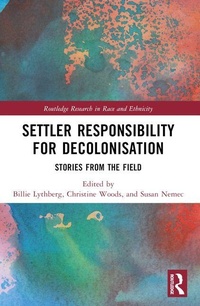
Settler Responsibility for Decolonisation
Stories from the Field
1st Edition
Will be published approx. on 28. November 2025
Book
Paperback/Softback
186 pages
978-1-032-73665-5 (ISBN)
Description
This edited collection presents perspectives from a range of disciplines on the challenges of dismantling coloniality in settler societies.
Showcasing a variety of pedagogies and case studies, the book offers approaches to the praxis of decolonisation in diverse settings including tertiary education, activism, arts curatorial practice, the media, trans-Indigeneity, and psychosocial therapy. Chapters centre on the personal, relational, and political work needed to support decolonisation in settler societies in Aotearoa New Zealand, Australia, the United States, and Canada. Drawing from experiences in the field, contributors argue that to decolonise research and build authentic relationships with Indigenous communities, settler researchers must learn from Indigenous worldviews without appropriating them, disrupt colonial epistemologies, and reconcile their place in colonialism. Indigenising is discussed as a counterpart to the decolonisation process, involving restoring and centring the Indigenous voice within Indigenised socio-cultural, economic, legal, and political structures and institutions, including the return of land.
The book is a rich resource for researchers seeking to understand and support decolonisation in settler societies, and will appeal to non-Indigenous scholars, students, and those involved in decolonisation work in community and institutional settings.
Showcasing a variety of pedagogies and case studies, the book offers approaches to the praxis of decolonisation in diverse settings including tertiary education, activism, arts curatorial practice, the media, trans-Indigeneity, and psychosocial therapy. Chapters centre on the personal, relational, and political work needed to support decolonisation in settler societies in Aotearoa New Zealand, Australia, the United States, and Canada. Drawing from experiences in the field, contributors argue that to decolonise research and build authentic relationships with Indigenous communities, settler researchers must learn from Indigenous worldviews without appropriating them, disrupt colonial epistemologies, and reconcile their place in colonialism. Indigenising is discussed as a counterpart to the decolonisation process, involving restoring and centring the Indigenous voice within Indigenised socio-cultural, economic, legal, and political structures and institutions, including the return of land.
The book is a rich resource for researchers seeking to understand and support decolonisation in settler societies, and will appeal to non-Indigenous scholars, students, and those involved in decolonisation work in community and institutional settings.
More details
Series
Language
English
Place of publication
London
United Kingdom
Publishing group
Taylor & Francis Ltd
Target group
College/higher education
Postgraduate and Undergraduate Advanced
Illustrations
2 s/w Photographien bzw. Rasterbilder, 2 s/w Tabellen, 2 s/w Abbildungen
2 Tables, black and white; 2 Halftones, black and white; 2 Illustrations, black and white
Dimensions
Height: 234 mm
Width: 156 mm
Thickness: 12 mm
Weight
348 gr
ISBN-13
978-1-032-73665-5 (9781032736655)
Copyright in bibliographic data and cover images is held by Nielsen Book Services Limited or by the publishers or by their respective licensors: all rights reserved.
Schweitzer Classification
Other editions
Additional editions
Billie Lythberg | Christine Woods | Susan Nemec
Settler Responsibility for Decolonisation
Stories from the Field
E-Book
09/2024
1st Edition
Routledge
€60.49
Available for download
Billie Lythberg | Christine Woods | Susan Nemec
Settler Responsibility for Decolonisation
Stories from the Field
E-Book
09/2024
1st Edition
Routledge
€60.49
Available for download
Billie Lythberg | Christine Woods | Susan Nemec
Settler Responsibility for Decolonisation
Stories from the Field
Book
09/2024
1st Edition
Routledge
€206.30
Shipment within 10-20 days
Persons
Billie Lythberg is of Swedish, Scottish, and English descent. She is a Senior Lecturer in the Department of Management and International Business at Waipapa Taumata Rau | The University of Auckland, and an affiliated researcher of Va Moana - Pacific Spaces at Te Wananga Aronui o Tamaki Makau Rau |Auckland University of Technology. She has worked on multiple projects for the Royal Society of New Zealand with Maori and Moana colleagues, including the Marsden-funded project this book developed out of. She publishes extensively in print and online; curates and critiques exhibitions; and develops documentaries for broadcast television.
Christine Woods is the Theresa Gattung Chair for Women in Entrepreneurship at the Faculty of Business and Economics, Waipapa Taumata Rau | The University of Auckland. She also directs the Aotearoa Centre for Enterprising Women and teaches courses on Women and Entrepreneurship to undergraduate and MBA students. Her research interests include women and entrepreneurship, SME and family business, social entrepreneurship, Maori entrepreneurship, and entrepreneurship education. Chris is part of The ICEHOUSE Business Growth Programmes' directing team and mentors several women who have recently started businesses. She is also on the board of several businesses and is a founding director of Maori Maps, and has worked on multiple projects for the Royal Society of New Zealand with Maori colleagues, including the Marsden-funded project this book developed out of.
Susan Nemec is a research associate at the Waipapa Taumata Rau | The University of Auckland. Her research interests are multifaceted, weaving together various threads to explore contemporary social dynamics. Her interests include how gender dynamics shape entrepreneurial endeavours and the intricate relationship between media representation and cross-cultural understanding. Susan's research provides a nuanced and interdisciplinary understanding of identity, representation, and power dynamics in contemporary society, contributing to both academic scholarship and broader societal discussions.
Christine Woods is the Theresa Gattung Chair for Women in Entrepreneurship at the Faculty of Business and Economics, Waipapa Taumata Rau | The University of Auckland. She also directs the Aotearoa Centre for Enterprising Women and teaches courses on Women and Entrepreneurship to undergraduate and MBA students. Her research interests include women and entrepreneurship, SME and family business, social entrepreneurship, Maori entrepreneurship, and entrepreneurship education. Chris is part of The ICEHOUSE Business Growth Programmes' directing team and mentors several women who have recently started businesses. She is also on the board of several businesses and is a founding director of Maori Maps, and has worked on multiple projects for the Royal Society of New Zealand with Maori colleagues, including the Marsden-funded project this book developed out of.
Susan Nemec is a research associate at the Waipapa Taumata Rau | The University of Auckland. Her research interests are multifaceted, weaving together various threads to explore contemporary social dynamics. Her interests include how gender dynamics shape entrepreneurial endeavours and the intricate relationship between media representation and cross-cultural understanding. Susan's research provides a nuanced and interdisciplinary understanding of identity, representation, and power dynamics in contemporary society, contributing to both academic scholarship and broader societal discussions.
Content
List of contributors
Preface
Introduction
Section One
Chapter 1: Making space at the institutional table: Co-work and risk in the colonial university
Sarah Maddison
Chapter 2: 'So, are you Indigenous?' Settler responsibilities when teaching Indigenous Australian Studies
Holly Randell-Moon
Chapter 3: 'It's complicated': Reflections on Teaching Citizenship in Aotearoa - New Zealand
Sharon McLennan, Giles Dodson, Ella Kahu, Carol Neill, and Richard Shaw
Chapter 4: Indigenous Peer Learning in a Digital Third Space
Christine Woods and Billie Lythberg
Chapter 5: Remembering and repositioning episodes of historical violence between settlers and Indigenous people
Liana MacDonald (Ngati Kuia, Rangitane o Wairau, Ngati Koata)
Section Two
Chapter 6: Tau(gh)t relationships and fraught responsibilities: (de)colonisation practices in new non-Maori adult learners of te reo, the Maori language
Michelle O'Toole
Chapter 7: Co-Conspiring in a time of Hulihia at Mauna Kea
Leanne P. Day and Rebecca H. Hogue
Chapter 8: Critical White Settler Projects as an intergenerational responsibility: Activating decolonial co-resistance in the cultural sector
Leah Decter and Carla Taunton
Chapter 9: Does Indigenous Media have a role in building new migrant narratives of decolonisation?
Susan Nemec
Chapter 10: S is for Settler: A Psychosocial Perspective on Belonging and Unbelonging in Aotearoa New Zealand
Keith Tudor
Chapter 11: Thinking about Pacific relational space, along-side and in the presence of tangata whenua in Aotearoa-New Zealand.
Tina (A.-Chr.) Engels-Schwarzpaul
Index
Preface
Introduction
Section One
Chapter 1: Making space at the institutional table: Co-work and risk in the colonial university
Sarah Maddison
Chapter 2: 'So, are you Indigenous?' Settler responsibilities when teaching Indigenous Australian Studies
Holly Randell-Moon
Chapter 3: 'It's complicated': Reflections on Teaching Citizenship in Aotearoa - New Zealand
Sharon McLennan, Giles Dodson, Ella Kahu, Carol Neill, and Richard Shaw
Chapter 4: Indigenous Peer Learning in a Digital Third Space
Christine Woods and Billie Lythberg
Chapter 5: Remembering and repositioning episodes of historical violence between settlers and Indigenous people
Liana MacDonald (Ngati Kuia, Rangitane o Wairau, Ngati Koata)
Section Two
Chapter 6: Tau(gh)t relationships and fraught responsibilities: (de)colonisation practices in new non-Maori adult learners of te reo, the Maori language
Michelle O'Toole
Chapter 7: Co-Conspiring in a time of Hulihia at Mauna Kea
Leanne P. Day and Rebecca H. Hogue
Chapter 8: Critical White Settler Projects as an intergenerational responsibility: Activating decolonial co-resistance in the cultural sector
Leah Decter and Carla Taunton
Chapter 9: Does Indigenous Media have a role in building new migrant narratives of decolonisation?
Susan Nemec
Chapter 10: S is for Settler: A Psychosocial Perspective on Belonging and Unbelonging in Aotearoa New Zealand
Keith Tudor
Chapter 11: Thinking about Pacific relational space, along-side and in the presence of tangata whenua in Aotearoa-New Zealand.
Tina (A.-Chr.) Engels-Schwarzpaul
Index