

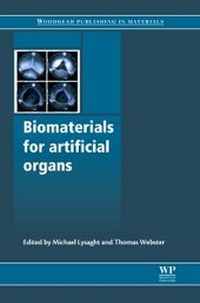
Biomaterials for Artificial Organs
Published on 20. December 2010
Book
Hardback
320 pages
978-1-84569-653-5 (ISBN)
Description
The worldwide demand for organ transplants far exceeds available donor organs. Consequently some patients die whilst waiting for a transplant. Synthetic alternatives are therefore imperative to improve the quality of, and in some cases, save people's lives. Advances in biomaterials have generated a range of materials and devices for use either outside the body or through implantation to replace or assist functions which may have been lost through disease or injury. Biomaterials for artificial organs reviews the latest developments in biomaterials and investigates how they can be used to improve the quality and efficiency of artificial organs.
Part one discusses commodity biomaterials including membranes for oxygenators and plasmafilters, titanium and cobalt chromium alloys for hips and knees, polymeric joint-bearing surfaces for total joint replacements, biomaterials for pacemakers, defibrillators and neurostimulators and mechanical and bioprosthetic heart valves. Part two goes on to investigate advanced and next generation biomaterials including small intestinal submucosa and other decullarized matrix biomaterials for tissue repair, new ceramics and composites for joint replacement surgery, biomaterials for improving the blood and tissue compatibility of total artificial hearts (TAH) and ventricular assist devices (VAD), nanostructured biomaterials for artificial tissues and organs and matrices for tissue engineering and regenerative medicine.
With its distinguished editors and international team of contributors Biomaterials for artificial organs is an invaluable resource to researchers, scientists and academics concerned with the advancement of artificial organs.
Part one discusses commodity biomaterials including membranes for oxygenators and plasmafilters, titanium and cobalt chromium alloys for hips and knees, polymeric joint-bearing surfaces for total joint replacements, biomaterials for pacemakers, defibrillators and neurostimulators and mechanical and bioprosthetic heart valves. Part two goes on to investigate advanced and next generation biomaterials including small intestinal submucosa and other decullarized matrix biomaterials for tissue repair, new ceramics and composites for joint replacement surgery, biomaterials for improving the blood and tissue compatibility of total artificial hearts (TAH) and ventricular assist devices (VAD), nanostructured biomaterials for artificial tissues and organs and matrices for tissue engineering and regenerative medicine.
With its distinguished editors and international team of contributors Biomaterials for artificial organs is an invaluable resource to researchers, scientists and academics concerned with the advancement of artificial organs.
Reviews / Votes
"Undoubtedly a useful resource, it would be well placed in the biotechnology section of any university library." --Materials WorldMore details
Series
Language
English
Place of publication
Cambridge
United Kingdom
Publishing group
Elsevier Science & Technology
Target group
College/higher education
Professional and scholarly
Dimensions
Height: 234 mm
Width: 156 mm
Weight
630 gr
ISBN-13
978-1-84569-653-5 (9781845696535)
Copyright in bibliographic data and cover images is held by Nielsen Book Services Limited or by the publishers or by their respective licensors: all rights reserved.
Schweitzer Classification
Other editions
Additional editions
Michael Lysaght | Thomas J Webster
Biomaterials for Artificial Organs
Book
10/2018
Woodhead Publishing Ltd
€186.01
The article will not be published
E-Book
12/2010
Woodhead Publishing Ltd
€180.00
Available for download
Persons
Dr. Michael Lysaght was the Founder and Director Emeritus of Brown University, USA's Center for Biomedical Engineering, and a retired member of the Brown Faculty. He sadly passed away before he could see this finished book and remains a widely recognized and well-respected figure in the field of biomedical engineering for his contributions to organ replacement technology. Professor Thomas J. Webster, a chemical and biomedical engineer, holds degrees from the University of Pittsburgh and RPI. He has founded over a dozen companies with FDA-approved medical products benefiting over 30,000 patients and is involved in sustainability and renewable energy technologies. Currently a professor at multiple universities, he has received numerous accolades, including recognition as a top scientist by PLOS and Clarivate. With over 1,350 publications and 66,000 citations, he is a former president of the U.S. Society for Biomaterials and was recently nominated for the Nobel Prize in Chemistry. He also established a fund for Nigerian student research in the USA.
Content
Part 1 Commodity biomaterials: Membranes for oxygenators and plasmafilters: Titanium and cobalt-chromium alloys for hips and knees; Polymeric joint bearing surfaces for total joint replacements; Biomaterials for pacemakers, defibrillators and neurostimulators; Mechanical and bioprosthetic valves. Part 2 Advanced and next generation biomaterials: Small intestinal submucosa and other decullarized matrix biomaterials for tissue repair; New ceramics and composites for joint replacement surgery; Biomaterials for improving the blood and tissue compatibility of Total Artificial Hearts (TAH) and Ventricular Assist Devices (VAD); Nanostructured biomaterials for artificial tissues and organs; Matrices for tissue engineering and regenerative medicine.