

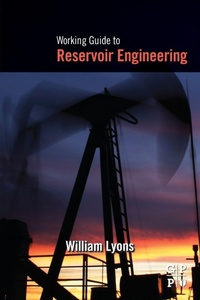
Working Guide to Reservoir Engineering
Published on 3. November 2009
Book
Paperback/Softback
327 pages
978-1-85617-824-2 (ISBN)
Description
Working Guide to Reservoir Engineering provides an introduction to the fundamental concepts of reservoir engineering. The book begins by discussing basic concepts such as types of reservoir fluids, the properties of fluid containing rocks, and the properties of rocks containing multiple fluids. It then describes formation evaluation methods, including coring and core analysis, drill stem tests, logging, and initial estimation of reserves. The book explains the enhanced oil recovery process, which includes methods such as chemical flooding, gas injection, thermal recovery, technical screening, and laboratory design for enhanced recovery. Also included is a discussion of fluid movement in waterflooded reservoirs.
More details
Language
English
Place of publication
Oxford
United Kingdom
Publishing group
Elsevier Science & Technology
Target group
Professional and scholarly
Cluster E-brochure, trade shows and conferences, online display ads, 2x-Email blast to in-house subs
Product notice
Paperback (trade)
Dimensions
Height: 229 mm
Width: 152 mm
Thickness: 18 mm
Weight
441 gr
ISBN-13
978-1-85617-824-2 (9781856178242)
Copyright in bibliographic data and cover images is held by Nielsen Book Services Limited or by the publishers or by their respective licensors: all rights reserved.
Schweitzer Classification
Other editions
Additional editions
William Lyons
Working Guide to Reservoir Engineering
E-Book
09/2009
Gulf Professional Publishing
€73.95
Available for download
Person
William C. Lyons, Ph.D., P.E. (retired), holds nine patents in industrial drilling and has been responsible for the development of several important innovations in drilling and production technology. He is the lead Editor of the Standard Handbook of Petroleum and Gas Engineering, 3rd edition, publishing with Elsevier and co-author of several other professional books in drilling and production engineering for the petroleum industry. Dr. Lyons was a Professor in Petroleum Engineering and in Mechanical Engineering at the New Mexico Institute of Mining and Technology for 30 years. He also served two one-year tours as a Distinguished Visiting Professor in Mechanical Engineering at the U.S. Air Force Academy in Colorado Springs during his academic career. Since retiring from teaching, Dr. Lyons is currently a Technical Learning Advisor with Chevron's Clear Leader Center in Houston, TX.
Content
1. Basic Principles, Definitions, and Data2. Formation Evaluation 3. Pressure Transient Testing of Oil and Gas Wells4. Mechanisms and Recovery of Hydrocarbons5. Material Balance and Volumetric Analysis 6. Decline-Curve Analysis 7. Reserve Estimates8. Secondary Recovery 9. Fluid Movement in Waterflooded Reservoirs10. Estimating Waterflood Residual Oil Saturation 11. Enhanced Oil Recovery Methods 12. References