

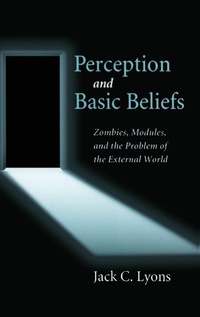
Perception and Basic Beliefs
Zombies, Modules and the Problem of the External World
Published on 22. January 2009
Book
Hardback
216 pages
978-0-19-537357-8 (ISBN)
Description
Perception is our main source of epistemic access to the outside world. Perception and Basic Beliefs addresses two central questions in epistemology: which beliefs are epistemologically basic (i.e., noninferentially justified) and where does perception end and inferential cognition begin. Jack Lyons offers a highly externalist theory, arguing that what makes a belief a basic belief or a perceptual belief is determined by the nature of the cognitive system, or module, that produced the beliefs. On this view, the sensory experiences that typically accompany perceptual beliefs play no indispensable role in the justification of these beliefs, and one can have perceptual beliefs-justified perceptual beliefs-even in the absence of any sensory experiences whatsoever. Lyons develops a general theory of basic beliefs and argues that perceptual beliefs are a species of basic beliefs. This results from the fact that perceptual modules are a special type of basic belief-producing modules. Importantly, some beliefs are not the outputs of this class of cognitive module; these beliefs are therefore non-basic, thus requiring inferential support from other beliefs for their justification. This last point is used to defend a reliabilist epistemology against an important class of traditional objections (where the agent uses a reliable process that she doesn't know to be reliable).
Perception and Basic Beliefs brings together an important treatment of these major epistemological topics and provides a positive solution to the traditional problem of the external world.
Perception and Basic Beliefs brings together an important treatment of these major epistemological topics and provides a positive solution to the traditional problem of the external world.
More details
Language
English
Place of publication
New York
United States
Target group
College/higher education
Dimensions
Height: 240 mm
Width: 161 mm
Thickness: 16 mm
Weight
496 gr
ISBN-13
978-0-19-537357-8 (9780195373578)
Copyright in bibliographic data and cover images is held by Nielsen Book Services Limited or by the publishers or by their respective licensors: all rights reserved.
Schweitzer Classification
Other editions
Additional editions
E-Book
01/2009
1st Edition
OUP eBook
€15.49
Available for download
E-Book
01/2009
1st Edition
OUP eBook
€16.49
Available for download
Person
Jack Lyons works primarily in epistemology, philosophy of mind, and cognitive science. He is Associate Professor of Philosophy at the University of Arkansas.
Content
Abbreviations; Chapter 1: External Object Foundationalism: 1.1The Problem of the External World; 1.2 Metaphysical and Epistemological Direct Realisms; 1.3 Basic Beliefs;Chapter 2: Doxastic and Nondoxastic Theories; 2.1 Evidential and Nonevidential Justifiers; 2.2 The Supervenience Argument; 2.3 Doxasticism and Nondoxasticism; 2.4 Doxastic Theories; Chapter 3: Experientialist Theories: 3.1 Sensation and Perception; 3.2 Sensations as Grounds; 3.2.1 Sensationless Perception; 3.2.2 The Sensation/perception Gap and Collateral Information; 3.2.3 Problems Concerning Basing; 3.2.4 SE and the Content of Sensations; 3.3 Percepts as Grounds; 3.3.1 In Search of the Percept; 3.3.2 Percepts and Beliefs; 3.3.3 The Zombies Return; 3.4 The Belief Principle; 3.5 Experiential States as Nonevidential Justifiers; 3.6 Intuitive Resistance; 3.7 Recapitulation; Chapter 4: Perceptual Systems and Perceptual Beliefs: 4.1 Perceptual Systems; 4.1.1 Cognitive Systems/Modules; 4.1.2 Perceptual Modules; 4.2 The Plausibility of the Perceptual System Theory; 4.2.1 The Grain Size of Perceptual Beliefs; 4.2.2 Perception and Ungrounded Justified Belief; 4.2.3 Perceptual Learning and Nonexperiential Looks ; 4.2.4 Percept Experientialism Revisited; 4.3 Perceptual Beliefs and Basic Beliefs; Chapter 5: Perception, Clairvoyance, and Reliability: 5.1 Simple Reliabilism and the Norman/Truetemp Objections; .5.2 Clairvoyance and Basicality; 5.2.1 Underspecification and the Clairvoyance Challenge; 5.2.2 Perception and Other Cognitive Abilities; 5.2.3 Meta-Incoherence; 5.3 Reliability and Basicality; 5.3.1Clairvoyance and Defeat; 5.3.2 Experientialist Reliabilism; 5.3.3 Early Reliabilism; 5.3.4 Teleological Reliabilism; Chapter 6: Basic Beliefs: 6.1 The Delineation Problem; 6.1.1 The Desiderata; 6.1.2 A Systems Theory of Basicality; 6.1.3 Counterexamples and Replies: 6.2 Intuitions and Beyond; 6.2.1 Descriptive and Normative Epistemology; 6.2.2 Cognitive Science and Basicality; 6.2.3 Illustration: Why My Philosophy is More God-Friendly than Plantingas ;6.2.4 Reflective Equilibrium and Etiological Constraints; Chapter 7: Basic and Nonbasic Beliefs in a Reliabilist Epistemology: 7.1Toward a Theory of Justification; 7.1.1 Evidential Justification; 7.1.2 Defeat; 7.1.3 Outline of a Theory; 7.2 Internalism and Externalism; 7.3 The Problem(s) of the External World; References; Index