

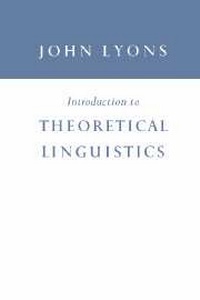
Introduction to Theoretical Linguistics
Published on 1. June 1968
Book
Hardback
530 pages
978-0-521-05617-5 (ISBN)
Description
This is a comprehensive introduction to theoretical linguistics. It presupposes no previous knowledge and terms are defined as they are introduced; but it gives a rigorous and technical treatment of a wide range of topics, and brings the reader to an advanced level of understanding. Since its first publication in 1968 Introduction to Theoretical Linguistics has been one of the classic introductions to the discipline. In a field which is often seen as rapidly moving, it will continue to be used by students seeking an overview of the central areas of linguistics - phonetics and phonology, grammar and semantics - and to be of great value to anyone interested in the ways in which theory can help to explain the key problems of human language.
Reviews / Votes
"Prof. Lyons...has succeeded brilliantly in his aim to provide a comprehensive introduction to the most important trends in contemporary linguistic theory." Modern Language ReviewMore details
Language
English
Place of publication
Cambridge
United Kingdom
Target group
Professional and scholarly
Weight
787 gr
ISBN-13
978-0-521-05617-5 (9780521056175)
Copyright in bibliographic data and cover images is held by Nielsen Book Services Limited or by the publishers or by their respective licensors: all rights reserved.
Schweitzer Classification
Other editions
New editions
John Lyons
Introduction to Theoretical Linguistics
Book
06/1968
Cambridge University Press
€111.40
Shipment within 15-20 days
Additional editions
John Lyons
Introduction to Theoretical Linguistics
Book
06/1968
Cambridge University Press
€111.40
Shipment within 15-20 days
John Lyons
Introduction to Theoretical Linguistics
E-Book
06/1968
1st Edition
Cambridge University Press
€67.99
Available for download
Content
1. Linguistics: the scientific study of language; 2. The structure of language; 3. The sounds of language; 4. Grammar: general principles; 5. Grammatical units; 6. Grammatical structure; 7. Grammatical categories; 8. Grammatical functions; 9. Semantics: general principles; 10. Semantic structure; Notes and references; Addenda; Bibliography; Table of symbols and notational conventions; Index of proper names; Index of subjects.