

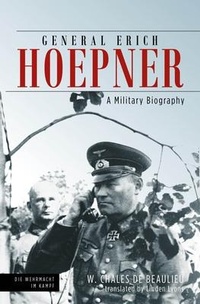
General Erich Hoepner
Portrait of a Panzer Commander
Published on 1. March 2021
Book
Hardback
264 pages
978-1-61200-976-6 (ISBN)
Description
This volume in the Die Wehrmacht im Kampf series examines Erich Hoepner's leadership of panzer formations in Poland in 1939, France in 1940, and Russia in 1941. It is written by Walter Chales de Beaulieu, a general staff officer who fought alongside Hoepner. Erich Hoepner was one of the most competent tank commanders of World War II, playing a significant role in Germany's early successes. As the commander of the XVI Panzer Corps at the outbreak of war in 1939, Hoepner carried out the main thrust towards Warsaw. The panzer corps covered 250 kilometres and reached the outskirts of the city in only eight days.
In 1940, commanding the same formation, Hoepner fought the French Cavalry Corps in Belgium, partook in the encirclement of Allied forces near Dunkirk, and advanced southwards over the Weygand Line deep into French territory. In 1941, Hoepner became the commander of Panzer Group 4, which was the main attack formation for the advance on Leningrad. It made rapid progress to begin with, but an increasingly wide and exposed front meant that the attack gradually ground to a halt. After one final attempt to capture the city in the middle of September failed, the panzer group was redeployed to the central sector of the Eastern Front. It was there that the panzer group was to help with the push towards Moscow. In conjunction with Panzer Group 3, Hoepner's Panzer Group 4 completed and eliminated the Vyazma pocket. Hoepner frequently felt that he was not allowed to advance on Moscow quickly enough by his superiors, yet his decision to conduct a withdrawal in January 1942 led to his dismissal.
In this book, Walter Chales de Beaulieu provides insight into Erich Hoepner's ability as a panzer commander, painting a picture of a man who was committed to the military profession, who possessed a strong sense of responsibility, and who was confident enough to exercise his own will.
In 1940, commanding the same formation, Hoepner fought the French Cavalry Corps in Belgium, partook in the encirclement of Allied forces near Dunkirk, and advanced southwards over the Weygand Line deep into French territory. In 1941, Hoepner became the commander of Panzer Group 4, which was the main attack formation for the advance on Leningrad. It made rapid progress to begin with, but an increasingly wide and exposed front meant that the attack gradually ground to a halt. After one final attempt to capture the city in the middle of September failed, the panzer group was redeployed to the central sector of the Eastern Front. It was there that the panzer group was to help with the push towards Moscow. In conjunction with Panzer Group 3, Hoepner's Panzer Group 4 completed and eliminated the Vyazma pocket. Hoepner frequently felt that he was not allowed to advance on Moscow quickly enough by his superiors, yet his decision to conduct a withdrawal in January 1942 led to his dismissal.
In this book, Walter Chales de Beaulieu provides insight into Erich Hoepner's ability as a panzer commander, painting a picture of a man who was committed to the military profession, who possessed a strong sense of responsibility, and who was confident enough to exercise his own will.
Reviews / Votes
This is an excellent military biography of one of the chief Panzer commanders of the early part of World War II. The author shows us the thoughts and writings of Hoepner during these campaigns. It is a window into the inner workings of the Panzer forces early in the war. * A Wargamer's Needful Things 28/09/2022 *More details
Series
Language
English
Place of publication
United States
Target group
Professional and scholarly
Dimensions
Height: 163 mm
Width: 238 mm
Thickness: 27 mm
Weight
560 gr
ISBN-13
978-1-61200-976-6 (9781612009766)
Copyright in bibliographic data and cover images is held by Nielsen Book Services Limited or by the publishers or by their respective licensors: all rights reserved.
Schweitzer Classification
Other editions
Additional editions
E-Book
03/2021
Casemate
€25.99
Available for download
Persons
Linden Lyons holds a master's degree in history from Monash University in Melbourne, Australia. He studied German at the University of Freiburg and librarianship at the University of Canberra. He is the translator of several titles in the Die Wehrmacht im Kampf series, most recently Counter-Strike Operations, Normandy, and Rome to the Po River. Walter Chales de Beaulieu was Erich Hoepner's first general staff officer during the campaign in Poland in 1939 and his chief of staff during the campaigns in France in 1940 and Russia in 1941. He was discharged from service in early 1945 following Hoepner's involvement with the plot of 20 July 1944. After the war, he wrote this book.
Content
During the campaign in Poland 1939
Mission of 14th Panzerkorps
Breakthrough of14th Panzerkorps in direction of Warsaw
The 14th Panzerkorps in a blocking positionwest of Warsaw
Decision at river Buzra
Observations on Leadership. The campaign in France 1940
Time for preparations
The push on to Belgium
The main effort at Flanders
The offensive against the Weygand line
Over river Marne toriver Rhone. The push on to Leningrad 1941
Preparations and operational intents
A quick push toriver Duena
Through Lettland to the Stalin line
The setting for the offensive against the city of Leningrad
The Panzergruppe is stopped for the first time
Restructuring measures
Attack from the river Luga bridge head
Armour in front of Leningrad. The attack on to Moscow
Deployment of forces and intentions
The "Kessel" of Wjasma
The Deployment for Moscow
The "general" order
The dismissal of Colonel General Hoepner
Conclusion
Mission of 14th Panzerkorps
Breakthrough of14th Panzerkorps in direction of Warsaw
The 14th Panzerkorps in a blocking positionwest of Warsaw
Decision at river Buzra
Observations on Leadership. The campaign in France 1940
Time for preparations
The push on to Belgium
The main effort at Flanders
The offensive against the Weygand line
Over river Marne toriver Rhone. The push on to Leningrad 1941
Preparations and operational intents
A quick push toriver Duena
Through Lettland to the Stalin line
The setting for the offensive against the city of Leningrad
The Panzergruppe is stopped for the first time
Restructuring measures
Attack from the river Luga bridge head
Armour in front of Leningrad. The attack on to Moscow
Deployment of forces and intentions
The "Kessel" of Wjasma
The Deployment for Moscow
The "general" order
The dismissal of Colonel General Hoepner
Conclusion