

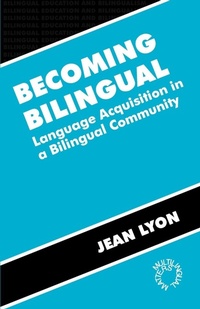
Becoming Bilingual
Language Acquisition in a Bilingual Community
Published on 11. November 1996
Book
Paperback/Softback
288 pages
978-1-85359-317-8 (ISBN)
Description
Language is one of humanity's greatest achievements, yet one which virtually all children achieve remarkably quickly. How much more remarkable, therefore, when children learn not one but two languages! There are many single case studies describing children from families where determined parents adopt strategies to maximise their children's chances of becoming bilingual. Many more children, whose parents speak a mixture of languages, also become bilingual without this extra help. How this occurs and why some children have more problems than others in a bilingual environment are some of the issues addressed by this book, which is a longitudinal study of how children learn to use more than one language. The family is assumed to be the key factor in these processes, and bilingual language development is placed firmly within an interactive context, as it is from this context that the development of childhood bilingualism can best be understood. Thus the aims of this book are to examine how young children become bilingual, and to show what factors predict early childhood bilingualism.
More details
Series
Language
English
Place of publication
Bristol
United Kingdom
Publishing group
Channel View Publications Ltd
Target group
College/higher education
Professional and scholarly
Dimensions
Height: 216 mm
Width: 140 mm
Thickness: 17 mm
Weight
404 gr
ISBN-13
978-1-85359-317-8 (9781853593178)
Copyright in bibliographic data and cover images is held by Nielsen Book Services Limited or by the publishers or by their respective licensors: all rights reserved.
Schweitzer Classification
Other editions
Additional editions
Book
11/1996
Multilingual Matters
€88.14
Article exhausted; check different version
Person
Dr Jean Lyon is a Consultant Clinical Psychologist and an expert in the field of child and family relationships. She has made a long-term study of children's communication and how they use language, and how language is used in the family setting. She is an honorary lecturer in Psychology at the University of Wales, Bangor, and is currently researching the incidence of a wide range of problems in bilingual children and their families.
Content
Introduction
1. How do Children Acquire Language?
2. Where Do You Find Bilingual Children?
3. What is Meant by Childhood Bilingualism?
4. How can Child Language be Studied?
5. What Language Backgrounds are There?
6. What Opinions Do Parents Hold About Language?
7. A Close Look at the Language of Young Children
8. How Do Children in a Bilingual Community Learn Language?
9. How Do Young Children Use Language and Do They Know What They Are Doing?
10. Which Parent has More Influence on the Language of the Home?
11. What Predicts a Child's Language?
12. How Do Young Children Become Bilingual?
Appendices: Language Background Questionnaire (QI)
Language Development Questionnaire (QII)
Dictionary of Common Words
1. How do Children Acquire Language?
2. Where Do You Find Bilingual Children?
3. What is Meant by Childhood Bilingualism?
4. How can Child Language be Studied?
5. What Language Backgrounds are There?
6. What Opinions Do Parents Hold About Language?
7. A Close Look at the Language of Young Children
8. How Do Children in a Bilingual Community Learn Language?
9. How Do Young Children Use Language and Do They Know What They Are Doing?
10. Which Parent has More Influence on the Language of the Home?
11. What Predicts a Child's Language?
12. How Do Young Children Become Bilingual?
Appendices: Language Background Questionnaire (QI)
Language Development Questionnaire (QII)
Dictionary of Common Words