

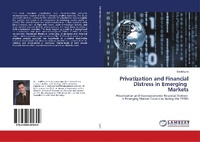
Privatization and Financial Distress in Emerging Markets
Privatization and Macroeconomic Financial Distress in Emerging Market Countries during the 1990s
Published on 29. June 2009
Book
Paperback/Softback
204 pages
978-3-8383-0469-4 (ISBN)
Description
This book examines privatization and the relationship between macroeconomic financial distress in emerging market countries. The study was undertaken to investigate the rationales of privatization and to explain the pattern and behavior of privatization in emerging market countries (EMCs). The central hypothesis under investigation is that countries with fiscal pressures such as high debt levels, significant budget deficits, and large current account deficits, ceteris paribus, are more likely to increase their privatization activities. The study begins by providing a background on privatization and state- owned-enterprises (SOEs) in EMCs. It then reviews the theoretical literature underlying privatization and financial distress. Next it provides a comparative profile of EMCs that privatized. The empirical analysis supports the hypothesis of a positive relationship between financial distress (with an emphasis on debt as a primary driver of distress) and privatization. In particular, higher levels of debt caused financial distress which caused countries to privatize relatively more.
More details
Language
English
Place of publication
Germany
Product notice
Paperback (trade)
Unsewn / adhesive bound
Dimensions
Height: 220 mm
Width: 150 mm
Thickness: 13 mm
Weight
322 gr
ISBN-13
978-3-8383-0469-4 (9783838304694)
Copyright in bibliographic data and cover images is held by Nielsen Book Services Limited or by the publishers or by their respective licensors: all rights reserved.
Schweitzer Classification
Person
Dr. David Lynn is an economist, institutional real estate investor, and strategist with extensive experience in national and international markets. Dr. Lynn earned his Ph.D. in Financial Economics at the London School of Economics where he also earned an MS. He obtained an MBA from MIT, an MA from Cornell and a BA from Berkeley.