

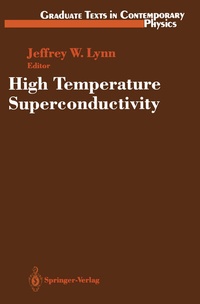
High Temperature Superconductivity
Will be published approx. on 1. March 1990
Book
Hardback
XV, 403 pages
978-0-387-96770-7 (ISBN)
Description
One of the most exciting developments in modern physics has been the discovery of the new class of oxide materials with high superconducting transition temperature. Systems with Tc well above liquid nitrogen temperature are already a reality and higher Tc's are anticipated. Indeed, the idea of a room-temperature superconductor, which just a short time ago was considered science fiction, appears to be a distinctly possible outcome of materials research. To address the need to train students and scientists for research in this exciting field, Jeffrey W. Lynn and colleagues at the University of Maryland, College Park, as well as other superconductivity experts from around the U.S., taught a graduate-level course in the fall of 1987, from which the chapters in this book were drawn. Subjects included are: Survey of superconductivity (J. Lynn).- The theory of type-II superconductivity (D. Belitz).- The Josephson effect (P. Ferrell).- Crystallography (A. Santoro).- Electronic structure (C.P.Wang).- Magnetic properties and interactions (J. Lynn).- Synthesis and diamagnetic properties (R. Shelton).- Electron pairing (P. Allen).- Superconducting devices (F. Bedard).- Superconducting properties (J. Crow, N.-P. Ong).
More details
Series
Edition
1990 edition
Language
English
Place of publication
New York
United States
Target group
Professional and scholarly
Research
Product notice
sewn/stitched
Cloth over boards
Illustrations
XV, 403 p.
Dimensions
Height: 244 mm
Width: 163 mm
Thickness: 26 mm
Weight
726 gr
ISBN-13
978-0-387-96770-7 (9780387967707)
DOI
10.1007/978-1-4612-3222-3
Schweitzer Classification
Other editions
Additional editions
Jeffrey W. Lynn
High Temperature Superconductivity
Book
10/2011
Springer
€53.49
Shipment within 15-20 days
Persons
Content
1 Survey of Superconductivity.- 1.1. Introduction.- 1.2. dc Electrical Resistance.- 1.3. Perfect Diamagnetism.- 1.4. Energy Gap.- 1.5. Electron-Phonon Interaction and Cooper Pairing.- 1.6. BCS Theory.- 1.7. Type-II Superconductors.- 1.8. New Topics in Superconductivity.- References.- 2 Theory of Type-II Superconductivity.- 2.1. Introduction.- 2.2. Ginzburg-Landau Theory.- 2.3. Microscopic Theory.- 2.4. Beyond Dirty Limit Theory.- References.- 3 The Josephson Effect.- 3.1. Phenomenology.- 3.2. Microscopic Theory.- 3.3. Quantum Effects.- 3.4. Summary.- References.- 4 Crystallography.- 4.1. Introduction.- 4.2. The Rietveld Method.- 4.3. The Structure of Perovskite.- 4.4. The System BaPb
1?x
BixO
3.- 4.5. The System La
2?x
MxCuO
4?y
(M = Ba, Sr).- 4.6. The System Ba
2
MCu3O
?
(M = Y, Gd, Eu, etc.).- 4.7. The System Ba
2?x
La1?x
Cu3
O?.- 4.8. The System BiCaSr2
Cu2
O?.- 4.9. Materials With Crystallographic Shear.- References.- 5 Electronic Structure, Lattice Dynamics, and Magnetic Interactions.- 5.1. Introduction.- 5.2. Electronic Structure of La2?x
(Ba,Sr)x
CuO4.- 5.3. Electronic Properties of YBa2
Cu3
O7?x.- 5.4. Electronic Structure of the Bismuth and Thallium Superconductors.- 5.5. Electron-Phonon Interaction.- 5.6. Electron-Electron Correlations.- References.- 6 Synthesis and Diamagnetic Properties.- 6.1. Introduction.- 6.2. The System La2?xM
x
CuO4?y
(M = Ba, Sr, Ca).- 6.3. The System MBa2
Cu3
Ox(M = Rare Earth).- 6.4. Superconductivity above 100 K.- References.- 7 Thermal and Transport Properties.- 7.1. Introduction.- 7.2. Normal State Transport Properties of the High-TCOxides.- 7.3. Specific Heat.- 7.4. The Role of Phonons.- References.- 8 Magnetic Properties.- 8.1. Introduction.- 8.2. Cu-O Magnetism.- 8.3. Rare Earth Magnetism.- References.- 9 Electron Pairing: How and Why?.- 9.1. Introduction.- 9.2. Cooper Pairs.- 9.3. Bose Condensation.- 9.4. BCS Theory for T
C.- 9.5. The Interaction in BCS Theory.- 9.6. The BCS Ground State.- 9.7. Off-Diagonal Long Range Order (ODLRO).- 9.8. Eliashberg Theory of Electron-Phonon Superconductors.- 9.9. Excitons and Plasmons.- 9.10. Spin Fluctuations.- 9.11. Weak versus Strong Coupling.- 9.12. Bipolarons.- 9.13. The Hubbard Model in Strong Coupling.- 9.14. RVB Theory.- 9.15. Oxygen Holes and Copper Spins.- 9.16. Postscript.- References.- 10 Superconducting Devices.- 10.1. Introduction.- 10.2 Cryotron.- 10.3 Josephson Device.- 10.4 A Voltage Standard.- 10.5 Single-Junction SQUID.- 10.6 SQUID Magnetometer.- 10.7 Two-Junction SQUIDs.- 10.8 Binary Counter.- 10.9 Sampling Oscilloscope.- 10.10 Transmission Lines.- 10.11. Conclusion.- References.- Chemical Formula Index.