

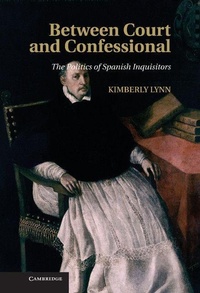
Between Court and Confessional
The Politics of Spanish Inquisitors
Published on 8. July 2013
Book
Hardback
410 pages
978-1-107-03116-6 (ISBN)
Description
Between Court and Confessional explores the lives of Spanish inquisitors, closely examining the careers and writings of five sixteenth- and seventeenth-century inquisitors. Kimberly Lynn considers what shaped particular inquisitors, what kinds of official experience each accumulated, and to what ends each directed his acquired knowledge and experience. The case studies examine the complex interplay of careerism and ideological commitments evident in inquisitorial activities. Whereas many studies of the Spanish Inquisition tend to depict inquisitors as faceless and interchangeable, Lynn probes the lives of individual inquisitors to show how inquisitors' operations in their social, political, religious and intellectual worlds set the Inquisition in motion. By focusing on specific individuals, this study explains how the theory and regulations of the Inquisition were rooted in local conditions, particular disputes and individual experiences.
Reviews / Votes
'The Inquisitor is a figure engulfed in myth, yet about whom very little is actually known. Kimberly Lynn sets the record straight in this thoroughly researched and well-written book. Showcasing individual portraits of five inquisitors from different parts of the early modern Hispanic empire, she offers a lively and convincing composite biography of a unique - and uniquely complex - figure poised between medieval theocracy and modern bureaucracy.' James S. Amelang, Universidad Autonoma, Madrid 'This outstanding piece of scholarship demonstrates how little the Spanish inquisitors fit the conventional view of them as insular men in single-minded pursuit of heresy. In a series of exacting and illuminating portraits, Kimberly Lynn reveals them in the full range of their activities, engaged in turf battles, jostling for position at court, moving from post to post, suffering career setbacks and disappointments, and seeking patronage and bestowing patronage - that is, negotiating the complex power structures of early modern Spain like other members of the power elite.' Miriam Bodian, University of Texas, Austin '... carefully researched ... enlightening ... we emerge much the wiser about what made these men tick.' History Today 'Lynn's masterful book merits a place alongside the work of other well-respected scholars, such as James Amelang and Francisco Bethencourt. It deserves to be read by anyone with an interest in early modern Spain or early modern Catholicism.' Jan Machielsen, European History QuarterlyMore details
Language
English
Place of publication
Cambridge
United Kingdom
Target group
Professional and scholarly
Illustrations
3 Maps; 7 Halftones, unspecified
Dimensions
Height: 235 mm
Width: 157 mm
Thickness: 29 mm
Weight
814 gr
ISBN-13
978-1-107-03116-6 (9781107031166)
Copyright in bibliographic data and cover images is held by Nielsen Book Services Limited or by the publishers or by their respective licensors: all rights reserved.
Schweitzer Classification
Other editions
Additional editions
Book
04/2015
Cambridge University Press
€42.40
Shipment within 15-20 days
E-Book
07/2013
Cambridge University Press
€21.99
Available for download
E-Book
06/2013
1st Edition
Cambridge University Press
€24.99
Available for download
Person
Kimberly Lynn is an Associate Professor of Early Modern Europe in the Department of Liberal Studies at Western Washington University. Professor Lynn has been awarded a William J. Fulbright Fellowship to research in Spain and an Andrew W. Mellon Fellowship in Humanistic Studies. She also won a Philanthropic Educational Organization Scholar Award, as well as short-term research fellowships to the Herzog August Bibliothek in Wolfenbuettel, Germany, and the Folger Shakespeare Library in Washington, DC.
Content
Introduction: arbiters of faith, administrators of empire; 1. Visiting the flock: the pastoral agenda of Cristobal Fernandez de Valtodano; 2. Writing the inquisition: the trials of Diego de Simancas; 3. Courting the king, courting the pope: Luis de Paramo between Spain and Italy; 4. Falling from grace: the disenchantments of Juan Adam de la Parra; 5. Negotiating the Catholic monarchy: the transatlantic maneuvering of Juan de Manozca y Zamora; 6. Building careers, making a legal culture: toward an appraisal of inquisitorial office; Epilogue: the afterlife of Spanish Inquisitors.