

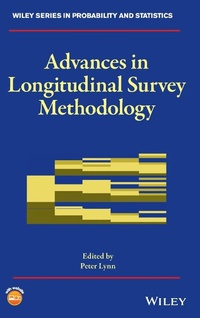
Advances in Longitudinal Survey Methodology
Published on 18. March 2021
Book
Hardback
624 pages
978-1-119-37693-4 (ISBN)
Description
This book provides a comprehensive overview of the many advances that have been made in the field of longitudinal survey methodology over the past twelve years, as well as slightly extending the topic coverage of the earlier volume, "Methodology of Longitudinal Surveys." As such, it describes the state of the art in designing, implementing, and analysing longitudinal surveys.
The greatly expanded enthusiasm for longitudinal surveys has brought with it a thirst for knowledge about the best ways to design and implement such surveys. Considerable advances in knowledge have been made in recent years in areas that are covered in this book that encompasses all stages of the design and implementation of longitudinal surveys.
Topics include:
Dynamic sampling for the representation of dynamic populations;
Methods for tracking mobile sample members over time;
Methods for maintaining co-operation over time;
Targeted design features for response maximisation;
The use of longitudinal survey paradata for field management;
Advances in dependent interviewing techniques;
This book is an invaluable resource providing deeper insight into longitudinal surveys.
The greatly expanded enthusiasm for longitudinal surveys has brought with it a thirst for knowledge about the best ways to design and implement such surveys. Considerable advances in knowledge have been made in recent years in areas that are covered in this book that encompasses all stages of the design and implementation of longitudinal surveys.
Topics include:
Dynamic sampling for the representation of dynamic populations;
Methods for tracking mobile sample members over time;
Methods for maintaining co-operation over time;
Targeted design features for response maximisation;
The use of longitudinal survey paradata for field management;
Advances in dependent interviewing techniques;
This book is an invaluable resource providing deeper insight into longitudinal surveys.
More details
Other editions
Additional editions
Peter Lynn
Advances in Longitudinal Survey Methodology
E-Book
03/2021
1st Edition
Wiley
€103.99
Available for download
Peter Lynn
Advances in Longitudinal Survey Methodology
E-Book
03/2021
1st Edition
Wiley
€103.99
Available for download
Person
Peter Lynn is Professor of Survey Methodology at the Institute for Social and Economic Research (ISER), University of Essex. ISER is one of the leading research centres in the world for longitudinal survey methods and Professor Lynn has headed the survey methods programme at ISER since he joined Essex in 2001. Professor Lynn has published more than 50 articles on survey methods topics in top scientific journals, mostly on topics specific to longitudinal surveys, in addition to numerous book chapters, reports and other articles. He is Editor of the 2009 Wiley book, Methodology of Longitudinal Surveys, to which the current book is intended as a sequel, as well as the 2015 Routledge book, "Improving Survey Methods." Professor Lynn has worked in the field of survey methods for nearly 30 years and has specialised in longitudinal surveys for more than half of that time. He is currently co-investigator of Understanding Society: the UK Longitudinal Household Study, a major data resource in which the ESRC has to date invested nearly GBP100M, and is President-elect of the International Association of Survey Statisticians. He has extensive editorial experience with both books and journals and in 2005 was the founding editor of Survey Research Methods, which is now one of the leading journals in the field. His full CV is attached as an annex to this document.
Content
List of contributors
Preface by Peter Lynn
About the companion website
1. Refreshment Sampling for Longitudinal Surveys
Nicole Watson and Peter Lynn
2. Collecting Biomarker Data in Longitudinal Surveys
Meena Kumari and Michaela Benzeval
3. Innovations in Participant Engagement and Tracking in Longitudinal Surveys
Lisa Calderwood, Matt Brown, Emily Gilbert and Erica Wong
4. Effects on Panel Attrition and Fieldwork Outcomes from Selection for a Supplemental Study: Evidence from the Panel Study of Income Dynamics
Narayan Sastry, Paula Fomby and Katherine A. McGonagle
5. The Effects of Biological Data Collection in Longitudinal Surveys on Subsequent Wave Co-operation
Fiona Pashazadeh, Alexandru Cernat and Joseph W. Sakshaug
6. Understanding Data Linkage Consent in Longitudinal Surveys
Annette Jackle, Kelsey Beninger, Jonathan Burton and Mick P. Couper
7. Determinants of Consent to Administrative Records Linkage in longitudinal Surveys: Evidence from Next Steps
Darina Peycheva, George Ploubidis and Lisa Calderwood
8. Consent to Data Linkage: Experimental Evidence from an Online Panel
Ben Edwards and Nicholas Biddle
9. Mixing Modes in Household Panel Surveys: Recent Developments and New Findings
Marieke Voorpostel, Oliver Lipps and Caroline Roberts
10. Estimating the Measurement Effects of Mixed Modes in Longitudinal Studies: Current Practice and Issues
Alexandru Cernat and Joseph W. Sakshaug
11. Measuring Cognition in a Multi-mode Context
Mary Beth Ofstedal, Colleen A. McClain and Mick P. Couper
12. Panel conditioning: Types, causes and empirical evidence of what we know so far
Bella Struminskaya and Michael Bosnjak
13. Interviewer Effects in Panel Surveys
Simon Kuhne and Martin Kroh
14. Improving Survey Measurement of Household Finances: A Review of New Data Sources and Technologies
Annette Jackle, Mick P. Couper, Alessandra Gaia and Carli Lessof
15. How to Pop the Question? Interviewer and Respondent Behaviours when Measuring Change with Dependent Interviewing
Annette Jackle, Tarek Al Baghal, Stephanie Eckman and Emanuela Sala
16. Assessing Discontinuities and Rotation Group Bias in Rotating Panel Designs
Jan A. van den Brakel, Paul A. Smith, Duncan Elliott, Sabine Krieg, Timo Schmid and Nikos Tzavidis
17. Proper Multiple Imputation of Clustered or Panel Data
Martin Spiess, Kristian Kleinke and Jost Reinecke
18. Issues in Weighting for Longitudinal Surveys
Peter Lynn and Nicole Watson
19. Small-Area Estimation of Cross-Classified Gross Flows Using Longitudinal Survey Data
Yves Thibaudeau, Eric Slud and Yang Cheng
20. Non-Parametric Estimation for Longitudinal Data with Informative Missingness
Zahoor Ahmad and Li-Chun Zhang
Preface by Peter Lynn
About the companion website
1. Refreshment Sampling for Longitudinal Surveys
Nicole Watson and Peter Lynn
2. Collecting Biomarker Data in Longitudinal Surveys
Meena Kumari and Michaela Benzeval
3. Innovations in Participant Engagement and Tracking in Longitudinal Surveys
Lisa Calderwood, Matt Brown, Emily Gilbert and Erica Wong
4. Effects on Panel Attrition and Fieldwork Outcomes from Selection for a Supplemental Study: Evidence from the Panel Study of Income Dynamics
Narayan Sastry, Paula Fomby and Katherine A. McGonagle
5. The Effects of Biological Data Collection in Longitudinal Surveys on Subsequent Wave Co-operation
Fiona Pashazadeh, Alexandru Cernat and Joseph W. Sakshaug
6. Understanding Data Linkage Consent in Longitudinal Surveys
Annette Jackle, Kelsey Beninger, Jonathan Burton and Mick P. Couper
7. Determinants of Consent to Administrative Records Linkage in longitudinal Surveys: Evidence from Next Steps
Darina Peycheva, George Ploubidis and Lisa Calderwood
8. Consent to Data Linkage: Experimental Evidence from an Online Panel
Ben Edwards and Nicholas Biddle
9. Mixing Modes in Household Panel Surveys: Recent Developments and New Findings
Marieke Voorpostel, Oliver Lipps and Caroline Roberts
10. Estimating the Measurement Effects of Mixed Modes in Longitudinal Studies: Current Practice and Issues
Alexandru Cernat and Joseph W. Sakshaug
11. Measuring Cognition in a Multi-mode Context
Mary Beth Ofstedal, Colleen A. McClain and Mick P. Couper
12. Panel conditioning: Types, causes and empirical evidence of what we know so far
Bella Struminskaya and Michael Bosnjak
13. Interviewer Effects in Panel Surveys
Simon Kuhne and Martin Kroh
14. Improving Survey Measurement of Household Finances: A Review of New Data Sources and Technologies
Annette Jackle, Mick P. Couper, Alessandra Gaia and Carli Lessof
15. How to Pop the Question? Interviewer and Respondent Behaviours when Measuring Change with Dependent Interviewing
Annette Jackle, Tarek Al Baghal, Stephanie Eckman and Emanuela Sala
16. Assessing Discontinuities and Rotation Group Bias in Rotating Panel Designs
Jan A. van den Brakel, Paul A. Smith, Duncan Elliott, Sabine Krieg, Timo Schmid and Nikos Tzavidis
17. Proper Multiple Imputation of Clustered or Panel Data
Martin Spiess, Kristian Kleinke and Jost Reinecke
18. Issues in Weighting for Longitudinal Surveys
Peter Lynn and Nicole Watson
19. Small-Area Estimation of Cross-Classified Gross Flows Using Longitudinal Survey Data
Yves Thibaudeau, Eric Slud and Yang Cheng
20. Non-Parametric Estimation for Longitudinal Data with Informative Missingness
Zahoor Ahmad and Li-Chun Zhang