

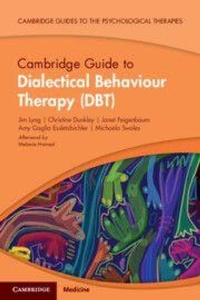
Cambridge Guide to Dialectical Behaviour Therapy (DBT)
Will be published approx. on 30. September 2026
Book
Paperback/Softback
238 pages
978-1-009-07800-9 (ISBN)
Description
An essential, accessible introduction to Dialectical Behaviour Therapy (DBT) for reducing self-harm, suicidal behaviours, and other major problems associated with emotional dysregulation. It breaks the treatment down into user-friendly steps for novice clinicians while refreshing knowledge for more experienced practitioners. Covering all modes of DBT, chapters also span case formulation, recent research, the DBT suicide crisis protocol, case studies, running standalone DBT skills training, and implementing a DBT programme. Authored by accredited DBT therapists and supervisors who are all senior members of the British Isles DBT National Training Team which has seeded 650+ DBT teams in the UK and across Europe since 1997, this practical textbook is packed with rich, everyday clinical examples and useful ideas for practice. Part of the Cambridge Guides to the Psychological Therapies series, offering all the latest scientifically rigorous, and practical information on a range of key, evidence-based psychological interventions for clinicians.
More details
Series
Language
English
Place of publication
Cambridge
United Kingdom
Target group
College/higher education
Product notice
Paperback (trade)
Illustrations
Worked examples or Exercises
ISBN-13
978-1-009-07800-9 (9781009078009)
Copyright in bibliographic data and cover images is held by Nielsen Book Services Limited or by the publishers or by their respective licensors: all rights reserved.
Schweitzer Classification
Persons
Jim Lyng, Ph.D. is a counselling psychologist with twenty-five years clinical experience in mental health services for adults and adolescents and a senior DBT trainer. For many years he led a community-based DBT team as well as serving as an adjunct assistant professor at the School of Psychology at Trinity College Dublin where he taught and supervised on cognitive-behavioural therapies. He is an active, grant-supported researcher and has recently co-led an award winning programme of service transformation to reduce waiting times at Jigsaw, the centre for youth mental health in Ireland, where he is currently the national clinical practice lead. Christine Dunkley DClinP, FSfDBT is a consultant DBT trainer with thirty years' NHS experience. She has authored numerous papers and books, including Regulating Emotion the DBT Way. Founding Chair of the Society for DBT and member of the UCL Expert Reference Group for Personality Disorders, she received a Learning Contributor award from NICE. Her 'top tips' have gained a lively LinkedIn following. Christine is an Executive Director at British Isles DBT Training and is internationally recognised as a trainer, mentor, and keynote speaker. Janet Feigenbaum, Ph.D. is an associate professor in clinical psychology and an international consultant DBT trainer. Following her original training with treatment developer Marsha Linehan, Janet was research lead for a randomized controlled trial of DBT in a naturalistic NHS setting in London. Janet then established the DBT programme in North East London, which was selected as one of three personality disorder demonstration sites by the UK Department of Health. Janet has been awarded an NIHR programme grant to develop and evaluate DBT for unemployment. She was a founding member of the Society for DBT. Amy Gaglia Essletzbichler, Ph.D. is a consultant trainer with the British Isles DBT training team and an accredited DBT supervisor. She has trained hundreds therapists throughout the UK and Europe and supervises therapists across Europe. She is the Director of Applied Research and Training in DBT for Intercontinental Business Support, GmbH. She has researched and written about consultation team and supervision in DBT and is highly involved in DBT adherence and fidelity work. She is the current chair and a member of the board of the European DBT Association. Michaela Swales, Ph.D. is professor in clinical psychology and director of the North Wales Clinical Psychology Programme at Bangor University. She is the director of the British Isles DBT Training Team, recognised internationally for its quality. She has trained more than a thousand professionals in DBT, seeding over 400 programmes, in both the UK and further afield. Michaela co-authored, Dialectical Behaviour Therapy: Distinctive Features (2009; 2017) and Changing Behavior in DBT: Problem-Solving in Action (2015). She is the Editor of the Oxford Handbook of DBT (2019) and president of the World DBT Association.
Author
St John of God Community Mental Health Services and British Isles DBT Training
British Isles DBT Training
University College London and British Isles DBT Training
British Isles DBT Training
Bangor University and Betsi Cadwaladr University Health Board, Wales and British Isles DBT Training
Afterword
VA Puget Sound Health Care System, Seattle
Content
A Note from the Series Editor Patricia Graham; Part I. Overview of the Model: 1. The development of DBT: a story of behaviour therapy, Zen, dialectics, and modes; 2. Who is DBT intended to serve? Understanding and identifying the problems treated by DBT; 3. What does the evidence tell us: research on DBT with Julieta Azevedo; Part II. The Dialectical Behaviour Therapy Model in Practice: 4. The DBT consultation team: therapy for DBT therapists; 5. Individual therapy in DBT: targeting problems and putting solutions into practice; 6. The DBT skills training class: a dialectically balanced curriculum of acceptance and problem-solving; 7. Between-session coaching in DBT: getting help where and when it is needed; 8. The DBT suicide protocol: treating an imminently high-risk situation; Part III. Application and Adaptations for Mental Health Presentations: 9. Case study one: Kim: DBT for an adult client with suicidal behaviours and a diagnosis of borderline personality disorder; 10. Case study two: Sophia: DBT for a suicidal teen with recurrent self-harm and disordered eating; Part IV. Application of the Dialectical Behaviour Therapy Model in Different Populations and Different Settings: 11. Standalone DBT skills training: what is it, who it is for, and how to do it; 12. Successful implementation of DBT: using the principles of the treatment to effect service change; Afterword: on learning DBT: an interview with Dr Melanie Harned; Index.