

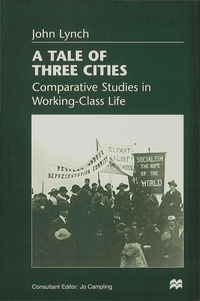
A Tale of Three Cities
Comparative Studies in Working-Class Life
Published on 12. July 1998
Book
Hardback
IX, 237 pages
978-0-333-71383-9 (ISBN)
Description
The city of Belfast tends to be discussed in terms of its distinctiveness from the rest of Ireland, an industrial city in an agricultural country. However, when compared with another 'British' industrial port such as Bristol it is the similarities rather than the differences that are surprising. When these cities are compared with Dublin, the contrasts become even more painfully evident. This book seeks to explore these contrasting urban centres at the start of the twentieth century.
More details
Edition
1998 edition
Language
English
Place of publication
London
United Kingdom
Target group
Professional and scholarly
Product notice
sewn/stitched
Cloth over boards
Illustrations
IX, 237 p.
Dimensions
Height: 216 mm
Width: 140 mm
Thickness: 18 mm
Weight
463 gr
ISBN-13
978-0-333-71383-9 (9780333713839)
DOI
10.1007/978-1-349-14599-7
Schweitzer Classification
Other editions
Additional editions
Book
07/1998
Palgrave Macmillan
€106.99
Shipment within 15-20 days
E-Book
07/1998
Palgrave Macmillan
€96.29
Available for download
Persons
JOHN LYNCH worked for many years in the Civil Service and then returned to education in 1987 with an ILO studentship at Ruskin College, Oxford. During his two years there he studied for a Diploma in History. In 1989 he moved to Belfast and took a degree in Irish Studies at Queen's University. Subsequently he was employed as a Teaching Fellow in the Department of Economic and Social History, teaching mainly Irish and Japanese history. He was awarded a doctorate in 1996 and now teaches Irish Migration Studies.
Content
Acknowledgements Introduction A Tale of Three Cities: Bristol, Belfast and Dublin Trade Union Growth: a Comparison The Labour Movement: a Wider View The Belfast Shipyard Workers: a Study in Organised Labour Industrial Relations Working Class or Classes? Living Conditions and Problems Sectarianism War and Rebellion Conclusion Notes on Chapters Bibliography Index