

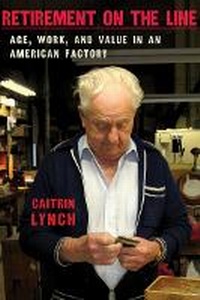
Retirement on the Line
Age, Work, and Value in an American Factory
Published on 8. March 2012
Book
Hardback
240 pages
978-0-8014-5026-6 (ISBN)
Description
In an era when people live longer and want (or need) to work past the traditional retirement age, the Vita Needle Company of Needham, Massachusetts, provides inspiration and important lessons about the value of older workers. Vita Needle is a family-owned factory that was founded in 1932 and makes needles, stainless steel tubing and pipes, and custom fabricated parts. As part of its unusual business model, the company seeks out older workers; the median age of the employees is seventy-four.
In Retirement on the Line, Caitrin Lynch explores what the company's commitment to an elderly workforce means for the employer, the workers, the community, and society more generally. Benefiting from nearly five years of fieldwork at Vita Needle, Lynch offers an intimate portrait of the people who work there, a nuanced explanation of the company's hiring practices, and a cogent analysis of how the workers' experiences can inform our understanding of aging and work in the twenty-first century. As an in-depth study of a singular workplace, rooted in the unique insights of an anthropologist who specializes in the world of work, this book provides a sustained focus on values and meanings-with profound consequences for the broader assumptions our society has about aging and employment.
In Retirement on the Line, Caitrin Lynch explores what the company's commitment to an elderly workforce means for the employer, the workers, the community, and society more generally. Benefiting from nearly five years of fieldwork at Vita Needle, Lynch offers an intimate portrait of the people who work there, a nuanced explanation of the company's hiring practices, and a cogent analysis of how the workers' experiences can inform our understanding of aging and work in the twenty-first century. As an in-depth study of a singular workplace, rooted in the unique insights of an anthropologist who specializes in the world of work, this book provides a sustained focus on values and meanings-with profound consequences for the broader assumptions our society has about aging and employment.
Reviews / Votes
In Retirement on the Line, Caitrin Lynch provides a welcome ethnography of the labors of old workers at Vita Needle, a family-owned factory in Needham, Massachusetts...Lynch does a superb job of attending to the voices of old workers in this factory, revealing the complex labor relations within contemporary capitalism, and complicating the discussion of exploitation. The readability of her book makes it an excellent addition to courses not only on aging but in the sociology of work, which tends to ignore old workers or see them as something 'other'-and for this reason, it also stands as a scholarly contribution for those who examine paid work.- Toni Calasanti (American Journal of Sociology) Stressing a 'cultural anthropology' vantage point, and claiming that new understandings may arise from duly considered work in its culture-related dynamics, this book actually delivers valuable learnings on capitalism as a cultural frame. We learn from it not so much on the meanings of working at old age, but rather on old age capitalism and its meanings. Studying workers who take the accumulation of surplus-value as the measure of all values- this certainly provides a lesson on the undeniable resilience and continuance of the capitalist worldview.
(Critique of Anthropology) The book is based on intensive ethnographic research undertaken by the author during 2006-2011. Working on Vita's shop floor, side by side with factory employees, enabled the author to produce a rich, nuanced, and insightful piece of anthropological writing that not only explores "what work means for people...of conventional retirement age," but also touches upon broader social issues such as aging, productivity, and work ethic in the contemporary United States...Lynch's book expands beyond a mere case study and proposes broader reflections on the struggles and aspirations of elderly employees-a group rarely studied by sociologists of work.
- HannaGospodarczyk (Laboratorium: Russian Review of Social Research)
More details
Language
English
Place of publication
New York
United States
Publishing group
Cornell University Press
Target group
Professional and scholarly
Product notice
Paper over boards
Illustrations
8 halftones, 4 tables, 1 chart/graph - 8 Halftones, black and white
Dimensions
Height: 229 mm
Width: 152 mm
Thickness: 24 mm
Weight
907 gr
ISBN-13
978-0-8014-5026-6 (9780801450266)
Copyright in bibliographic data and cover images is held by Nielsen Book Services Limited or by the publishers or by their respective licensors: all rights reserved.
Schweitzer Classification
Other editions
Additional editions
E-Book
03/2012
ILR Press
€21.49
Available for download
Person
Caitrin Lynch is Associate Professor of Anthropology at Olin College. She is the author of Juki Girls, Good Girls: Gender and Cultural Politics in Sri Lanka's Global Garment Industry, also from Cornell.
Content
Cast of Characters
Introduction: Making Needles, Making LivesPart I: Up the Stairs
Pigeonholed by Jim Downey
1. Making Money for Fred: Productivity, People, and Purpose
2. Antique Machinery and Antique People: The Vita Needle Family
3. No Chains on the Seats: Freedom and FlexibilityPart II: In the Press
4. Riding the Gray Wave: Global Interest in Vita Needle
5. Rosa, a National Treasure: Agency in the Face of Media StardomConclusion: Vita's Larger LessonsPostscriptNotes
References
Acknowledgments
Index
Introduction: Making Needles, Making LivesPart I: Up the Stairs
Pigeonholed by Jim Downey
1. Making Money for Fred: Productivity, People, and Purpose
2. Antique Machinery and Antique People: The Vita Needle Family
3. No Chains on the Seats: Freedom and FlexibilityPart II: In the Press
4. Riding the Gray Wave: Global Interest in Vita Needle
5. Rosa, a National Treasure: Agency in the Face of Media StardomConclusion: Vita's Larger LessonsPostscriptNotes
References
Acknowledgments
Index